The
Day Moses Finally Disappeared (Part
4 of 5) Introduction † Moses
stands as one of the most important figures in all of Scripture. † Through
Moses came the Law, the tabernacle, the priesthood, and the covenant
that governed Israel for centuries. † Yet
many people never ask why Moses appeared with Jesus at the
Transfiguration. † Moses
had died nearly fifteen centuries earlier, yet he suddenly appeared
and spoke with Christ about events that were soon to occur. † The
appearance of Moses was not random. It announced that his covenant
was approaching its end. Deuteronomy
34:5-6
So Moses the servant of the Lord
died there in the land of Moab, in accordance with the word of the
Lord. And He buried him
in the valley in the land of Moab, opposite Beth-peor; but no one
knows his burial place to this day.
† Moses
died before Israel entered the promised land. † His
death marked the end of his personal ministry. † Yet
the covenant associated with Moses continued for centuries afterward. † Israel
lived under the Law of Moses until the coming of Christ. † Moses
died physically, but his covenant remained alive within Israel. Matthew
17:1-3
Six days later, Jesus took with Him Peter and James, and his brother
John, and led them up on a high mountain by themselves. And He was
transfigured before them; and His face shone like the sun, and His
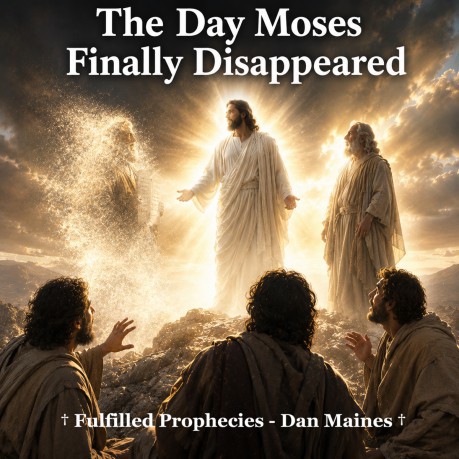
garments became as white as light. And behold, Moses and Elijah
appeared to them, talking with Him.
† Moses
appeared with Elijah and stood beside Christ in glory. † The
Law and the Prophets were both represented on the mountain. † Everything
they had written pointed forward to Christ. † The
appearance of Moses was not about exalting Moses. † It
was about showing that Christ was the fulfillment of everything Moses
anticipated. (John 5:46) Luke
9:30-31
And behold, two men were talking with Him; and they were Moses and
Elijah, who, appearing in glory, were speaking of His departure,
which He was about to accomplish at Jerusalem.
† Moses
and Elijah discussed Christ's coming departure. † The
word translated decease carries the idea of an exodus. † Jesus
would accomplish the greater deliverance that Moses only
foreshadowed. † The
old covenant deliverance from Egypt pointed toward the greater
redemption accomplished through Christ. † Moses
was handing the stage to the One greater than himself. Hebrews
3:5-6
Now Moses was faithful in all God's house as a servant, for a
testimony of those things which were to be spoken later; but Christ
was faithful as a Son over His house-whose house we are, if we hold
firmly to our confidence and the boast of our hope.
† Moses
was faithful as a servant. † Christ
is presented as the Son over the house. † The
servant was never intended to outrank the Son. † Moses
testified about things that would come later. † The
arrival of Christ signaled the approaching completion of Moses'
purpose. 2
Corinthians 3:13-14
and we are not like Moses, who used to put a veil over his face so
that the sons of Israel would not stare at the end of what was fading
away. But their minds were hardened; for until this very day at the
reading of the old covenant the same veil remains unlifted, because
it is removed in Christ.
† Paul
said the old covenant was passing away. † The
veil remained over those who continued trusting in Moses rather than
Christ. † What
Moses represented was never intended to last forever. † The
covenant associated with Moses was approaching its conclusion. † Christ
accomplished what the Law could never accomplish. (Romans 8:3-4) Hebrews
8:13
When He said, "A new covenant," He has made the first
obsolete. But whatever is becoming obsolete and growing old is about
to disappear.
† The
writer of Hebrews described the old covenant as aging. † It
was growing old and nearing its disappearance. † This
was written before AD 70 while the temple still stood. † Moses'
covenant had reached its final days. † The
destruction of Jerusalem publicly confirmed what the apostles had
been teaching for decades. Historical
References † Josephus
recorded the destruction of the temple and the end of the sacrificial
system in AD 70. † Eusebius
viewed Jerusalem's fall as the fulfillment of Christ's covenant
warnings. † Early
Christian writers consistently taught that Christ fulfilled what was
foreshadowed in the Law of Moses. † The
first century marked the closing of the Mosaic age and the full
establishment of the new covenant order. How
It Applies To Us Today † Our
faith rests in Christ, not in the covenant given through Moses. † We
respect Moses as God's servant while recognizing that Christ is
greater. † The
Law pointed forward to Christ and found its fulfillment in Him. † We
are not living in the age of Moses. † We
are living in the age of the risen and reigning Christ. Q&A
Appendix Q:
Why
did Moses appear at the Transfiguration? A:
Moses
appeared as the representative of the Law, bearing witness that
everything pointed forward to Christ. (Matthew 17:1-3) Q:
Why
were Moses and Elijah together? A:
They
represented the Law and the Prophets, both of which testified
concerning Christ. (Luke 24:44) Q:
Did
the Law fail? A:
No.
The Law accomplished its purpose by leading people to Christ.
(Galatians 3:24) Q:
When
did Moses' covenant finally disappear? A:
Its
public end came with the destruction of Jerusalem and the temple in
AD 70. (Hebrews 8:13) † This
is the fulfilled perspective we proclaim at Fulfilled Prophecies † © Fulfilled
Prophecies - Dan Maines. Source
Index † Deuteronomy
34:5-6; Matthew 17:1-3; Luke 9:30-31; Hebrews 3:5-6; 2 Corinthians
3:13-14; Hebrews 8:13 † Josephus,
Wars of the Jews; Eusebius, Ecclesiastical History
By Dan Maines
Part
1 of 5
Part
2 of 5
Part
3 of 5
Part
4 of 5
Part
5 of 5
Links