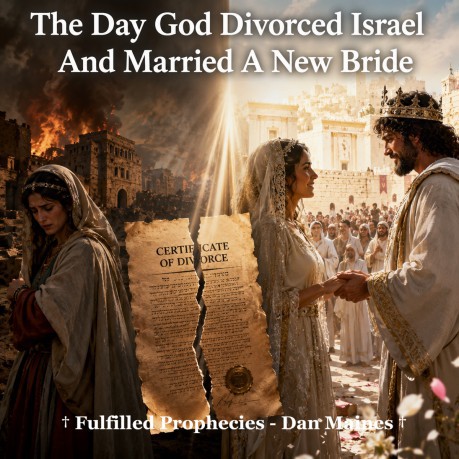
The
Day God Divorced Israel And Married A New Bride (Part
1 of 5) Introduction † Many
people know that Scripture speaks of Israel as God's wife and the
church as the bride of Christ, but few have followed the complete
story from beginning to end. † The
prophets spoke of a covenant marriage, a covenant unfaithfulness, and
a covenant divorce. † Jesus
came during the final days of that covenant relationship and
announced the judgment that would soon come upon Jerusalem. † The
destruction of Jerusalem in AD 70 was not merely the fall of a city.
It marked the final end of the old covenant relationship and the full
revealing of the new covenant bride. Jeremiah
3:8
And I saw that for all the adulteries of faithless Israel, I had sent
her away and given her a certificate of divorce, yet her treacherous
sister Judah did not fear; but she went and prostituted herself also.
† God
plainly said He gave Israel a bill of divorce because of her covenant
unfaithfulness. † This
was covenant language, not merely political language. † The
marriage relationship between God and Israel had been broken through
continual spiritual adultery. † The
prophets repeatedly described idolatry as adultery against God.
(Ezekiel 16:32, Hosea 4:12-13) Hosea
2:2
Dispute with your mother, dispute, † God
declared that the covenant relationship had been broken. † Israel
continued claiming covenant privileges while rejecting covenant
faithfulness. † Hosea
presents the tragedy of a wife who abandoned her husband while still
claiming to belong to him. † This
became a picture of first century Jerusalem, which claimed to
represent God while rejecting His Son. (Matthew 21:38-39) Matthew
22:7
Now the king was angry, and he sent his armies and destroyed those
murderers and set their city on fire.
† Jesus
warned Jerusalem that judgment was coming upon those who rejected
Him. † The
king's armies point to God's use of the Roman armies as instruments
of judgment. † The
burning of their city perfectly matches the destruction of Jerusalem
in AD 70. † The
old covenant city that rejected the Son faced the covenant judgment
Jesus repeatedly warned about. (Matthew 23:37-38, Luke 21:20-22) Ephesians
5:25-27
Husbands, love your wives, just as Christ also loved the church and
gave Himself up for her, so that He might sanctify her, having
cleansed her by the washing of water with the word, that He might
present to Himself the church in all her glory, having no spot or
wrinkle or any such thing; but that she would be holy and blameless.
† Paul
presents Christ as the bridegroom and the church as His bride. † This
is not a future bride but a present covenant relationship. † Christ
gave Himself for His people so that they might be presented holy and
blameless. † The
focus is no longer an earthly nation but a spiritual people united in
Christ. (Galatians 3:28-29) Revelation
19:7-8
Let's rejoice and be glad and give the glory to Him, because the
marriage of the Lamb has come, and His bride has prepared herself. It
was given to her to clothe herself in fine linen, bright and clean;
for the fine linen is the righteous acts of the saints.
† The
marriage of the Lamb arrives after the judgment of the harlot. † The
old covenant unfaithful city is removed before the new covenant bride
is fully revealed. † Revelation
presents two women, the harlot and the bride. † One
is judged and the other is presented in glory. (Revelation 17:1-6,
Revelation 21:9-10) Revelation
21:2
And I saw the holy city, new Jerusalem, coming down out of heaven
from God, prepared as a bride adorned for her husband.
† The
New Jerusalem is identified as a bride. † This
is not an earthly city rebuilt in the future. † The
New Jerusalem represents God's redeemed covenant people. † The
contrast is intentional. Earthly Jerusalem was judged, but New
Jerusalem remains forever. (Hebrews 12:22-24) Revelation
21:9-10
Then one of the seven angels who had the seven bowls, full of the
seven last plagues, came and spoke with me, saying, "Come here,
I will show you the bride, the wife of the Lamb." And he carried me
away in the Spirit to a great and high mountain, and showed me the
holy city, Jerusalem, coming down out of heaven from God, † The
angel specifically identifies the bride as New Jerusalem. † Scripture
interprets Scripture. † The
bride is not a future physical city. † The
bride is God's covenant people dwelling in union with Him through
Christ. Historical
References † Eusebius
recorded that Jerusalem's destruction fulfilled the warnings given by
Christ concerning the city and temple. † Josephus
described the burning of Jerusalem and the temple exactly as Jesus
foretold. † Clement
of Alexandria wrote of the transition from the old covenant order to
the new covenant established through Christ. † Early
Christian writers consistently viewed Jerusalem's destruction as a
major covenant turning point in redemptive history. How
It Applies To Us Today † We
are not waiting to become the bride of Christ, we belong to Him now. † Our
identity is found in Christ and His covenant, not in earthly
Jerusalem. † The
old covenant system has passed away, but the new covenant
relationship remains. † We
live as citizens of the New Jerusalem that Scripture says we have
already come to. (Hebrews 12:22-24) † Our
confidence rests in a completed covenant relationship established by
Christ's finished work. Q&A
Appendix Q:
Did
God literally stop loving Israel? A:
No.
God's judgment was against covenant unfaithfulness, not against His
own character. The old covenant relationship ended, but salvation
remained available through Christ to Jew and Gentile alike. (Romans
10:12-13) Q:
Who
is the bride of Christ? A:
The
bride is God's redeemed covenant people, revealed as New Jerusalem,
the wife of the Lamb. (Revelation 21:9-10) Q:
When
did the marriage of the Lamb occur? A:
Revelation
places the marriage after the judgment of the harlot and in
connection with the completion of God's covenant promises,
culminating in the events surrounding Jerusalem's fall. (Revelation
19:7-8) Q:
Are
believers part of the bride today? A:
Yes.
All who are in Christ belong to His covenant people and share in the
blessings of the New Jerusalem. (Hebrews 12:22-24) † This
is the fulfilled perspective we proclaim at Fulfilled Prophecies † © Fulfilled
Prophecies - Dan Maines. Source
Index † Jeremiah
3:8; Hosea 2:2; Matthew 22:7; Ephesians 5:25-27; Revelation 19:7-8;
Revelation 21:2; Revelation 21:9-10 † Josephus,
Wars of the Jews; Eusebius, Ecclesiastical History; Clement of
Alexandria
By Dan Maines
Part
1 of 5
Part
2 of 5
Part
3 of 5
Part
4 of 5
Part
5 of 5
Because she is not my wife,
and I am not her husband;
But she must remove her infidelity
from her face
And her adultery from between her breasts,
Links