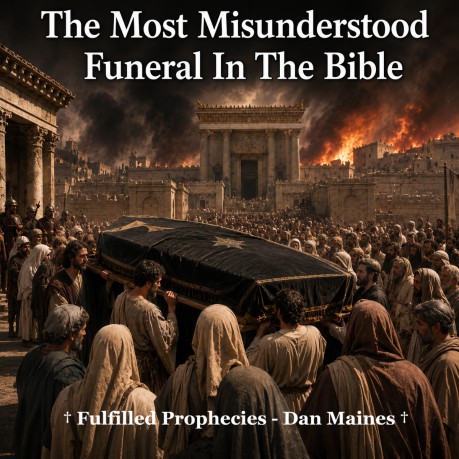
The
Most Misunderstood Funeral In The Bible (Part
3 of 5) Introduction † When
most people hear the word funeral, they think of the death and burial
of a person. † Yet
the New Testament speaks of something much larger that was passing
away. † The
apostles lived during the final days of an old covenant world that
was growing old and ready to disappear. † What
died in the first century was not the physical planet. What died was
the covenant order that had governed Israel for centuries. † AD
70 was the public funeral of a covenant world that had already
received its death sentence. Romans
7:4
Therefore, my brothers and sisters, you also were put to death in
regard to the Law through the body of Christ, so that you might
belong to another, to Him who was raised from the dead, in order that
we might bear fruit for God.
† Paul
describes a covenant death. † Believers
were made dead to the Law through the body of Christ. † A
covenant relationship cannot continue once death has occurred. † The
purpose was not merely separation from the old covenant but union
with Christ. † One
covenant relationship ended so another covenant relationship could
begin. (Galatians 3:24-25) Romans
7:6
But now we have been released from the Law, having died to that by
which we were bound, so that we serve in newness of the Spirit and
not in oldness of the letter.
† Paul
contrasts two covenant realities. † The
oldness of the letter belonged to the Mosaic covenant system. † The
newness of the Spirit belongs to the covenant established by Christ. † The
old covenant was not being improved. It was passing away. † A
funeral marks the end of what once existed. 2
Corinthians 3:7
But if the ministry of death, engraved in letters on stones, came
with glory so that the sons of Israel could not look intently at the
face of Moses because of the glory of his face, fading as it was,
† Paul
calls the Mosaic administration the ministration of death. † The
covenant given through Moses possessed glory. † Yet
that glory was already passing away during the apostolic age. † Something
that is passing away is moving toward an ending. † Paul
was describing a transition already underway. 2
Corinthians 3:11
For if that which fades away was with glory, much more that which
remains is in glory.
† One
covenant was passing away. † Another
covenant was remaining. † The
contrast is not between two groups of people. † The
contrast is between two covenant systems. † The
old was temporary. The new remains. Hebrews
8:13
When He said, "A new covenant," He has made the first
obsolete. But whatever is becoming obsolete and growing old is about
to disappear.
† The
writer of Hebrews said the first covenant was becoming old. † He
said it was aging. † He
said it was near to vanishing away. † Those
words only make sense before AD 70 while the temple still stood. † The
old covenant was approaching its final disappearance. Hebrews
12:26-28
And His voice shook the earth then, but now He has promised, saying,
"Yet once more I will
shake not only the earth, but
also the heaven." This expression, "Yet once more,"
denotes the removing of those things which can be shaken, as of
created things, so that those things which cannot be shaken may
remain. Therefore, since we receive a kingdom which cannot be shaken,
let's show gratitude, by which we may offer to God an acceptable
service with reverence and awe;
† The
shaking was about covenant removal. † Things
associated with the old covenant order were being removed. † The
kingdom of Christ would remain after the shaking ended. † The
focus is covenant transition, not the destruction of the physical
universe. † The
funeral was for the old covenant world. Historical
References † Josephus
recorded the destruction of Jerusalem and the temple in AD 70,
bringing an end to the sacrificial system. † Eusebius
viewed Jerusalem's fall as a fulfillment of Christ's warnings
concerning the end of the old order. † Early
Christian writers repeatedly spoke of the transition from the old
covenant system to the new covenant established by Christ. † The
historical record confirms that the temple, priesthood, sacrifices,
and genealogical system all disappeared in the first century. How
It Applies To Us Today † We
are not living under a covenant that is passing away. † We
belong to the covenant that remains. † Our
confidence is not in temple rituals, sacrifices, or earthly
priesthoods. † Our
confidence rests entirely in Christ and His finished work. † We
live in the kingdom that cannot be shaken. Q&A
Appendix Q:
What
was being buried at this funeral? A:
The
old covenant order centered in the Law, temple, sacrifices, and
priesthood. (Hebrews 8:13) Q:
Was
the Law evil? A:
No.
The Law was holy and served God's purpose, but it was temporary and
pointed forward to Christ. (Romans 7:12) Q:
When
did the funeral reach its public conclusion? A:
In
AD 70 when Jerusalem and the temple were destroyed and the old
covenant system came to its end. (Hebrews 8:13) Q:
What
remains today? A:
The
unshakable kingdom of Christ and the new covenant established through
His blood. (Hebrews 12:28) † This
is the fulfilled perspective we proclaim at Fulfilled Prophecies † © Fulfilled
Prophecies - Dan Maines. Source
Index † Romans
7:4; Romans 7:6; 2 Corinthians 3:7; 2 Corinthians 3:11; Hebrews 8:13;
Hebrews 12:26-28 † Josephus,
Wars of the Jews; Eusebius, Ecclesiastical History
By Dan Maines
Part
1 of 5
Part
2 of 5
Part
3 of 5
Part
4 of 5
Part
5 of 5
Links