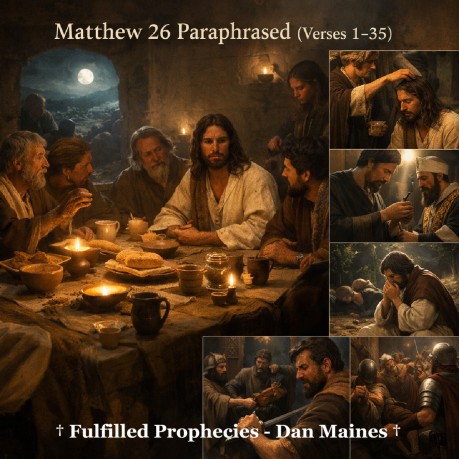
Matthew 26 Paraphrased
(Verses 1-35) Introduction † Matthew 26 begins the final stage of Jesus'
earthly ministry before the crucifixion. Everything Jesus had warned
about was now about to unfold. The religious leaders were already
plotting His death, and Jesus openly told His disciples that the time
had come. (Matthew 16:21) † This chapter shows the contrast between human
schemes and God's predetermined plan. While the chief priests
believed they were acting secretly, Jesus already knew every detail
of what was about to happen. Nothing in this chapter surprised Him.
(Acts 2:23) † The events recorded here lead directly to the
sacrifice that would bring the Old Covenant age to its conclusion and
establish the New Covenant that the prophets had promised. (Jeremiah
31:31-34) Matthew 26:1 When Jesus had finished all these words, He said to His disciples, † Jesus had just finished the Olivet Discourse.
Now He turned to the events that would happen immediately. The
warnings of Matthew 24 and 25 were now about to begin unfolding in
real time. (Matthew 24:34) † The phrase finished all these words marks the
end of Jesus' final prophetic teaching before the crucifixion events
began. (Matthew 7:28) Matthew 26:2 You know that after two days the Passover is coming, and the Son
of Man is to be handed over for crucifixion. † Jesus directly connected His death with the
Passover. The Passover lamb had always pointed forward to Christ. (1
Corinthians 5:7) † The timing was not accidental. God's plan
required that the true Lamb be sacrificed during Passover. (Exodus
12:3-14) Matthew 26:3 Then the chief priests and the elders of the people gathered
together in the courtyard of the high priest named Caiaphas, † The leadership of Israel had already decided
that Jesus must die. Their concern was protecting their authority and
position. (John 11:47-53) † Caiaphas served as high priest during this
critical moment and played a central role in the plot against Jesus.
(John 18:13) Matthew 26:4 and they plotted together to seize Jesus by stealth and kill Him. † The religious leaders secretly planned murder
while publicly claiming to defend God's law. This exposed the
corruption Jesus had already condemned. (Matthew 23:27) † Their actions fulfilled the prophecy that
rulers would rise against the Messiah. (Psalm 2:1-2) Matthew 26:5 But they were saying, Not during the festival, otherwise a riot
might occur among the people. † They feared the crowd because Jesus had many
supporters in Jerusalem. (Matthew 21:46) † Ironically they tried to avoid the festival
timing, yet God's plan ensured the crucifixion occurred exactly
during Passover. (Acts 4:27-28) Matthew 26:6 Now when Jesus was in Bethany, at the home of Simon the leper, † Bethany was a village just outside Jerusalem
where Jesus often stayed with close followers. (John 11:18) † Simon the leper was likely someone Jesus had
previously healed, showing how Jesus transformed lives wherever He
went. (Luke 5:13) Matthew 26:7 a woman came to Him with an alabaster vial of very expensive
perfume, and she poured it on His head as He reclined at the table. † This act of devotion was costly and
intentional, demonstrating deep honor toward Jesus. (Mark 14:3) † Jesus explained that this act symbolically
prepared Him for burial. (John 12:7) Matthew 26:8 But the disciples were indignant when they saw this, and said, Why
this waste? † The disciples looked at the value of the
perfume instead of recognizing the spiritual meaning of the act.
(John 12:4-5) † Even faithful followers sometimes
misunderstand the significance of what God is doing. (Luke 18:34) Matthew 26:9 For this perfume could have been sold at a high price and the
money given to the poor. † Helping the poor was important, but the
disciples missed the unique moment of honoring Christ before His
death. (Deuteronomy 15:11) † Judas especially used this argument while
secretly motivated by greed. (John 12:6) Matthew 26:10 But Jesus, aware of this, said to them, Why are you bothering the
woman? For she has done a good deed for Me. † Jesus immediately defended her devotion and
recognized the sincerity of her act. (Mark 14:6) † Her action revealed spiritual understanding
that the disciples did not yet possess. (Matthew 26:12) Matthew 26:11 For you always have the poor with you, but you do not always have
Me. † Jesus was emphasizing the limited time
remaining before His death. (John 13:33) † This was not a dismissal of caring for the
poor but a recognition of the unique moment they were in. (Matthew
20:28) Matthew 26:12 For when she poured this perfume on My body, she did it to prepare
Me for burial. † Jesus openly stated again that His death was
approaching. (Matthew 16:21) † The woman's action unknowingly served as
preparation for the coming burial. (John 19:40) Matthew 26:13 Truly I say to you, wherever this gospel is preached in the whole
world, what this woman has done will also be spoken of in memory of
her. † Jesus predicted that the message of the
gospel would spread throughout the world. (Matthew 24:14) † Her act of devotion became permanently tied
to the story of Christ's sacrifice. (Mark 14:9) Matthew 26:14 Then one of the twelve, named Judas Iscariot, went to the chief
priests † Judas' betrayal fulfilled prophecy that a
close companion would turn against the Messiah. (Psalm 41:9) † Being close to Jesus physically did not
guarantee true faith. (John 13:2) Matthew 26:15 and said, What are you willing to give me to betray Him to you?
And they weighed out thirty pieces of silver to him. † Thirty pieces of silver fulfilled the
prophecy concerning the price placed on the shepherd of Israel.
(Zechariah 11:12) † Judas' actions were motivated by greed rather
than loyalty. (1 Timothy 6:10) Matthew 26:16 From then on he began looking for a good opportunity to betray
Jesus. † Judas waited for the moment when Jesus could
be taken quietly without crowds present. (Luke 22:6) † This demonstrated the careful plotting of the
religious leaders. (Mark 14:1) Matthew 26:17 Now on the first day of Unleavened Bread the disciples came to
Jesus and asked, Where do You want us to prepare for You to eat the
Passover? † The Passover meal commemorated Israel's
deliverance from Egypt. (Exodus 12:14) † This particular Passover would become the
moment when the New Covenant was revealed. (Luke 22:15) Matthew 26:18 And He said, Go into the city to a certain man, and say to him,
The Teacher says, My time is near, I am to keep the Passover at your
house with My disciples. † Jesus showed full awareness that His
appointed time had arrived. (John 12:23) † Everything was unfolding exactly according to
God's plan. (John 13:1) Matthew 26:19 The disciples did as Jesus had directed them, and they prepared
the Passover. † The disciples obeyed Jesus' instructions even
though they did not yet understand the significance of the evening.
(Luke 22:13) † This preparation led to the institution of
the Lord's Supper. (1 Corinthians 11:23-25) Matthew 26:20 Now when evening came, Jesus was reclining at the table with the
twelve disciples. † The Passover meal was traditionally eaten
after sunset. (Exodus 12:8) † This would be the final meal Jesus shared
with the twelve before His arrest. (Luke 22:16) Matthew 26:21 As they were eating, He said, Truly I say to you that one of you
will betray Me. † Jesus openly revealed that betrayal would
come from within His closest circle. (John 13:21) † This fulfilled prophecy concerning betrayal
by a trusted friend. (Psalm 41:9) Matthew 26:22 Being deeply grieved, they each one began to say to Him, Surely
not I, Lord? † The disciples were shocked and troubled by
Jesus' words. (Mark 14:19) † Each one examined himself after hearing the
warning. (2 Corinthians 13:5) Matthew 26:23 And He answered, He who dipped his hand with Me in the bowl is the
one who will betray Me. † Sharing food together symbolized close
fellowship in the ancient world. (Psalm 55:12-14) † The betrayal therefore came from someone
trusted. (John 13:26) Matthew 26:24 The Son of Man is to go, just as it is written of Him, but woe to
that man by whom the Son of Man is betrayed. † Jesus confirmed that His death fulfilled
prophecy. (Isaiah 53:7) † Judas still remained responsible for his
decision. (Acts 1:16) Matthew 26:25 And Judas, who was betraying Him, said, Surely it is not I, Rabbi?
Jesus said to him, You have said it yourself. † Judas attempted to hide his betrayal while
sitting among the disciples. (John 13:27) † Jesus' response showed that nothing about
this betrayal was hidden from Him. (John 6:64) Matthew 26:26 While they were eating, Jesus took some bread, and after a
blessing He broke it and gave it to the disciples, and said, Take,
eat, this is My body. † Jesus established the memorial that would
remind believers of His sacrifice. (1 Corinthians 11:23-24) † The bread symbolized the body He would soon
give for the world. (Luke 22:19) Matthew 26:27 And when He had taken a cup and given thanks, He gave it to them,
saying, Drink from it, all of you; † The cup symbolized the covenant sealed by His
blood. (Hebrews 9:22) † This moment pointed directly to the
crucifixion that was about to occur. (Matthew 20:28) Matthew 26:28 for this is My blood of the covenant, which is poured out for many
for forgiveness of sins. † Jesus identified His sacrifice as the
foundation of the New Covenant promised by the prophets. (Jeremiah
31:31-34) † Forgiveness would now come through His
finished work. (Ephesians 1:7) Matthew 26:29 But I say to you, I will not drink of this fruit of the vine from
now on until that day when I drink it new with you in My Father's
kingdom. † Jesus pointed forward to the coming kingdom
reality that would soon be established. (Matthew 16:28) † That kingdom would arrive within the lifetime
of those hearing Him. (Matthew 24:34) Matthew 26:30 After singing a hymn, they went out to the Mount of Olives. † The hymn likely came from the Passover psalms
sung during the meal. (Psalm 118) † The Mount of Olives would soon become the
place where Jesus would be arrested. (Luke 22:39) Matthew 26:31 Then Jesus said to them, You will all fall away because of Me this
night. † Jesus quoted prophecy that the shepherd would
be struck and the sheep scattered. (Zechariah 13:7) † Even devoted followers can falter in moments
of fear. (Luke 22:31) Matthew 26:32 But after I have been raised, I will go ahead of you to Galilee. † Jesus again predicted His resurrection.
(Matthew 28:7) † Galilee was where much of His ministry had
begun and where He would appear to them again. (Matthew 4:12) Matthew 26:33 But Peter said to Him, Even though all may fall away because of
You, I will never fall away. † Peter spoke with strong confidence in his
loyalty. (Luke 22:33) † Human confidence can collapse under pressure.
(Proverbs 16:18) Matthew 26:34 Jesus said to him, Truly I say to you that this very night, before
a rooster crows, you will deny Me three times. † Jesus precisely predicted Peter's coming
denial. (Luke 22:34) † This showed Jesus' complete knowledge of the
events about to unfold. (John 2:24-25) Matthew 26:35 Peter said to Him, Even if I have to die with You, I will not deny
You. All the disciples said the same thing too. † The disciples sincerely believed they would
remain loyal. (Mark 14:31) † Yet the coming hours would expose their
weakness and fear. (Matthew 26:56) Historical References † Josephus recorded that Passover brought
enormous crowds to Jerusalem, which explains why the leaders feared
arresting Jesus publicly. † Eusebius wrote that the crucifixion marked
the turning point between the Old Covenant system and the New
Covenant age. † Clement of Alexandria described Judas'
betrayal as proof that outward association with truth does not
guarantee genuine faith. How It Applies To Us Today † This chapter reminds us that God's plan
cannot be stopped by human schemes. Everything unfolded exactly as
scripture had foretold. (Acts 2:23) † The devotion of the woman in Bethany shows
that honoring Christ should come before worldly calculations. (Mark
14:9) † Peter's failure reminds believers that
weakness can happen, but restoration is possible through Christ.
(John 21:15-17) Q & A Appendix Q: Why did Jesus die during Passover? Q: Did Jesus know Judas would betray Him? Q: Why did Peter deny Jesus after claiming
loyalty? † This is the fulfilled perspective we proclaim at
Fulfilled Prophecies † Source Index † Matthew 26:1-35; Matthew 16:21; Matthew
24:34; Matthew 20:28; Matthew 16:28; Matthew 28:7; Mark 14:3-31; Luke
22:6-34; John 11:47-53; John 13:1-27; Acts 2:23; Acts 4:27-28;
Jeremiah 31:31-34; Exodus 12:3-14; Psalm 41:9; Psalm 55:12-14; Psalm
118; Zechariah 11:12; Zechariah 13:7; Isaiah 53:7; Ephesians 1:7;
Hebrews 9:22; 1 Corinthians 5:7; 1 Corinthians 11:23-25; Proverbs
16:18; 2 Corinthians 13:5 † Josephus, Antiquities of the Jews; Eusebius,
Ecclesiastical History; Clement of Alexandria, Stromata. Matthew 26 Paraphrased (Verses
1-35) https://fulfilledprophecies.com/topics/990.html
Matthew 26a Paraphrased (Verses 36-75) https://fulfilledprophecies.com/topics/991.html
By Dan Maines
A:
Because the Passover lamb pointed forward to Christ as the true Lamb
of God. (1 Corinthians 5:7)
A:
Yes. Jesus openly identified the betrayal during the Passover meal.
(John 13:26-27)
A: Fear overtook him in the moment,
but he was later restored and continued serving Christ. (Luke
22:61-62)
© Fulfilled Prophecies - Dan
Maines.
Links