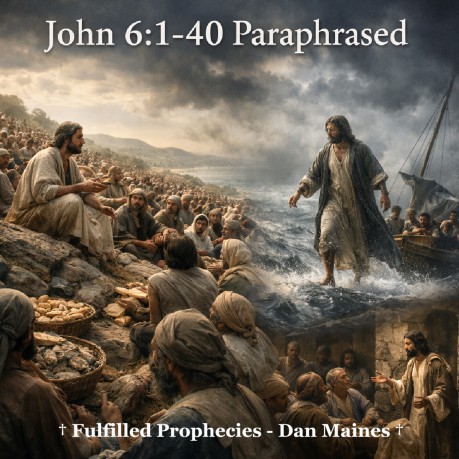
John 6:1-40
Paraphrased John 6:1-40 Paraphrased https://fulfilledprophecies.com/topics/1196.html
John 6:41-71 Paraphrased https://fulfilledprophecies.com/topics/1197.html
By Dan Maines
Introduction
†
This chapter shows Jesus revealing Himself as the true bread from
heaven, not just feeding bodies but giving life.
†
The crowd followed Him for signs, but He redirected them to the
deeper reality of fulfillment and covenant life (John 5:39-40).
†
This is about transition, from physical provision under Moses to
spiritual fulfillment in Christ.
John 6:1
After
this, Jesus crossed over the Sea of Galilee.
†
He moves intentionally, drawing a crowd for what is about to be
revealed.
† This isn't random travel, it's
setting the stage for a greater sign.
† His
movement reflects purpose tied to revelation (Isaiah 55:10-11).
John
6:2
A large crowd kept following Him because they saw
the signs He was doing on the sick.
† They
followed the miracles, not the message.
†
Their focus was physical healing, not spiritual truth.
†
This exposes the shallow motivation of the crowd (Matthew
13:20-21).
John 6:3
Jesus went up on the
mountain and sat there with His disciples.
†
Sitting shows teaching authority.
† The
mountain reflects a place of revelation, like Moses before.
†
He's about to give a new kind of provision (Exodus 19:3).
John
6:4
Now the Passover, the feast of the Jews, was
near.
† This ties directly to the Exodus and
manna.
† The timing is intentional, pointing
to fulfillment.
† Jesus is about to show He's
greater than Moses (Deuteronomy 18:15).
John 6:5
Jesus
looked up and saw a large crowd coming to Him, and He said to Philip,
Where are we to buy bread so these may eat?
†
He tests Philip, not because He doesn't know.
†
This question exposes human limitation.
† God
often tests to reveal faith (Exodus 16:4).
John 6:6
He
said this to test him, for He Himself knew what He was going to do.
†
Jesus already has the answer.
† The test
reveals dependence on Him.
† This shows
divine control over the situation.
John 6:7
Philip
answered Him, Two hundred denarii worth of bread isn't enough for
each of them to receive a little.
† Philip
calculates naturally.
† He sees lack instead
of provision.
† This reflects reliance on
human resources.
John 6:8
One of His
disciples, Andrew, Simon Peter's brother, said to Him,
†
Andrew steps forward with what little they have.
†
Even small faith begins to look to Jesus.
†
This shows movement toward trust.
John 6:9
There
is a boy here who has five barley loaves and two fish, but what are
these for so many people?
† The supply seems
insignificant.
† Yet Jesus works through
small offerings.
† God multiplies what is
given (2 Kings 4:42-44).
John 6:10
Jesus
said, Have the people sit down. Now there was much grass in the
place, so the men sat down, about five thousand in number.
†
He brings order before provision.
† The
number shows the scale of the miracle.
† This
echoes shepherd imagery (Psalm 23:2).
John 6:11
Jesus
then took the loaves, and after giving thanks, He distributed them to
those who were seated, likewise also of the fish as much as they
wanted.
† He gives thanks before
multiplying.
† Provision flows from Him
alone.
† This points to Him as the source of
abundance.
John 6:12
When they were
filled, He said to His disciples, Gather up the leftover fragments so
nothing will be lost.
† There is more than
enough.
† Nothing is wasted in God's
provision.
† This shows completeness.
John
6:13
So they gathered them up and filled twelve baskets
with fragments from the five barley loaves which were left over by
those who had eaten.
† Twelve baskets reflect
Israel.
† Provision extends to the whole
covenant people.
† This symbolizes fullness
and restoration.
John 6:14
Therefore when
the people saw the sign which He had performed, they said, This is
truly the Prophet who is to come into the world.
†
They recognize Him partially.
† They connect
Him to prophecy.
† But they still
misunderstand His mission.
John 6:15
So
Jesus, perceiving that they were intending to come and take Him by
force to make Him king, withdrew again to the mountain by Himself
alone.
† They want a political king.
†
Jesus rejects earthly expectations.
† His
kingdom isn't of this world (John 18:36).
John 6:16
Now
when evening came, His disciples went down to the sea,
†
The scene shifts to another sign.
† The
disciples are separated from Him.
† This sets
up a test of trust.
John 6:17
and after
getting into a boat, they started to cross the sea to Capernaum. It
had already become dark, and Jesus had not yet come to them.
†
Darkness represents uncertainty.
† They are
without His visible presence.
† This reflects
moments of testing.
John 6:18
The sea
began to be stirred up because a strong wind was blowing.
†
Chaos enters the scene.
† Trials often follow
moments of revelation.
† This tests their
faith.
John 6:19
Then, when they had rowed
about three or four miles, they saw Jesus walking on the sea and
drawing near to the boat, and they were frightened.
†
Jesus comes over the chaos.
† He shows
authority over creation.
† Fear reveals their
lack of understanding.
John 6:20
But He
said to them, It is I, don't be afraid.
† His
presence brings peace.
† He identifies
Himself clearly.
† Faith replaces fear.
John
6:21
So they were willing to receive Him into the boat,
and immediately the boat was at the land to which they were going.
†
Once He is received, the journey is complete.
†
This shows His power over time and space.
†
His presence brings fulfillment.
John 6:22
The
next day the crowd that stood on the other side of the sea saw that
there was no other small boat there except one, and that Jesus hadn't
entered with His disciples into the boat, but that His disciples had
gone away alone.
† The crowd is still
tracking Him.
† Their focus remains
physical.
† They seek signs, not truth.
John
6:23
Other small boats came from Tiberias near to the
place where they ate the bread after the Lord had given thanks.
†
The location confirms the miracle.
† The
memory of provision draws them.
† Yet they
still misunderstand.
John 6:24
So when the
crowd saw that Jesus wasn't there, nor His disciples, they themselves
got into the small boats and came to Capernaum seeking Jesus.
†
They seek Him, but for the wrong reason.
†
Their desire is driven by what they received.
†
This sets up His correction.
John 6:25
When
they found Him on the other side of the sea, they said to Him, Rabbi,
when did You get here?
† They are curious
about the sign.
† They miss the meaning
behind it.
† Their focus is still
outward.
John 6:26
Jesus answered them and
said, Truly, truly, I say to you, you seek Me, not because you saw
signs, but because you ate of the loaves and were filled.
†
He exposes their motive.
† They followed for
food, not truth.
† This is a direct
rebuke.
John 6:27
Don't work for the food
which perishes, but for the food which endures to eternal life, which
the Son of Man will give to you, for on Him the Father, God, has set
His seal.
† He shifts them to eternal
reality.
† The true provision comes from
Him.
† This is covenant fulfillment.
John
6:28
Therefore they said to Him, What shall we do, so
that we may work the works of God?
† They
think in terms of effort.
† They seek a
checklist.
† This reflects law-based
thinking.
John 6:29
Jesus answered and
said to them, This is the work of God, that you believe in Him whom
He has sent.
† Faith replaces works.
†
The focus is on trusting Him.
† This fulfills
the law (Habakkuk 2:4).
John 6:30
So they
said to Him, What then do You do as a sign, so that we may see, and
believe You? What work do You perform?
† They
demand more proof.
† They ignore what they've
already seen.
† This shows unbelief.
John
6:31
Our fathers ate the manna in the wilderness, as it
is written, He gave them bread out of heaven to eat.
†
They point back to Moses.
† They compare
Jesus to past provision.
† They still don't
see He is greater.
John 6:32
Jesus then
said to them, Truly, truly, I say to you, it wasn't Moses who has
given you the bread out of heaven, but My Father gives you the true
bread out of heaven.
† He corrects their
understanding.
† The source was always God.
†
Now the true bread is revealed.
John 6:33
For
the bread of God is that which comes down out of heaven, and gives
life to the world.
† The bread is a person,
not food.
† It gives life beyond Israel.
†
This includes the nations.
John 6:34
Then
they said to Him, Lord, always give us this bread.
†
They still think physically.
† Yet they
desire it continually.
† They are close but
not understanding.
John 6:35
Jesus said to
them, I am the bread of life, he who comes to Me will not hunger, and
he who believes in Me will never thirst.
† He
reveals Himself plainly.
† He is the
fulfillment of all provision.
† This is
covenant life.
John 6:36
But I said to you
that you have seen Me, and yet don't believe.
†
Seeing doesn't equal believing.
† Their
hearts remain closed.
† This exposes their
condition.
John 6:37
All that the Father
gives Me will come to Me, and the one who comes to Me I will
certainly not cast out.
† There is assurance
in Him.
† Those given will come.
†
This shows covenant security.
John 6:38
For
I have come down from heaven, not to do My own will, but the will of
Him who sent Me.
† He operates under the
Father's will.
† His mission is defined and
certain.
† This shows unity with the
Father.
John 6:39
This is the will of Him
who sent Me, that of all that He has given Me I lose nothing, but
raise it up on the last day.
† Nothing given
is lost.
† The raising is covenant
fulfillment.
† This points to the completion
in that generation.
John 6:40
For this is
the will of My Father, that everyone who sees the Son and believes in
Him will have eternal life, and I Myself will raise him up on the
last day.
† Eternal life is present through
belief.
† The last day refers to the end of
that covenant age.
† This is fulfilled
reality, not future speculation.
Historical References
†
Josephus, Antiquities of the Jews, Book 3, describes manna as a
temporary provision, pointing beyond itself.
†
Irenaeus, Against Heresies, connects Christ as the true bread from
heaven.
† Clement of Alexandria, Stromata,
speaks of spiritual nourishment in Christ surpassing physical food.
†
Eusebius, Ecclesiastical History, records early understanding of
Christ as fulfillment of the law and prophets.
How it
applies to us today
† We don't chase
signs or physical blessings, we rest in Christ as our complete
provision.
† Our life isn't sustained by
outward things but by Him alone.
† Belief
isn't a work we perform, it's trust in what He's already fulfilled.
†
We live in the reality of eternal life now, not waiting for it
later.
Q & A Appendix:
Q:
What was the crowd really seeking
A: They were
seeking physical provision, not spiritual truth (John 6:26)
Q:
What is the true bread from heaven
A: Jesus
Himself, who gives life to the world (John 6:33-35)
Q:
What is the work of God
A: To believe in the
One He sent (John 6:29)
Q: What does it mean to
never hunger or thirst
A: It means complete
satisfaction in Christ (John 6:35)
Q: When is
the last day
A: It refers to the end of the old
covenant age fulfilled in that generation (John 6:39-40)
†
This is the fulfilled perspective we proclaim at Fulfilled Prophecies
†
© Fulfilled Prophecies - Dan Maines.
Source
Index
† John 6:1-40
†
Josephus, Antiquities of the Jews
† Irenaeus,
Against Heresies
† Eusebius, Ecclesiastical
History
† Clement of Alexandria, Stromata
Links