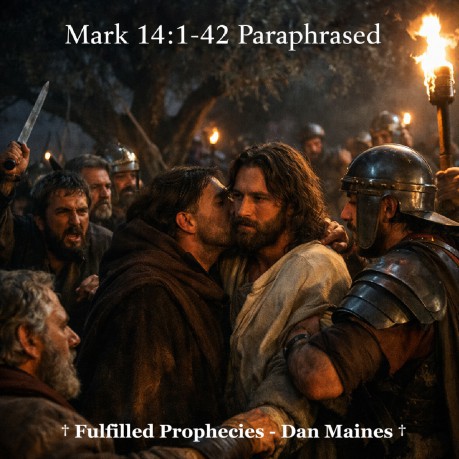
Mark 14:1-42
Paraphrased Mark 14:1-42 Paraphrased https://fulfilledprophecies.com/topics/1138.html
Mark 14:43-72 Paraphrased https://fulfilledprophecies.com/topics/1139.html
By Dan Maines
Introduction
†
Mark records the final hours leading up to Jesus' arrest and the plot
forming against Him as Passover approached.
†
These events happen exactly as Jesus had already predicted earlier in
His ministry (Mark 10:33-34).
† The timing
during Passover is important because the Passover lamb pointed
forward to the sacrifice Jesus was about to make (1 Corinthians
5:7).
Mark 14:1
Two days before the
Passover and the Feast of Unleavened Bread, the chief priests and the
scribes were secretly looking for a way to arrest Jesus by deception
and kill Him.
† The leadership of Israel had
moved beyond disagreement and were now plotting murder.
†
Their actions fulfilled the pattern of rejection spoken about the
Messiah by the prophets (Psalm 118:22).
†
Josephus describes the priestly leadership of this time as
politically driven and deeply corrupt, which explains their hostility
toward Jesus.
Mark 14:2
But they were
saying, not during the festival, or there may be a riot among the
people.
† The leaders feared the crowd
because many people admired Jesus and listened to Him gladly (Luke
19:48).
† Their concern was political
stability, not truth or justice.
† Even while
trying to avoid Passover, God's plan ensured the Lamb would die at
Passover.
Mark 14:3
While He was in
Bethany at the house of Simon the leper and reclining at the table, a
woman came with an alabaster vial of very expensive perfume made of
pure nard. She broke the vial and poured the perfume over His head.
†
John identifies this woman as Mary of Bethany, the sister of Lazarus
(John 12:3).
† The perfume was extremely
valuable, likely worth nearly a year's wages.
†
Her act symbolically prepared Jesus for burial even though she likely
didn't realize the full meaning yet.
Mark 14:4
But
some were angrily criticizing her and saying, why has this perfume
been wasted?
† Judas was the primary voice
behind this complaint according to John.
†
What they called waste, Jesus saw as devotion.
†
The moment exposes how easily sincere worship can be
misunderstood.
Mark 14:5
This perfume
could have been sold for more than three hundred denarii and the
money given to the poor. And they were scolding her harshly.
†
Three hundred denarii represented roughly a year's wages for a
laborer.
† Judas' concern for the poor wasn't
genuine because he often stole from the money bag (John 12:6).
†
This moment exposes how spiritual sounding arguments can hide selfish
motives.
Mark 14:6
But Jesus said, leave
her alone. Why are you bothering her? She has done a good deed for
Me.
† Jesus publicly defended her act of love
and devotion.
† Worship that honors Christ is
never wasteful.
† The disciples were learning
that devotion to Christ takes priority over appearances.
Mark
14:7
For you always have the poor with you, and
whenever you want you can do good for them, but you don't always have
Me.
† Jesus wasn't dismissing helping the
poor because the law repeatedly commanded it (Deuteronomy 15:11).
†
He was emphasizing the uniqueness of this moment before His death.
†
The opportunity to physically honor Him was about to pass.
Mark
14:8
She did what she could. She anointed My body
beforehand for burial.
† In Jewish burial
customs, bodies were prepared with spices and oils.
†
Jesus interpreted her act as preparation for His coming burial.
†
This shows that even acts done in love can carry prophetic
meaning.
Mark 14:9
Truly I say to you,
wherever the gospel is preached in the whole world, what this woman
has done will also be spoken of in memory of her.
†
Jesus declared that her act would permanently become part of the
gospel message.
† For two thousand years
believers have remembered her devotion when reading this passage.
†
Her story reminds us that simple acts of love toward Christ are never
forgotten.
Mark 14:10
Then Judas Iscariot,
who was one of the twelve, went away to the chief priests in order to
betray Him to them.
† Judas wasn't an
outsider, he was one of the twelve disciples.
†
His betrayal fulfilled prophecy about the Messiah being betrayed by a
close companion (Psalm 41:9).
† Early
Christian writers like Irenaeus recorded Judas as an example of false
discipleship.
Mark 14:11
They were glad
when they heard this and promised to give him money. And he began
seeking how to betray Him at the right time.
†
The leaders celebrated the opportunity Judas provided.
†
Judas became the inside connection they needed to arrest Jesus
quietly.
† Greed and hatred joined together
to accomplish the betrayal.
Mark 14:12
On
the first day of Unleavened Bread, when the Passover lamb was being
sacrificed, His disciples said to Him, where do You want us to go and
prepare for You to eat the Passover?
†
Passover remembered Israel's deliverance from Egypt (Exodus 12:14).
†
The lamb symbolized protection from judgment.
†
Jesus Himself was about to become the true Passover Lamb.
Mark
14:13
He sent two of His disciples and said to them, go
into the city and a man carrying a jar of water will meet you, follow
him.
† Men normally didn't carry water jars,
so this man would be easy to identify.
† The
instructions reveal Jesus' complete knowledge of the situation.
†
Even in these moments, He remained in full control of the events
unfolding.
Mark 14:14
Wherever he enters,
say to the owner of the house, the Teacher says, where is My guest
room where I may eat the Passover with My disciples?
†
Jesus often referred to Himself as the Teacher among the disciples.
†
The guest room would be an upper room large enough for the group.
†
Passover meals required careful preparation in advance.
Mark
14:15
And he himself will show you a large upper room
furnished and ready. Prepare for us there.
†
The upper room became the location of the final meal with the
disciples.
† Early church tradition
remembered this room as a gathering place for believers.
†
Eusebius later wrote about the early church preserving memories of
these locations.
Mark 14:16
The disciples
went out and came to the city and found everything just as He had
told them, and they prepared the Passover.
†
Once again Jesus' words proved completely accurate.
†
The meal included lamb, unleavened bread, wine, and bitter herbs.
†
These traditional elements would take on new meaning through
Christ.
Mark 14:17
When it was evening He
came with the twelve.
† Passover meals were
eaten after sunset.
† This would be the final
meal Jesus shared with the twelve before His arrest.
†
The disciples still didn't fully understand what was about to
happen.
Mark 14:18
As they were reclining
at the table and eating, Jesus said, truly I say to you that one of
you will betray Me, one who is eating with Me.
†
Sharing a meal together symbolized close fellowship.
†
Betrayal from someone at the table made the act especially
shocking.
† This fulfilled Psalm 41:9
concerning betrayal by a close friend.
Mark 14:19
They
began to be distressed and to say to Him one by one, surely not I?
†
The disciples were troubled and uncertain.
†
Each one examined himself.
† None of them
immediately suspected Judas.
Mark 14:20
And
He said to them, it is one of the twelve, one who dips with Me in the
bowl.
† Dipping bread into a shared dish was
normal at meals.
† The statement narrowed the
betrayal to His closest circle.
† The
closeness of the relationship made the betrayal even more
tragic.
Mark 14:21
For the Son of Man is
going just as it is written about Him, but woe to that man by whom
the Son of Man is betrayed. It would have been better for that man if
he had not been born.
† Jesus confirmed His
death was already written in Scripture.
†
Judas still remained fully responsible for his choice.
†
The statement shows both God's plan and human accountability.
Mark
14:22
While they were eating, He took some bread, and
after a blessing He broke it and gave it to them, and said, take it,
this is My body.
† This moment established
the memorial meal later practiced by Christians.
†
The bread symbolized His body given for them.
†
Paul later explained the meaning of this practice to the churches (1
Corinthians 11:23-24).
Mark 14:23
And when
He had taken a cup and given thanks, He gave it to them, and they all
drank from it.
† The cup represented
participation in the covenant.
† Drinking
together symbolized unity in the covenant.
†
Early Christians continued observing this meal regularly.
Mark
14:24
And He said to them, this is My blood of the
covenant, which is poured out for many.
†
This echoes Moses speaking about covenant blood in Exodus 24:8.
†
Jesus declared His death would establish the new covenant promised in
Jeremiah 31:31.
† His sacrifice would
accomplish what animal sacrifices never could.
Mark
14:25
Truly I say to you, I will never again drink of
the fruit of the vine until that day when I drink it new in the
kingdom of God.
† Jesus pointed ahead to the
fulfillment of God's kingdom.
† From the
fulfilled perspective that kingdom was established through His
victory and the events culminating in AD 70.
†
The statement pointed forward to the completed reign of Christ.
Mark
14:26
After singing a hymn, they went out to the Mount
of Olives.
† The hymn likely came from the
Hallel Psalms traditionally sung during Passover.
†
The Mount of Olives sits just east of Jerusalem.
†
This would be the location of Jesus' final prayer before His
arrest.
Mark 14:27
And Jesus said to them,
you will all fall away, because it is written, I will strike down the
shepherd, and the sheep will be scattered.
†
Jesus quoted Zechariah 13:7.
† The scattering
of the disciples had already been predicted centuries earlier.
†
The prophecy showed the coming crisis was part of God's plan.
Mark
14:28
But after I have been raised, I will go ahead of
you to Galilee.
† Jesus promised resurrection
even before His death.
† Galilee was where
much of His ministry began.
† The promise
offered hope beyond the coming suffering.
Mark 14:29
But
Peter said to Him, even though all may fall away, yet I will not.
†
Peter spoke with deep loyalty.
† His
confidence was sincere but overestimated his strength.
†
The coming hours would reveal the weakness of human resolve.
Mark
14:30
And Jesus said to him, truly I say to you that
this very night, before a rooster crows twice, you yourself will deny
Me three times.
† Jesus predicted Peter's
denial with precise detail.
† The rooster
crow marked the early morning hours.
† This
showed Jesus' complete foreknowledge of events.
Mark
14:31
But Peter kept insisting, even if I have to die
with You, I will not deny You. And they all were saying the same
thing also.
† The other disciples echoed
Peter's loyalty.
† Their devotion was real
but their strength was limited.
† The coming
events would test every one of them.
Mark 14:32
They
came to a place named Gethsemane, and He said to His disciples, sit
here until I have prayed.
† Gethsemane means
oil press, referring to the olive grove there.
†
The garden became the setting of Jesus' intense prayer.
†
Prayer was His response to the coming suffering.
Mark
14:33
And He took with Him Peter and James and John,
and began to be very distressed and troubled.
†
These three were the closest disciples to Jesus.
†
Mark shows the deep emotional weight Jesus felt.
†
This reveals the true humanity of Christ.
Mark 14:34
And
He said to them, My soul is deeply grieved to the point of death,
remain here and keep watch.
† Jesus openly
expressed His anguish.
† He asked the
disciples to remain alert and watch with Him.
†
The moment reveals the depth of the coming sacrifice.
Mark
14:35
And He went a little beyond them, and fell to the
ground and began to pray that if it were possible, the hour might
pass Him by.
† The hour referred to the
suffering and death ahead.
† Jesus faced the
weight of the mission before Him.
† His
prayer shows the seriousness of what was coming.
Mark
14:36
And He was saying, Abba Father, all things are
possible for You, remove this cup from Me, yet not what I will, but
what You will.
† Abba expresses deep personal
closeness with the Father.
† The cup
symbolized the suffering He would endure.
†
Despite the anguish He chose obedience.
Mark 14:37
And
He came and found them sleeping, and said to Peter, Simon, are you
asleep? Could you not keep watch for one hour?
†
Peter who had just promised loyalty couldn't remain awake.
†
The disciples were exhausted and overwhelmed.
†
The moment exposes human weakness.
Mark 14:38
Keep
watching and praying so that you don't come into temptation, the
spirit is willing but the flesh is weak.
†
Jesus explained the danger of spiritual weakness.
†
Prayer was the protection against temptation.
†
The statement still applies to believers today.
Mark
14:39
Again He went away and prayed, saying the same
words.
† Jesus continued in persistent
prayer.
† The struggle in the garden was
intense.
† Yet His submission to the Father
remained firm.
Mark 14:40
And again He
came and found them sleeping, for their eyes were very heavy, and
they didn't know what to answer Him.
† The
disciples couldn't stay awake.
† Their
exhaustion left them speechless.
† The
contrast between Jesus praying and the disciples sleeping is
striking.
Mark 14:41
And He came the third
time and said to them, are you still sleeping and resting? It is
enough, the hour has come, behold, the Son of Man is being betrayed
into the hands of sinners.
† The moment of
betrayal had arrived.
† Judas and the
arresting group were already approaching.
†
Everything Jesus predicted was now unfolding.
Mark
14:42
Get up, let's be going, behold, the one who
betrays Me is at hand.
† Jesus didn't run or
hide.
† He walked toward the moment of
arrest.
† His willingness shows the
deliberate nature of His sacrifice.
Historical
References
† Josephus describes the
corruption and political nature of the priestly leadership during
this time in Antiquities of the Jews.
†
Irenaeus discussed the betrayal of Judas and fulfillment of prophecy
in Against Heresies.
† Eusebius recorded
early church traditions about the final days of Jesus in
Ecclesiastical History.
How It Applies To Us Today
†
The devotion of the woman reminds us that genuine love for Christ
often appears costly.
† Judas reminds us that
outward association with Jesus doesn't guarantee faithfulness.
†
The disciples' weakness reminds us that prayer is necessary when
facing temptation.
† Jesus' obedience in
Gethsemane shows the example of submitting to God's will even in
suffering.
† Christ's faithfulness assures us
that God's plan was accomplished exactly as intended.
Q
& A Appendix
Q Why did the
religious leaders want to arrest Jesus secretly?
A
They feared the crowd because many people respected Jesus and
listened to Him (Luke 19:48).
Q Why did Jesus
defend the woman who poured perfume on Him?
A
Her act symbolized preparation for His burial and sincere devotion
(John 12:7).
Q Why did Judas betray Jesus?
A
Scripture connects the betrayal to greed and prophecy (Psalm 41:9;
John 12:6).
Q What did the bread and cup
represent at the meal?
A They symbolized
Christ's body and blood establishing the new covenant (1 Corinthians
11:23-26).
Q Why did Jesus pray in
Gethsemane?
A He faced the coming suffering and
submitted fully to the Father's will (Hebrews 5:7).
†
This is the fulfilled perspective we proclaim at Fulfilled Prophecies
†
© Fulfilled Prophecies - Dan Maines.
Source
Index
† Mark 14
†
Josephus, Antiquities of the Jews
† Irenaeus,
Against Heresies
† Eusebius, Ecclesiastical
History
Links