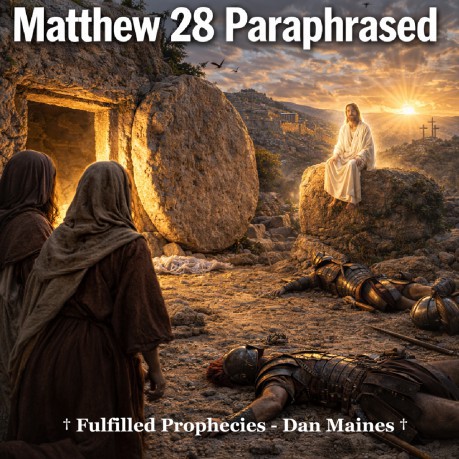
Matthew 28 Paraphrased Introduction † Matthew ends his Gospel with the event that
proves everything Jesus said was true, the resurrection. The empty
tomb shows that death could not hold Him and that God's plan was
being fulfilled exactly as foretold (Psalm 16:10; Acts 2:31). † The resurrection also confirms Jesus as the
reigning Messiah. His authority over heaven and earth is now openly
declared, and His disciples are sent to proclaim His rule to the
nations (Daniel 7:13-14). † From the fulfilled perspective, this moment
marks the final transition into the kingdom age. The risen Christ now
reigns and His gospel would soon spread throughout the world before
the judgment of Jerusalem in that generation (Matthew 24:34;
Colossians 1:23). Scripture Matthew 28:1 † The women came expecting to mourn, not to
witness the resurrection. Their presence shows the honesty of the
Gospel accounts, since women were not normally used as legal
witnesses in that culture (Luke 24:1-3). † Their visit also confirms that Jesus truly
died and was buried. The location of the tomb was known, which made
the empty tomb impossible to deny later (John 19:41-42). † The first day of the week becomes important
because it marks the day Christ rose. Early believers later gathered
on that same day to remember the risen Lord (Acts 20:7). Matthew 28:2 † The stone was not rolled away to let Jesus
out, but to let the witnesses see that the tomb was already empty
(John 20:6-8). † Earthquakes in Scripture often accompany
divine intervention and judgment, showing that God Himself was acting
in this moment (Exodus 19:18). † The angel sitting on the stone symbolizes
complete victory over death and the grave. Matthew 28:3 † The description reflects heavenly glory.
Angels often appear with radiant brightness when delivering messages
from God (Luke 24:4). † This dramatic appearance emphasizes that the
resurrection was a divine act, not something done secretly by men. † The brightness also parallels the glory
revealed at the transfiguration of Christ (Matthew 17:2). Matthew 28:4 † Roman soldiers were trained warriors, yet
even they collapsed in fear when confronted with the power of heaven. † Their reaction proves the reality of what
happened. These guards later reported the event to the authorities
(Matthew 28:11). † The scene also fulfills the pattern seen
throughout Scripture where humans fall in fear when confronted with
heavenly beings (Daniel 10:7-9). Matthew 28:5 † The angel reassures them because they came in
faith and devotion. † The phrase Jesus who was crucified reminds us
that the same one who died on the cross is the one who has now been
raised. † The resurrection proves that the crucifixion
was not defeat but victory (Acts 2:23-24). Matthew 28:6 † The empty tomb confirms that Jesus kept His
own prophecy about rising again (Matthew 16:21). † The angel invites them to examine the
evidence themselves. † Christianity is built on a historical event,
the resurrection of Christ (1 Corinthians 15:14). Matthew 28:7 † The women become the first messengers of the
resurrection. † Jesus had already told His disciples that He
would meet them again in Galilee (Matthew 26:32). † This command begins the chain of eyewitness
testimony that spread the gospel throughout the world. Matthew 28:8 † Their fear came from witnessing a powerful
supernatural event. † Their joy came from realizing that Jesus had
truly risen. † This mixture of fear and joy often appears
when people encounter the power of God (Luke 24:41). Matthew 28:9 † The women physically touched Jesus, proving
the resurrection was not symbolic or imaginary. † Their act of worship confirms that Jesus is
worthy of divine honor (Hebrews 1:6). † This moment shows that the risen Christ was
truly alive in bodily form. Matthew 28:10 † Jesus calls the disciples His brothers,
showing restored fellowship even after their earlier failures. † This also demonstrates the grace of Christ
toward those who had abandoned Him during the crucifixion. † The meeting in Galilee had been planned
beforehand, confirming Jesus' foreknowledge. Matthew 28:11 † The guards themselves confirmed the
resurrection events. † This testimony created a serious problem for
the religious leaders who had opposed Jesus. † Instead of accepting the truth, the leaders
began planning how to cover it up. Matthew 28:12 † The leaders attempted to suppress the truth
through bribery. † This reaction shows that they knew the tomb
was empty. † Rather than deny the resurrection directly,
they tried to create an alternate explanation. Matthew 28:13 † This explanation was logically impossible. If
the guards were asleep, they could not know who stole the body. † Roman guards sleeping on duty would have
faced severe punishment, making the story unlikely. † The false explanation itself confirms that
the tomb was empty. Matthew 28:14 † The leaders promised to protect the soldiers
from Roman discipline. † This shows the depth of the conspiracy to
hide the truth. † Even hostile sources indirectly confirm the
resurrection by admitting the tomb was empty. Matthew 28:15 † Matthew records that this false rumor
continued circulating for years. † Early Christian writers later addressed this
same accusation. † The persistence of the rumor actually proves
how widely the resurrection claim was known. Matthew 28:16 † The disciples obeyed the instructions given
by Jesus through the women. † Their gathering shows that the movement
continued even after the crucifixion. † This meeting prepared them for the mission
ahead. Matthew 28:17 † The honesty of the Gospel includes the fact
that some struggled to believe at first. † Even so, the overwhelming evidence convinced
them. † Their later willingness to suffer and die for
this testimony shows the strength of their conviction. Matthew 28:18 † This statement fulfills the prophecy of the
Son of Man receiving dominion from God (Daniel 7:13-14). † Christ's authority extends over all nations
and powers. † The resurrection publicly confirms His
kingship. Matthew 28:19 † The gospel was no longer limited to Israel
alone but was going to the entire world. † This command began the global mission of the
church. † The message of Christ would soon spread
throughout the Roman world (Colossians 1:23). Matthew 28:20 † The phrase end of the age refers to the end
of the old covenant age that Jesus had spoken about earlier (Matthew
24:3). † Christ's presence with His followers
continues through the power of the Spirit. † His kingdom continues advancing throughout
the world. Historical References † Ignatius of Antioch wrote that Jesus truly
suffered and truly rose again, affirming the historical resurrection. † Justin Martyr explained that the Jewish
leaders spread the stolen body story, confirming Matthew's record. † Eusebius recorded that the resurrection
message quickly spread throughout the Roman Empire. How It Applies To Us Today † The resurrection reminds us that Christ truly
reigns. Our faith is grounded in a real historical event, not a myth
(1 Corinthians 15:17). † Because Jesus has all authority, believers
today live under His kingdom rule. † The mission given to the disciples continues
as the gospel is shared throughout the world. Q & A Appendix Q Did the resurrection really happen in history? A Yes. The empty tomb, eyewitness testimony, and
the rapid growth of the early church all confirm it (1 Corinthians
15:3-8). Q Why did the leaders spread the stolen body
story? A Because they could not deny that the tomb was
empty, so they attempted to create an alternate explanation (Matthew
28:11-15). Q What does Jesus mean by the end of the age? A It refers to the end of the old covenant age
that culminated with the destruction of Jerusalem in AD 70 (Matthew
24:3; Hebrews 8:13). Q Did Jesus really rise physically from the dead? A Yes. The Gospels show that the disciples
touched Him and spoke with Him after the resurrection. The tomb was
empty and His followers became eyewitnesses of the event (Luke 24:39;
John 20:27; 1 Corinthians 15:3-8). Q Why were women the first witnesses to the
resurrection? A In the first century women were not considered
primary legal witnesses. The fact that the Gospels record women
discovering the empty tomb shows the writers were reporting what
actually happened, not inventing a story (Luke 24:1-11). Q Could the disciples have stolen the body? A The tomb was guarded by Roman soldiers and
sealed by the authorities. The guards themselves reported the
supernatural event. The story about the body being stolen was created
by the leaders to hide the truth (Matthew 27:65-66; Matthew
28:11-15). Q Why is the resurrection so central to the
gospel? A The resurrection proves that Jesus conquered
death and confirms everything He taught. Without it, the message of
the gospel would collapse (1 Corinthians 15:14-17). Q What does Jesus mean when He says all authority
in heaven and on earth has been given to Him? A This fulfills the prophecy of the Son of Man
receiving dominion from God. The risen Christ now rules as King over
all nations (Daniel 7:13-14; Ephesians 1:20-22). Q What does the phrase end of the age mean in
Matthew 28:20? A Jesus was referring to the end of the old
covenant age that He had spoken about earlier when the temple system
would pass away. That judgment came within that generation with the
destruction of Jerusalem in AD 70 (Matthew 24:3, 34; Hebrews 8:13). Q Why did Jesus send His disciples to all
nations? A The gospel was never meant to remain limited to
Israel. Through Christ the promise to Abraham was now reaching the
nations of the world (Genesis 22:18; Matthew 28:19). Q How do we know the resurrection message spread
quickly? A The book of Acts and early Christian writings
show that the message of the risen Christ spread rapidly throughout
the Roman world within a few decades (Acts 17:6; Colossians 1:23). Q Why did the Jewish leaders try to suppress the
resurrection story? A Because accepting the resurrection would mean
acknowledging Jesus as the Messiah they had rejected. Instead they
attempted to silence the truth through bribery and false reports
(Matthew 28:12-15). Q What does the resurrection mean for believers
today? A It assures us that Christ reigns, that death is
defeated, and that His kingdom continues advancing in the world (1
Corinthians 15:20-22; Hebrews 12:28). † This is the fulfilled perspective we proclaim at
Fulfilled Prophecies † Source Index † Matthew 24:3, 34; Matthew 26:32; Matthew
28:1-20; Luke 24:1-4; John 19:41-42; John 20:6-8; Acts 2:23-24; Acts
20:7; 1 Corinthians 15:3-8, 14, 17; Colossians 1:23; Daniel 7:13-14;
Psalm 16:10 † Ignatius of Antioch, Letter to the
Smyrnaeans; Justin Martyr, Dialogue with Trypho; Eusebius,
Ecclesiastical History
By Dan Maines
After the Sabbath had ended, as
the first day of the week was beginning to dawn, Mary Magdalene and
the other Mary went to see the tomb.
Suddenly there was a great
earthquake, because an angel from heaven came down, rolled the stone
away from the entrance, and sat on it.
His appearance shone like
lightning, and his clothing was bright and white like snow.
The guards trembled with fear
at the sight of him and fell down like dead men.
But the angel said to the
women, Do not be afraid. I know you are looking for Jesus who was
crucified.
He is not here, because He has
risen just as He said. Come and see the place where He was lying.
Go quickly and tell His
disciples that He has risen from the dead. He is going ahead of you
into Galilee. You will see Him there. Now I have told you.
They left the tomb quickly with
fear and great joy, and ran to report it to His disciples.
And suddenly Jesus met them and
greeted them. They came up, took hold of His feet, and worshiped Him.
Then Jesus said to them, Do
not be afraid. Go and tell My brothers to go to Galilee, and there
they will see Me.
While they were on their way,
some of the guards went into the city and reported everything that
had happened to the chief priests.
After meeting with the elders
and discussing the situation, they gave a large sum of money to the
soldiers.
They instructed the soldiers
to say that the disciples came at night and stole the body while they
were asleep.
If the governor hears about
this, we will persuade him and keep you out of trouble.
The soldiers took the money
and did as they were instructed. This story has been spread among the
Jews to this day.
But the eleven disciples went
to Galilee, to the mountain where Jesus had told them to go.
When they saw Him, they
worshiped Him, but some were doubtful.
Jesus came to them and said
that all authority in heaven and on earth had been given to Him.
Therefore they were to go and
make disciples of all nations, baptizing them in the name of the
Father and the Son and the Holy Spirit.
They were to teach people to
obey everything He had commanded, and He promised that He would be
with them always, even to the end of the age.
© Fulfilled Prophecies - Dan
Maines.
Links