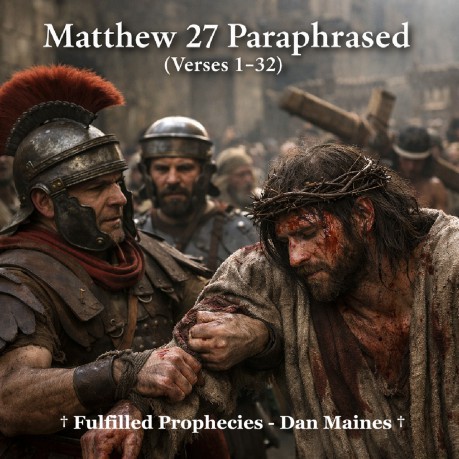
Matthew 27 Paraphrased
(Verses 1-32) Introduction † Matthew 27 records the final phase of Jesus'
trial and the events that led directly to His crucifixion. The
religious leaders had already decided the outcome during the night.
When morning came, they moved quickly to bring Jesus before the Roman
governor so the execution could legally take place. † Everything unfolding here is exactly what
Jesus had already told His disciples would happen. He said He would
be delivered to the chief priests, condemned, handed over to the
Gentiles, mocked, scourged, and crucified (Matthew 20:18-19). † These verses also show the complete rejection
of the Messiah by the leadership of that generation. Yet even through
their rejection, the scriptures were being fulfilled exactly as
foretold. Matthew 27:1 When morning came, all the chief priests and the elders of the
people conferred together against Jesus to put Him to death. † The decision had already been reached during
the nighttime trial, this meeting simply formalized their plan so
they could present Jesus to the Roman governor (Matthew 26:59-66). † Jewish authorities did not have legal
authority to carry out executions under Roman rule, which is why they
brought Jesus to Pilate (John 18:31). † Jesus had already told His disciples that He
would be condemned by the religious leaders and delivered to the
Gentiles (Matthew 20:18). Matthew 27:2 And they bound Him, and led Him away, and handed Him over to
Pilate the governor. † Binding Jesus symbolized their authority over
Him, yet it was ultimately part of God's predetermined plan (Acts
2:23). † Pontius Pilate governed Judea under the Roman
Empire during the reign of Tiberius Caesar. † This fulfilled Jesus' words that He would be
delivered to the Gentiles (Luke 18:32). Matthew 27:3 Then when Judas, who had betrayed Him, saw that He had been
condemned, he felt remorse and returned the thirty pieces of silver
to the chief priests and elders. † Judas experienced regret over his actions,
but scripture distinguishes regret from true repentance that leads to
life (2 Corinthians 7:10). † The thirty pieces of silver matched the
prophetic price placed on the rejected shepherd (Zechariah 11:12-13). † Judas now saw the outcome of the betrayal he
had set in motion. Matthew 27:4 Saying, I have sinned by betraying innocent blood. But they said,
What is that to us? See to that yourself. † Judas openly declared Jesus to be innocent. † The religious leaders showed no concern for
justice. † Their response revealed the hardness of their
hearts despite the admission of innocence. Matthew 27:5 And he threw the pieces of silver into the temple sanctuary and
left, and he went away and hanged himself. † Judas' tragic end shows the weight of guilt
without true repentance. † The temple itself became the place where the
betrayal money was rejected. † The field later purchased with the money
became known publicly as the Field of Blood (Acts 1:18-19). Matthew 27:6 The chief priests took the pieces of silver and said, It is not
lawful to put them into the temple treasury, since it is the price of
blood. † The leaders were concerned about temple
regulations but ignored the injustice they had committed. † Jesus had previously rebuked these leaders
for focusing on minor laws while neglecting justice (Matthew 23:23). † Their reasoning exposed their hypocrisy. Matthew 27:7 And they conferred together and with the money bought the Potter's
Field as a burial place for strangers. † Potter's fields were areas where clay had
been removed and the land could no longer be farmed. † The purchase fulfilled prophetic language
about the rejected shepherd's payment (Zechariah 11:13). † The land became a burial place for
foreigners. Matthew 27:8 For this reason that field has been called the Field of Blood to
this day. † The name preserved the memory of Judas'
betrayal. † The location was known publicly in the early
church (Acts 1:19). † Matthew records this as historical evidence
recognized by the people. Matthew 27:9 Then that which was spoken through Jeremiah the prophet was
fulfilled: And they took the thirty pieces of silver, the price of
the one whose price had been set by the sons of Israel. † Matthew identifies the prophetic fulfillment
connected to Judas' betrayal. † Israel's leadership placed a price on the
Messiah. † The rejected shepherd imagery in the prophets
pointed forward to Christ. Matthew 27:10 And they gave them for the Potter's Field, just as the Lord
directed me. † Even the final use of the silver fulfilled
the prophetic message. † What the leaders thought was a simple
financial decision actually fulfilled scripture. † God's plan was unfolding through these
events. Matthew 27:11 Now Jesus stood before the governor, and the governor questioned
Him, saying, Are You the King of the Jews? And Jesus said to him, It
is as you say. † The accusation presented to Pilate was
political. † Claiming kingship could be interpreted as
rebellion against Rome. † Jesus acknowledged His kingship but His
kingdom was not political in nature (John 18:36). Matthew 27:12 And while He was being accused by the chief priests and elders, He
did not answer. † Jesus' silence fulfilled the prophecy of the
suffering servant (Isaiah 53:7). † He allowed the accusations to proceed without
defending Himself. † This showed His willing submission to the
Father's plan. Matthew 27:13 Then Pilate said to Him, Do You not hear how many things they
testify against You? † Pilate expected the accused to defend
himself. † Jesus' silence surprised the governor. † The accusations continued without response. Matthew 27:14 And still He did not answer him in regard to even a single charge,
so the governor was quite amazed. † Pilate was surprised by the composure of
Jesus. † Jesus did not act like someone fearing
execution. † His silence revealed complete control over
the situation. Matthew 27:15 Now at the feast the governor was accustomed to release for the
crowd any one prisoner whom they wanted. † This custom was likely intended to maintain
peace during the Passover celebration. † Jerusalem's population increased dramatically
during the feast. † Pilate attempted to use this custom to
release Jesus. Matthew 27:16 At that time they were holding a notorious prisoner called
Barabbas. † Barabbas was known for violent rebellion
(Mark 15:7). † Rome treated such criminals harshly. † Pilate believed the crowd would choose Jesus
instead. Matthew 27:17 So when the people gathered together, Pilate said to them, Whom do
you want me to release for you? Barabbas, or Jesus who is called
Christ? † Pilate placed the decision directly before
the crowd. † The contrast between Jesus and Barabbas was
obvious. † Pilate expected Jesus to be chosen. Matthew 27:18 For he knew that because of envy they had handed Him over. † Pilate recognized jealousy as the true motive
behind the accusations. † Jesus' influence threatened the authority of
the religious leaders. † The governor understood this was not a
legitimate criminal case. Matthew 27:19 While he was sitting on the judgment seat, his wife sent him a
message, saying, Have nothing to do with that righteous Man, for last
night I suffered greatly in a dream because of Him. † The message from Pilate's wife increased his
hesitation. † Even outside the Jewish leadership Jesus'
innocence was recognized. † The dream warning added pressure on Pilate. Matthew 27:20 But the chief priests and the elders persuaded the crowds to ask
for Barabbas and to put Jesus to death. † The leaders stirred the crowd against Jesus. † Public opinion was manipulated by those in
authority. † The same city that welcomed Jesus earlier in
the week now rejected Him. Matthew 27:21 But the governor said to them, Which of the two do you want me to
release for you? And they said, Barabbas. † The crowd chose the violent criminal. † This moment symbolized the rejection of the
Messiah. † The influence of the religious leaders had
turned the people. Matthew 27:22 Pilate said to them, Then what shall I do with Jesus who is called
Christ? They all said, Crucify Him. † Crucifixion was one of the most brutal
punishments used by Rome. † The demand revealed the hostility stirred by
the leaders. † The rejection of Jesus reached its final
declaration. Matthew 27:23 And he said, Why, what evil has He done? But they kept shouting
all the more, saying, Crucify Him. † Pilate acknowledged that no crime had been
proven. † The crowd continued shouting louder. † Mob pressure forced the final decision. Matthew 27:24 And when Pilate saw that he was accomplishing nothing, but rather
that a riot was starting, he took water and washed his hands in front
of the crowd, saying, I am innocent of this Man's blood, see to that
yourselves. † Washing his hands symbolized an attempt to
remove responsibility. † Yet Pilate still authorized the execution. † Political stability was placed above justice. Matthew 27:25 And all the people replied, His blood shall be on us and on our
children. † The crowd accepted responsibility for the
decision. † Within that generation Jerusalem would face
destruction in AD 70. † Jesus had already warned that the blood of
the prophets would come upon that generation (Matthew 23:36). Matthew 27:26 Then he released Barabbas for them, but after having Jesus
flogged, he handed Him over to be crucified. † Roman scourging was extremely brutal. † The suffering fulfilled the prophecy
concerning the Messiah (Isaiah 53:5). † Jesus was then delivered to the soldiers for
execution. Matthew 27:27 Then the soldiers of the governor took Jesus into the Praetorium
and gathered the whole Roman cohort around Him. † The Praetorium was the governor's
headquarters. † A Roman cohort could contain hundreds of
soldiers. † The soldiers gathered to mock Jesus before
execution. Matthew 27:28 And they stripped Him and put a scarlet cloak on Him. † The cloak mocked the claim that Jesus was a
king. † Roman soldiers often ridiculed condemned
prisoners. † The act intensified the humiliation. Matthew 27:29 And after twisting together a crown of thorns, they put it on His
head, and a reed in His right hand, and they knelt down before Him
and mocked Him, saying, Hail, King of the Jews. † The crown of thorns symbolized mock royalty. † The reed acted as a fake scepter. † The soldiers mocked the title associated with
Jesus. Matthew 27:30 And they spat on Him, and took the reed and began to beat Him on
the head. † Spitting was a sign of deep humiliation. † The beating added to the suffering caused by
the scourging. † These events fulfilled prophetic descriptions
of the suffering servant (Isaiah 50:6). Matthew 27:31 And after they had mocked Him, they took the cloak off Him and put
His own garments back on Him, and led Him away to crucify Him. † The mockery ended as the execution procession
began. † Roman crucifixions were carried out publicly
as warnings. † Jesus was led toward the place of execution. Matthew 27:32 As they were coming out, they found a man of Cyrene named Simon,
whom they forced to carry His cross. † Simon was likely a Jewish pilgrim visiting
Jerusalem for Passover. † Roman soldiers had the authority to compel
civilians to carry burdens. † Jesus had been severely weakened from the
scourging and abuse. Historical References † Josephus records that Pontius Pilate governed
Judea during the reign of Tiberius and frequently dealt with unrest
in Jerusalem during the festivals. † Tacitus confirms Roman crucifixion as a
standard punishment used against those considered enemies of the
state. † Early Christian writers such as Justin Martyr
and Irenaeus affirmed that the suffering of Jesus fulfilled the
prophetic writings concerning the Messiah. How It Applies To Us Today † These events remind us that Jesus willingly
endured suffering to accomplish redemption. † The rejection of Jesus by the leadership
shows how religious systems can become blind when power and tradition
take priority over truth. † Believers today are called to remain faithful
to Christ rather than follow the pressure of crowds or institutions. Q & A Appendix Q Why did the Jewish leaders bring Jesus to
Pilate? A Because under Roman rule they did not have
authority to carry out capital punishment (John 18:31). Q Why was Barabbas offered for release? A Pilate used the Passover custom of releasing a
prisoner in an attempt to free Jesus (Matthew 27:15-17). Q Why did Jesus remain silent during the
accusations? A His silence fulfilled prophecy and showed His
willing submission to the plan of God (Isaiah 53:7). † This is the fulfilled perspective we proclaim at
Fulfilled Prophecies † Source Index † Matthew 20:18-19; Matthew 23:36; Matthew
26:59-66; Matthew 27:1-32; Luke 18:32; John 18:31; Acts 2:23; 2
Corinthians 7:10; Isaiah 50:6; Isaiah 53:5; Zechariah 11:12-13 † Josephus, Antiquities of the Jews; Tacitus,
Annals; Justin Martyr; Irenaeus
By Dan Maines
© Fulfilled Prophecies - Dan
Maines.
Links