By Dan Maines
Matthew 21
Paraphrased
Introduction
† Matthew 21 records
the public arrival of Jesus into Jerusalem during the final week
before His crucifixion. This moment openly revealed Him as the
promised King and fulfilled prophecy spoken centuries earlier.
†
The crowds celebrated His arrival, shouting praise and spreading
branches along the road. Yet most of them misunderstood the nature of
His kingdom and expected political deliverance.
†
This chapter also begins the open confrontation between Jesus and the
religious leadership of Israel. Their rejection of Him would soon
lead to the covenant judgment that Jesus later predicted.
†
From the fulfilled perspective, these events set the stage for the
coming destruction of Jerusalem that occurred within that generation
(Matthew 23:36-38; Matthew 24:1-2).
Matthew 21:1
As
Jesus and His disciples approached Jerusalem and came near Bethphage
at the Mount of Olives, He sent two disciples ahead.
†
The Mount of Olives held prophetic significance connected with the
coming of the Lord (Zechariah 14:4).
† Jesus
deliberately approached Jerusalem from this location in fulfillment
of prophecy.
† Bethphage was a small village
on the eastern slope of the Mount of Olives, just outside the city.
†
This approach marked the beginning of the final week leading to the
crucifixion.
Matthew 21:2
He told them to
go into the village ahead where they would immediately find a donkey
tied there and a colt with her, and they were to untie them and bring
them to Him.
† Jesus demonstrated knowledge
of events before they occurred.
† The donkey
symbolized peace rather than military conquest.
†
Ancient kings sometimes rode donkeys when entering a city in peace.
†
This action fulfilled prophecy describing the arrival of the
Messiah.
Matthew 21:3
If anyone asked what
they were doing, they were to say that the Lord needed them, and the
owner would send them immediately.
† Jesus
referred to Himself as Lord.
† The owner's
cooperation suggests Jesus was already known and respected.
†
This moment shows the providence of God in even small details.
†
The events of the final week unfolded according to divine purpose
(Acts 2:23).
Matthew 21:4
This happened so
that what had been spoken through the prophet would be fulfilled.
†
Matthew consistently highlights prophetic fulfillment.
†
The life of Christ confirmed the truth of the Scriptures.
†
Nothing in this moment was accidental.
†
God's promises spoken centuries earlier were now being
fulfilled.
Matthew 21:5
Tell the daughter
of Zion, Look, your King is coming to you gentle and riding on a
donkey, on a colt, the foal of a donkey.
†
This prophecy comes from Zechariah 9:9.
†
Daughter of Zion refers to the people of Jerusalem.
†
The prophecy described a humble king rather than a conquering
warrior.
† Jesus fulfilled the prophecy
exactly.
Matthew 21:6
The disciples went
and did exactly as Jesus instructed them.
†
Their obedience allowed prophecy to unfold.
†
The disciples trusted Jesus' authority.
†
Their actions became part of the fulfillment recorded in Scripture.
†
Faithful obedience played a role in God's plan.
Matthew
21:7
They brought the donkey and the colt, placed their
cloaks on them, and Jesus sat on them.
†
Placing cloaks on the animal was a gesture of royal honor.
†
The crowd was recognizing Jesus as the promised King.
†
Similar acts occurred when kings were proclaimed in Israel (2 Kings
9:13).
† The event symbolized royal
recognition.
Matthew 21:8
A large crowd
spread their cloaks on the road, while others cut branches from trees
and placed them on the road.
† This was a
public celebration of royal arrival.
†
Branches symbolized victory and deliverance.
†
The crowd believed the Messiah had come.
†
Their actions reflected Messianic expectation.
Matthew
21:9
The crowds going ahead of Him and those following
behind were shouting Hosanna to the Son of David, blessed is He who
comes in the name of the Lord, Hosanna in the highest.
†
Hosanna means save now.
† Son of David is a
Messianic title connected to God's covenant with David (2 Samuel
7:12-16).
† The crowd quoted Psalm 118:26.
†
Their praise recognized Jesus as the promised King.
Matthew
21:10
When He entered Jerusalem the entire city was
stirred and people were asking who He was.
†
Passover crowds filled Jerusalem.
† News
about Jesus had spread widely.
† The city
reacted with curiosity and excitement.
† His
arrival could not go unnoticed.
Matthew 21:11
The
crowds were saying this is the prophet Jesus from Nazareth in
Galilee.
† Many recognized Him as a prophet
but not yet fully as Messiah.
† Nazareth was
a small and often overlooked town (John 1:46).
†
His reputation had spread through His miracles and teaching.
†
The people were still forming their understanding of Him.
Matthew
21:12
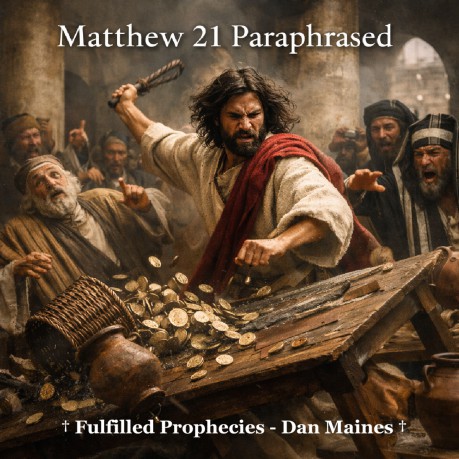
Jesus entered the temple and drove out those who
were buying and selling there and overturned the tables of the money
changers.
† The temple had become a place of
commercial profit.
† Money changers exchanged
currency for temple offerings.
† The system
was often abused by corrupt leadership.
†
Jesus exposed the corruption of the temple system.
Matthew
21:13
He told them God's house was meant to be a house
of prayer but they had turned it into a den of robbers.
†
Jesus quoted Isaiah 56:7.
† He also echoed
Jeremiah 7:11.
† The prophets had long
condemned corruption in Israel's worship.
†
Jesus stood in the tradition of the prophets.
Matthew
21:14
The blind and the lame came to Him in the temple
and He healed them.
† Even while confronting
corruption Jesus showed compassion.
† The
miracles confirmed His authority (Isaiah 35:5-6).
†
The temple became a place of restoration through Christ.
†
The healing demonstrated the power of the Messiah.
Matthew
21:15
When the chief priests and scribes saw the
miracles and heard children shouting Hosanna to the Son of David they
became angry.
† The leaders feared losing
their authority.
† The recognition of Jesus
as Messiah threatened their control.
†
Jealousy blinded them to the truth.
† Their
reaction revealed hardened hearts.
Matthew 21:16
Jesus
replied that Scripture says praise will come from the mouths of
children and infants.
† He quoted Psalm
8:2.
† Children recognized what leaders
rejected.
† God often reveals truth to the
humble.
† The praise of children exposed the
blindness of the rulers.
Matthew 21:17
Jesus
left the city and went to Bethany where He spent the night.
†
Bethany was the home of Lazarus, Mary, and Martha (John 11:1).
†
The village was located on the eastern slope of the Mount of
Olives.
† Jesus often stayed there during His
final week.
† It provided a place of rest
away from the hostile leadership in Jerusalem.
Matthew
21:18
Now in the morning when He was returning to the
city, He became hungry.
† This simple detail
shows the genuine humanity of Jesus.
† The
event introduces the lesson of the fig tree that immediately
follows.
† The location is still near
Jerusalem during the final week.
† What
happens next becomes a living parable about Israel.
Matthew
21:19
Seeing a fig tree by the road, He went to it but
found nothing on it except leaves. He said that no fruit would ever
come from it again, and immediately the fig tree withered.
†
The fig tree often symbolized Israel in the Scriptures (Hosea 9:10;
Jeremiah 8:13).
† The leaves represented
outward religion without true fruit.
† The
withering illustrated the coming judgment on unfruitful Israel.
†
The act served as a prophetic sign of the fate awaiting
Jerusalem.
Matthew 21:20
When the
disciples saw this they were amazed and asked how the fig tree
withered so quickly.
† The disciples
recognized the miracle but had not yet understood its deeper
meaning.
† Jesus used the moment to teach
them about faith and authority.
† The miracle
was both a sign and a lesson.
† The event
illustrated the seriousness of spiritual fruitlessness.
Matthew
21:21
Jesus told them that if they had faith and did
not doubt, they could do what had been done to the fig tree and even
say to a mountain to be removed and cast into the sea.
†
The mountain imagery reflects prophetic language often used for
kingdoms and powers (Isaiah 40:4).
† Faith
connects believers with the authority of God.
†
Jesus emphasized confidence in God's power.
†
The disciples would soon need this faith in the years ahead.
Matthew
21:22
He said that whatever they asked in prayer
believing they would receive.
† Prayer was
tied to trust in God's will and power.
† The
statement emphasized dependence on God rather than human strength.
†
Faith and prayer were essential for the mission of the disciples.
†
The promise encouraged them during difficult times.
Matthew
21:23
When Jesus entered the temple again the chief
priests and elders questioned His authority and asked who gave Him
the right to do these things.
† The leaders
were threatened by the authority Jesus displayed.
†
Their question revealed their refusal to accept Him as Messiah.
†
They were protecting their religious and political power.
†
The confrontation between Jesus and the leadership
intensified.
Matthew 21:24
Jesus answered
by asking them a question about the authority of John the Baptist.
†
Jesus exposed their unwillingness to answer truthfully.
†
John had prepared the way for the Messiah.
†
Their response would reveal their true motives.
†
The question placed them in a difficult position.
Matthew
21:25
They debated among themselves because admitting
John's authority came from heaven would condemn their own unbelief.
†
Their concern was not truth but reputation.
†
They feared losing credibility before the people.
†
Their reasoning was political rather than spiritual.
†
Their hearts were hardened.
Matthew 21:26
They
also feared the crowd because the people believed John was a
prophet.
† Public opinion controlled their
actions.
† The leaders were more concerned
with popularity than truth.
† Fear of the
people prevented them from answering honestly.
†
Their authority was built on influence rather than
righteousness.
Matthew 21:27
They said
they did not know, and Jesus told them He would not answer their
question either.
† Their dishonest response
exposed their hypocrisy.
† Because they
rejected John's authority they could not recognize Christ's
authority.
† Jesus refused to play their
political game.
† The exchange revealed the
spiritual blindness of Israel's leadership.
Matthew
21:28
Jesus then asked them about a man who had two
sons and told the first son to work in the vineyard.
†
This parable illustrated the difference between words and actions.
†
The vineyard again symbolizes Israel (Isaiah 5:1-7).
†
Jesus used simple stories to expose deeper truths.
†
The parable directly challenged the leaders.
Matthew
21:29
The first son refused at first but later changed
his mind and went to work.
† This represents
sinners who later repented.
† Repentance
matters more than initial resistance.
† Many
who were considered outsiders responded to the message of John and
Jesus.
† Their obedience revealed genuine
change.
Matthew 21:30
The second son said
he would go but never did.
† This represents
religious leaders who claimed obedience but rejected God.
†
Their words sounded righteous but their actions proved otherwise.
†
Hypocrisy defined their response to God's call.
†
Their outward religion lacked genuine obedience.
Matthew
21:31
Jesus asked which son did the will of the father,
and they answered that the first one did.
†
Their answer condemned their own behavior.
†
Jesus explained that tax collectors and prostitutes were entering the
kingdom before them.
† Repentant sinners
responded to the message of God.
† The
leaders refused to believe.
Matthew 21:32
John
came in the way of righteousness and they did not believe him, but
sinners believed.
† The ministry of John the
Baptist exposed the hearts of the nation.
†
Many sinners repented when they heard his message.
†
The religious leaders remained hardened.
†
Their refusal continued even after seeing others repent.
Matthew
21:33
Jesus told another parable about a landowner who
planted a vineyard and rented it to tenants.
†
The vineyard imagery again points to Israel (Isaiah 5:1-7).
†
The landowner represents God.
† The tenants
represent the leaders of Israel.
† The story
describes Israel's history with God's messengers.
Matthew
21:34
When harvest time came the owner sent servants to
collect the fruit.
† The servants represent
the prophets.
† God repeatedly sent
messengers to Israel.
† The expectation was
for righteousness and faithfulness.
† The
prophets came calling the nation back to obedience.
Matthew
21:35
The tenants seized the servants and beat one,
killed another, and stoned another.
† This
reflects the history of Israel rejecting the prophets.
†
Many prophets were persecuted or killed (2 Chronicles 36:15-16).
†
The leaders consistently resisted God's warnings.
†
The pattern continued generation after generation.
Matthew
21:36
The owner sent more servants and they were
treated the same way.
† God's patience with
Israel lasted many centuries.
† The repeated
rejection revealed the hardness of the nation's leadership.
†
Yet God continued sending messengers.
† His
patience demonstrated mercy.
Matthew 21:37
Finally
the owner sent his son thinking they would respect him.
†
The son represents Jesus Christ.
† God sent
His Son after generations of rejected prophets.
†
This moment describes the climax of the story.
†
The coming crucifixion is foreshadowed.
Matthew
21:38
The tenants plotted to kill the son so they could
take the inheritance.
† This reveals the
intentions of the religious leadership.
†
They desired power and control.
† The parable
mirrors the plot forming against Jesus.
†
Their rejection of the Son was deliberate.
Matthew
21:39
They seized him, threw him out of the vineyard,
and killed him.
† Jesus would soon be
crucified outside the city walls.
† The
parable closely parallels the events that were about to happen.
†
The rejection of the Son sealed the fate of the leadership.
†
The story revealed their coming guilt.
Matthew
21:40
Jesus asked what the owner would do to those
tenants.
† The question forced the leaders to
pronounce judgment on themselves.
† Jesus
often used questions to reveal truth.
† Their
response would expose the justice of God's judgment.
†
The parable reached its conclusion.
Matthew 21:41
They
said the owner would destroy those wicked men and give the vineyard
to others who would produce fruit.
† Their
own answer predicted the outcome.
† The
kingdom privileges would be transferred.
†
God expected fruit from those entrusted with responsibility.
†
Failure to produce fruit led to judgment.
Matthew
21:42
Jesus quoted Scripture about the stone rejected
by the builders becoming the cornerstone.
†
This quote comes from Psalm 118:22.
† The
rejected stone represents Christ.
† Though
rejected by leaders He became the foundation.
†
God's plan could not be stopped.
Matthew 21:43
Jesus
said the kingdom of God would be taken from them and given to a
people producing its fruit.
† The corrupt
leadership of Israel would lose their privilege.
†
The kingdom would extend beyond the boundaries of national Israel.
†
Fruitfulness became the requirement.
† This
statement pointed forward to the expanding church.
Matthew
21:44
Whoever fell on that stone would be broken, but
whoever it fell on would be crushed.
† Christ
is either the foundation of salvation or the stone of judgment.
†
The imagery comes from Isaiah 8:14-15.
†
Acceptance of Christ brings life.
† Rejection
leads to destruction.
Matthew 21:45
The
chief priests and Pharisees realized that Jesus was speaking about
them.
† The meaning of the parable was
unmistakable.
† They understood the
accusation.
† Their hearts grew even
harder.
† The conflict intensified.
Matthew
21:46
They wanted to arrest Him but feared the crowds
because the people believed He was a prophet.
†
Public opinion delayed their plans.
† The
leaders acted out of fear rather than conviction.
†
The arrest of Jesus would soon follow.
†
Their rejection of Him set the stage for the events leading to the
cross.
Historical References
†
Josephus described the corruption and political struggle among the
priesthood in the first century.
† Tacitus
wrote about the unrest throughout Judea before the destruction of
Jerusalem.
† Eusebius later recorded how
early Christians remembered the warnings Jesus gave about the coming
judgment on the city.
How It Applies To Us Today
†
Outward religion without true obedience produces no fruit.
†
Genuine repentance matters more than reputation or status.
†
Christ must be accepted as the cornerstone of our lives.
†
Rejecting the truth leads to spiritual ruin.
Q & A
Appendex
Q What did the fig tree
represent?
A It symbolized unfruitful Israel
facing covenant judgment (Hosea 9:10; Matthew 21:19).
Q
Why did Jesus cleanse the temple?
A Because the
temple system had been corrupted by the leadership (Isaiah 56:7;
Jeremiah 7:11; Matthew 21:13).
Q What does the
vineyard parable represent?
A It describes
Israel rejecting the prophets and ultimately rejecting the Son
(Matthew 21:33-39; Isaiah 5:1-7).
Q Why did
Jesus choose to enter Jerusalem publicly at this time?
A
The timing was connected with Passover, when Jerusalem was filled
with people from all over Israel. This ensured that the prophetic
entry of the Messiah would be widely witnessed (Zechariah 9:9;
Matthew 21:4-5; John 12:12-13).
Q Why were palm
branches used by the crowd?
A Palm branches
were symbols of victory and celebration in Jewish culture. By
spreading branches and shouting Hosanna, the people were expressing
their expectation that the Messiah had arrived (Psalm 118:25-26;
Matthew 21:8-9).
Q Why did Jesus allow the
people to call Him the Son of David?
A Son of
David was a recognized Messianic title tied to the covenant promise
that a descendant of David would rule God's kingdom (2 Samuel
7:12-16; Matthew 21:9; Luke 1:32-33).
Q Why did
the religious leaders react with anger when children praised Jesus?
A
Their authority was being challenged. The recognition of Jesus as
Messiah threatened their position and influence over the people
(Matthew 21:15; John 11:47-48).
Q Why did Jesus
curse the fig tree instead of simply ignoring it?
A
The fig tree served as a prophetic sign. Just as the tree appeared
healthy but had no fruit, Israel's religious system looked impressive
outwardly but lacked true righteousness (Jeremiah 8:13; Hosea 9:10;
Matthew 21:19).
Q What did Jesus mean when He
spoke about moving a mountain?
A Mountain
imagery was often used in Scripture to represent kingdoms or major
obstacles. Jesus was teaching that faith in God allows believers to
overcome barriers that appear impossible (Isaiah 40:4; Matthew 17:20;
Matthew 21:21).
Q Why did Jesus refuse to
answer the leaders about His authority?
A Their
question was not sincere. They had already rejected the authority of
John the Baptist, who testified about Jesus, so answering them
directly would have accomplished nothing (Matthew 21:24-27; John
5:33-36).
Q Why did Jesus say tax collectors
and prostitutes were entering the kingdom ahead of the religious
leaders?
A Many sinners repented when they
heard the message of John and Jesus, while the religious leaders
refused to believe despite seeing the same evidence (Matthew
21:31-32; Luke 7:29-30).
Q What is the meaning
of the vineyard in the parable?
A The vineyard
represents Israel. The imagery comes from Isaiah where Israel is
described as God's vineyard that failed to produce good fruit (Isaiah
5:1-7; Matthew 21:33).
Q Who are the servants
sent by the vineyard owner?
A The servants
represent the prophets whom God sent throughout Israel's history.
Many were rejected, persecuted, or killed by the leaders of the
nation (2 Chronicles 36:15-16; Matthew 21:34-36).
Q
Who is the son in the vineyard parable?
A The
son represents Jesus Christ, whom God sent after generations of
rejected prophets (Matthew 21:37-39; Hebrews 1:1-2).
Q
What does the rejected stone becoming the cornerstone mean?
A
It means that although the leaders rejected Jesus, He became the
foundation of God's kingdom. This prophecy comes from Psalm 118:22
and is applied directly to Christ (Psalm 118:22; Matthew 21:42; Acts
4:11).
Q What does it mean that the kingdom
would be taken from them and given to another people?
A
Jesus was referring to the loss of kingdom privilege by the corrupt
leadership of Israel and the expansion of God's kingdom to those who
would bear its fruit (Matthew 21:43; Romans 9:30-31; 1 Peter 2:9).
Q
Why didn't the leaders arrest Jesus immediately?
A
They feared the reaction of the crowd because many people believed
Jesus was a prophet. Their fear of public opinion delayed their
actions (Matthew 21:46; Luke 20:19).
Q How does
this chapter point toward the coming judgment on Jerusalem?
A
The withered fig tree, the cleansing of the temple, and the vineyard
parable all pointed toward the coming judgment against the corrupt
leadership of Israel that would culminate in the destruction of
Jerusalem (Matthew 21:19; Matthew 21:43; Matthew 24:1-2).
†
This is the fulfilled perspective we proclaim at Fulfilled Prophecies
†
© Fulfilled Prophecies - Dan Maines.
Source
Index
† Matthew 21; Zechariah 9:9;
Psalm 118:22, 26; Isaiah 5:1-7; Isaiah 8:14-15; Isaiah 56:7; Jeremiah
7:11; Hosea 9:10; 2 Samuel 7:12-16
†
Josephus, Antiquities of the Jews; Tacitus, Histories; Eusebius,
Ecclesiastical History
Links