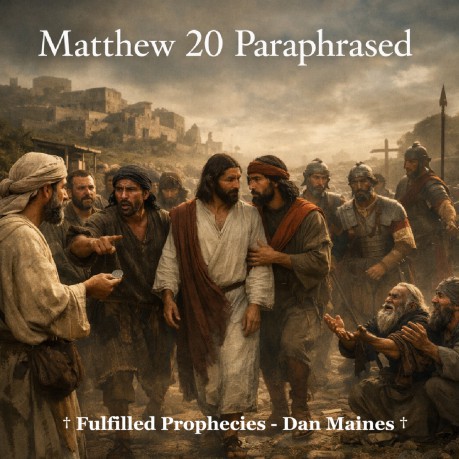
Matthew 20 Paraphrased Introduction Matthew 20:1 Matthew 20:2 Matthew 20:3 Matthew 20:4 Matthew 20:5 Matthew 20:6 Matthew 20:7 Matthew 20:8 Matthew 20:9 Matthew 20:10 Matthew 20:11 Matthew 20:12 Matthew 20:13 Matthew 20:14 Matthew 20:15 Matthew 20:16 Matthew 20:17 Matthew 20:18 Matthew 20:19 Matthew 20:20 Matthew 20:21 Matthew 20:22 Matthew 20:23 Matthew 20:24 Matthew 20:25 Matthew 20:26 Matthew 20:27 Matthew 20:28 Matthew 20:29 Matthew 20:30 Matthew 20:31 Matthew 20:32 Matthew 20:33 Matthew 20:34 Historical References How It Applies To Us Today Q & A Appendix Q Why did Jesus say the last will be first and
the first last? Q What does the denarius represent in the
parable? Q Why were the first workers upset if they
received what was promised? Q What does the vineyard represent in the
parable? Q Why did Jesus predict His death several times
to the disciples? Q What did Jesus mean by drinking the cup? Q Why did the other disciples become angry with
James and John? Q What lesson was Jesus teaching about
leadership? Q Why did the blind men call Jesus Son of
David? Q Why did Jesus heal the blind men at the end of
the chapter? † This is the fulfilled perspective we proclaim at
Fulfilled Prophecies † Source Index
By Dan Maines
† Matthew 20
continues Jesus' teaching that the kingdom of heaven does not operate
by human rank or seniority, but by the generosity of God (Matthew
19:30).
† The parable of the vineyard workers
shows that God's grace is given according to His will rather than
human comparison (Romans 9:15-16).
† Jesus
also again prepares His disciples for His coming suffering and death
in Jerusalem, revealing that the kingdom would come through sacrifice
rather than earthly power (Matthew 16:21; Matthew 17:22-23).
†
The chapter closes with the healing of blind men who recognize Jesus
as the Son of David, showing that faith often appears among those
others overlook (Matthew 15:14).
For the kingdom of heaven is
like a landowner who went out early in the morning to hire laborers
for his vineyard.
† Vineyards were a common
symbol of Israel in the prophets (Isaiah 5:1-7).
†
The landowner represents God calling people into His covenant work
(Matthew 21:33).
† Jesus begins the parable
by establishing that the kingdom operates under God's authority
rather than human expectation (Daniel 7:13-14).
When he had agreed with the
laborers for a denarius for the day, he sent them into his
vineyard.
† A denarius was the normal daily
wage for laborers in the Roman world (Matthew 22:19).
†
The agreement shows fairness from the beginning.
†
The tension later arises from comparison among workers rather than
injustice.
And he went out about the third
hour and saw others standing idle in the marketplace.
†
The third hour corresponds to about 9 AM in Jewish timekeeping.
†
Day laborers gathered in marketplaces hoping to be hired.
†
The landowner's repeated return shows continued invitation (Isaiah
55:1).
And to those he said, You also
go into the vineyard, and whatever is right I will give you. And so
they went.
† These workers trusted the
landowner to determine what was fair.
† Faith
trusts God's righteousness rather than demanding guarantees (Hebrews
11:6).
† Jesus highlights trust rather than
calculation.
Again he went out about the
sixth and the ninth hour, and did the same thing.
†
The sixth hour would be noon and the ninth hour about 3 PM.
†
The continued hiring emphasizes the ongoing invitation of the
kingdom.
† The gospel message continued
throughout that covenant generation (Matthew 23:36).
And about the eleventh hour he
went out and found others standing around, and he said to them, Why
have you been standing here idle all day long?
†
The eleventh hour would be about 5 PM near the end of the workday.
†
The parable emphasizes the generosity of the landowner who still
seeks workers late in the day.
† God's grace
reaches people even near the close of the covenant age (Hebrews
8:13).
They said to him, Because no
one hired us. He said to them, You go into the vineyard too.
†
These workers had not been rejected, they simply had not yet been
called.
† The invitation remained open until
the close of the day.
† This reflects the
widening proclamation of the gospel (Acts 13:46).
When evening came, the owner of
the vineyard said to his foreman, Call the laborers and pay them
their wages, beginning with the last group to the first.
†
Evening represents the time of accounting and reward.
†
The reversed order prepares the audience for the lesson of the
parable.
† This mirrors Jesus' statement
about the last being first (Matthew 19:30).
When those hired about the
eleventh hour came, each one received a denarius.
†
The last workers receive a full wage despite working only a short
time.
† The point is generosity rather than
strict calculation.
† God's grace exceeds
human expectations (Romans 6:23).
When those hired first came,
they thought that they would receive more, but each of them also
received a denarius.
† Their expectation came
from comparison with others.
† Comparison
often produces entitlement.
† Jesus exposes
the mindset common among religious leaders (Luke 18:11-14).
When they received it, they
grumbled at the landowner.
† Their complaint
reveals resentment rather than injustice.
†
They received exactly what was promised.
†
This mirrors the reaction of those who resented Jesus welcoming
sinners (Luke 15:2).
saying, These last men have
worked only one hour, and you have made them equal to us who have
borne the burden and the scorching heat of the day.
†
Equality offended their sense of hierarchy.
†
Human pride struggles with equal grace.
†
Jesus challenges the idea that effort earns superiority (Romans
3:27).
But he answered and said to
one of them, Friend, I am doing you no wrong, did you not agree with
me for a denarius?
† The landowner reminds
them that justice has not been violated.
†
Their complaint reveals envy rather than fairness.
†
God's generosity never contradicts His justice (Numbers 23:19).
Take what is yours and go, but
I wish to give to this last man the same as to you.
†
The landowner exercises his authority to be generous.
†
Grace is determined by the giver rather than the recipient.
†
This anticipates the later inclusion of Gentiles (Acts 10:34-35).
Is it not lawful for me to do
what I wish with what is my own? Or is your eye envious because I am
generous?
† The question exposes jealousy as
the real issue.
† God's goodness toward
others often reveals selfishness in the heart.
†
Jesus repeatedly confronted this attitude among the Pharisees
(Matthew 23:13).
So the last shall be first,
and the first last.
† This summarizes the
lesson of the parable.
† The kingdom reverses
human expectations of rank and privilege.
†
Many outsiders would enter the kingdom while many insiders rejected
it (Romans 11:17).
As Jesus was about to go up to
Jerusalem, He took the twelve disciples aside by themselves, and on
the way He said to them.
† Jesus prepares the
disciples again for the events that will occur in Jerusalem (Matthew
16:21).
† This is the third clear prediction
of His suffering.
† The disciples still
expected a political kingdom (Luke 24:21).
Behold, we are going up to
Jerusalem, and the Son of Man will be delivered to the chief priests
and scribes, and they will condemn Him to death.
†
Jesus clearly predicts His betrayal and condemnation.
†
The title Son of Man connects to Daniel's prophecy of authority
(Daniel 7:13-14).
† Israel's leadership would
reject their Messiah (Acts 2:23).
and will hand Him over to the
Gentiles to mock and scourge and crucify Him, and on the third day He
will be raised up.
† Jesus describes the
crucifixion in advance.
† The Gentiles refers
to Roman authorities carrying out the execution.
†
The resurrection confirms His victory over death (Acts 2:24).
Then the mother of the sons of
Zebedee came to Jesus with her sons, bowing down and making a request
of Him.
† Immediately after predicting
suffering, a request for status appears.
†
This shows the disciples still misunderstood the nature of the
kingdom.
† Many expected positions of honor
in a restored rule.
And He said to her, What do
you wish? She said to Him, Command that in Your kingdom these two
sons of mine may sit one on Your right and one on Your left.
†
Sitting at the right and left symbolized honor in royal courts.
†
The request reflects earthly thinking about the kingdom.
†
Jesus will redefine greatness through service.
But Jesus answered, You do not
know what you are asking. Are you able to drink the cup that I am
about to drink? They said to Him, We are able.
†
The cup represents suffering and sacrifice (Isaiah 51:17).
†
The disciples answered confidently without understanding the cost.
†
Following Christ includes hardship (Acts 14:22).
He said to them, My cup you
shall drink, but to sit on My right and on My left, this is not Mine
to give, but it is for those for whom it has been prepared by My
Father.
† Jesus confirms they will share in
suffering.
† Leadership in the kingdom is
determined by God's purpose.
† Several
apostles later faced persecution (Acts 12:2).
And hearing this, the ten
became indignant with the two brothers.
†
Their reaction shows they also desired status.
†
The conflict reveals human ambition.
† Jesus
now teaches true leadership.
But Jesus called them to
Himself and said, You know that the rulers of the Gentiles domineer
over them, and their great men exercise authority over them.
†
Jesus contrasts worldly leadership with kingdom leadership.
†
Earthly systems rely on dominance.
† The
kingdom operates differently (Philippians 2:5-7).
It is not this way among you,
but whoever wishes to become great among you shall be your servant.
†
True greatness is measured by service.
†
Jesus reverses worldly definitions of leadership.
†
This reflects Christ's example (John 13:14-15).
and whoever wishes to be first
among you shall be your slave.
† The highest
position is defined by humility.
† Kingdom
authority grows through sacrifice.
† This
principle shaped early Christian leadership.
just as the Son of Man did not
come to be served, but to serve, and to give His life a ransom for
many.
† Jesus presents Himself as the model
of servant leadership.
† His mission
culminates in sacrificial death.
† This
fulfills the suffering servant prophecy (Isaiah 53:10-12).
As they were leaving Jericho,
a large crowd followed Him.
† Jericho was one
of the final stops before Jerusalem.
† Crowds
followed Jesus because of His miracles and teaching.
†
Many believed the kingdom was near.
And two blind men sitting by
the road, hearing that Jesus was passing by, cried out, Lord, have
mercy on us, Son of David.
† Son of David is
a recognized Messianic title.
† These men
spiritually recognized what many leaders missed.
†
Faith often sees what pride cannot see (Matthew 16:16).
The crowd sternly told them to
be quiet, but they cried out all the more, Lord, Son of David, have
mercy on us!
† The crowd attempted to silence
them.
† Their persistence reveals genuine
faith.
† Faith continues even when
discouraged (Luke 18:1).
And Jesus stopped and called
them, and said, What do you want Me to do for you?
†
Jesus responds to sincere cries for mercy.
†
The question invites open expression of faith.
†
Christ often drew faith out through questions.
They said to Him, Lord, we
want our eyes to be opened.
† Their request
shows confidence in Jesus' authority.
†
Physical blindness becomes a symbol of spiritual sight.
†
Faith recognized the Messiah.
Moved with compassion, Jesus
touched their eyes, and immediately they regained their sight and
followed Him.
† Compassion is central to
Christ's ministry.
† The miracle demonstrates
His authority over blindness.
† Their
response shows true discipleship.
†
Josephus recorded strong messianic expectations among the Jewish
population during the first century (Wars of the Jews 6.5.4).
†
Justin Martyr taught that Christ's kingdom overturns worldly ideas of
rank and replaces them with humility (Dialogue with Trypho).
†
Irenaeus described Christ's kingdom as one defined by service rather
than domination (Against Heresies).
†
God's grace is not measured by human comparison. The kingdom operates
by generosity rather than competition (Romans 3:24).
†
True greatness in the kingdom comes through humility and service
rather than position or recognition (Mark 9:35).
†
Believers are called to rejoice when others receive grace rather than
resent it. Envy has no place in the kingdom of God (Romans 12:15).
†
The parable reminds us that God's call can come at different stages
of life, yet the reward of belonging to Christ is the same (Acts
2:21).
† The kingdom does not function like
worldly systems that reward status and power. Christ teaches that
leadership is demonstrated through serving others (Matthew
20:26-28).
† Followers of Christ must guard
their hearts against entitlement. Everything we receive from God
comes through grace rather than merit (Ephesians 2:8-9).
†
Jesus' prediction of His suffering reminds believers that God's
victory often comes through sacrifice rather than worldly success
(Philippians 2:8-9).
† The healing of the
blind men reminds us that spiritual sight begins with recognizing who
Jesus truly is (Matthew 16:16).
† Faith often
requires persistence even when others discourage us. The blind men
continued crying out until Jesus answered (Luke 18:1).
†
Christ's compassion toward the blind men shows that God is attentive
to those who call upon Him in faith (Psalm 34:17).
†
The chapter teaches believers to trust God's justice and generosity
rather than comparing our lives with others (Matthew 6:33).
†
Because Christ has established His kingdom, believers live with
confidence rather than fear about the future (Colossians 1:13).
A Jesus corrected the idea that
position or effort earns privilege in God's kingdom. The kingdom
operates by grace rather than human rank, Matthew 19:30; Romans 9:16.
A It represents the gracious reward of
participation in God's kingdom rather than wages earned by effort,
Ephesians 2:8-9.
A Their complaint
came from comparison and envy rather than injustice. Jesus exposes
the human tendency to measure ourselves against others instead of
trusting God's generosity, Luke 18:11-14; Romans 3:27.
A The vineyard commonly symbolizes
God's covenant people and His kingdom work, Isaiah 5:1-7; Matthew
21:33.
A Jesus showed that His death
was part of God's plan and not an unexpected tragedy. The Messiah
would suffer and then rise again according to prophecy, Isaiah
53:10-12; Acts 2:23-24.
A
The cup represents suffering and judgment. Jesus used it to describe
the suffering He would endure and the hardships His followers would
face, Isaiah 51:17; Acts 14:22.
A Their anger revealed that
they also desired status and authority. Jesus used the moment to
teach that greatness in His kingdom comes through service rather than
rank, Mark 9:35.
A Jesus showed that leadership in
God's kingdom is defined by humility and service, not by domination
or power, Matthew 20:26-28; John 13:14-15.
A Son of David was a recognized
Messianic title identifying Jesus as the promised king from David's
line, 2 Samuel 7:12-13; Matthew 22:42.
A Their healing demonstrated both
His compassion and His authority as the Messiah. It also illustrated
that true spiritual sight often appears among those others overlook,
Matthew 11:5; Matthew 15:14.
© Fulfilled Prophecies - Dan
Maines.
† Matthew
19:30; Isaiah 5:1-7; Matthew 21:33; Daniel 7:13-14; Matthew 22:19;
Isaiah 55:1; Hebrews 11:6; Matthew 23:36; Hebrews 8:13; Acts 13:46;
Romans 6:23; Luke 18:11-14; Luke 15:2; Romans 3:27; Numbers 23:19;
Acts 10:34-35; Matthew 23:13; Romans 11:17; Mark 9:35; Philippians
2:3
† Josephus, Wars of the Jews 6.5.4;
Justin Martyr, Dialogue with Trypho; Irenaeus, Against Heresies
Links