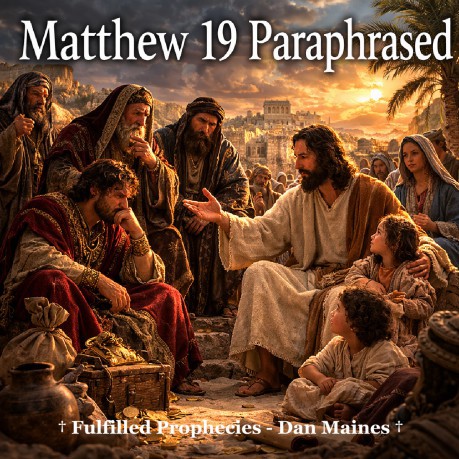
Matthew 19
Paraphrased
By Dan Maines
Introduction
†
Matthew 19 continues Jesus' public ministry as He moves closer to
Jerusalem, where the covenantal judgment on that generation would
soon unfold (Matthew 16:27-28; Matthew 24:34).
†
This chapter deals with marriage, divorce, children, wealth,
sacrifice, and reward, all spoken to real first century hearers
living under the fading Old Covenant order.
†
Jesus keeps exposing the heart, not just the outward act. The
Pharisees wanted legal loopholes, but Christ brought everything back
to God's original design.
† The rich young
ruler also shows that outward morality wasn't enough, because
whatever rules the heart will keep a man from following Christ fully
(Luke 14:33).
Matthew 19:1
Now when Jesus
had finished these words, He departed from Galilee and came into the
region of Judea beyond the Jordan.
† Matthew
often uses this wording to mark a transition from one major section
of teaching to the next (Matthew 7:28; Matthew 11:1).
†
Jesus is now moving closer to Judea and Jerusalem, where the final
confrontation with Israel's leaders would happen.
†
This journey matters because the things He had been warning about
would center in that land and city (Luke 21:20-22).
Matthew
19:2
And large crowds followed Him, and He healed them
there.
† The crowds followed because His
authority was undeniable, both in word and in power.
†
His healings were signs of the kingdom and evidence that the promised
Messiah had come (Isaiah 35:5-6).
† These
miracles showed that Israel was being visited by her King, yet many
still refused to believe (Luke 19:44).
Matthew 19:3
Some
Pharisees came to Jesus, testing Him and asking, Is it lawful for a
man to divorce his wife for any reason at all?
†
The Pharisees weren't seeking truth, they were testing Him.
†
Divorce had become a debated issue among Jewish teachers, and they
were trying to trap Jesus in that controversy.
†
Their question already shows a corrupted view of marriage, looking
for permission instead of asking what pleased God.
Matthew
19:4
And He answered and said, Have you not read that
He who created them from the beginning made them male and female,
†
Jesus goes straight back to creation, not later rabbinic arguments.
†
He reminds them that Scripture had already spoken clearly from the
beginning (Genesis 1:27).
† This is how
Christ handled error, He brought people back to the plain Word of
God.
Matthew 19:5
and said, For this
reason a man shall leave his father and mother and be joined to his
wife, and the two shall become one flesh?
†
Jesus quotes Genesis 2:24 to show God's original design for
marriage.
† Marriage is a covenant union, not
a temporary arrangement for personal convenience.
†
Becoming one flesh means this bond is real, sacred, and not to be
treated lightly.
Matthew 19:6
So they are
no longer two, but one flesh. Therefore what God has joined together,
no person is to separate.
† Christ makes the
point plain, marriage is not just man's arrangement, it is something
God joins together.
† Because God joins it,
man has no right to tear it apart for selfish reasons.
†
This rebuked the loose view of divorce that had spread among the
leaders.
Matthew 19:7
They said to Him,
Why then did Moses command to give her a certificate of divorce and
send her away?
† The Pharisees twisted the
law by calling a concession a command.
† They
were using Moses to defend hardness of heart.
†
This is what false teachers often do, they misuse Scripture to
protect sinful desires.
Matthew 19:8
He
said to them, Because of your hardness of heart Moses permitted you
to divorce your wives, but from the beginning it has not been this
way.
† Jesus explains that the divorce
allowance was a concession because of sin, not God's ideal.
†
Hardness of heart was the real issue, not a lack of technical legal
guidance.
† Christ keeps bringing them back
to the beginning because God's design had not changed.
Matthew
19:9
And I say to you, whoever divorces his wife,
except for sexual immorality, and marries another woman commits
adultery.
† Jesus restores the seriousness of
marriage and rejects the casual divorce culture of His day.
†
The exception He gives shows that covenant breaking through sexual
immorality is not the same as selfish separation.
†
This teaching exposed how far the leaders had drifted from God's
righteousness.
Matthew 19:10
The disciples
said to Him, If the relationship of the man with his wife is like
this, it is better not to marry.
† The
disciples understood that Jesus' standard was much stricter than the
common view around them.
† Their response
shows how deeply the culture had normalized easy divorce.
†
Christ's teaching forced them to see marriage as weighty and
covenantal.
Matthew 19:11
But He said to
them, Not all men can accept this statement, but only those to whom
it has been given.
† Jesus acknowledges that
not everyone is called to the same path.
†
Some are called to marriage, and some are given grace for
singleness.
† Both callings must be received
with humility and faithfulness.
Matthew 19:12
For
there are eunuchs who were born that way from their mother's womb,
and there are eunuchs who were made eunuchs by people, and there are
also eunuchs who made themselves eunuchs for the sake of the kingdom
of heaven. The one who is able to accept this, let him accept it.
†
Jesus describes different reasons a person may remain unmarried.
†
Some would willingly embrace singleness so they could serve the
kingdom without distraction.
† The focus is
not self denial for its own sake, but devotion to God's
purpose.
Matthew 19:13
Then some children
were brought to Him so that He might lay His hands on them and pray,
and the disciples rebuked them.
† The
disciples treated the children as if they were interruptions.
†
That exposed a worldly mindset, measuring importance by status.
†
Christ was about to show that the kingdom doesn't operate by that
kind of pride.
Matthew 19:14
But Jesus
said, Let the children alone, and do not forbid them to come to Me,
for the kingdom of heaven belongs to such as these.
†
Jesus welcomes the lowly and humble, not the proud and self
important.
† The point is not childishness,
but childlike dependence and trust.
† This
rebuked the disciples and showed what kind of heart belongs in the
kingdom.
Matthew 19:15
After laying His
hands on them, He departed from there.
†
Jesus didn't treat the children as unimportant, He blessed them.
†
His actions matched His words, showing compassion, dignity, and
care.
† This also showed that the kingdom
wasn't reserved for the elite.
Matthew 19:16
And
someone came to Him and said, Teacher, what good thing shall I do so
that I may obtain eternal life?
† This man
approached Jesus thinking eternal life could be secured by doing some
great work.
† His question reveals a works
centered mindset.
† Jesus will expose that
the problem wasn't lack of religious effort, but an unsubmitted
heart.
Matthew 19:17
And He said to him,
Why are you asking Me about what is good? There is only One who is
good, but if you want to enter life, keep the commandments.
†
Jesus directs the man to God's standard, not man's opinion.
†
The law reveals righteousness, but it also exposes sin (Romans
3:20).
† Christ is leading the man to see
that he has not truly fulfilled God's will as he imagined.
Matthew
19:18
Then he said to Him, Which ones? And Jesus said,
You shall not commit murder; You shall not commit adultery; You shall
not steal; You shall not give false testimony;
†
Jesus lists commandments dealing with human relationships.
†
This is where a man's heart is often revealed, in how he treats
others.
† The ruler still thought he was
doing well, but Christ wasn't finished yet.
Matthew
19:19
Honor your father and mother; and You shall love
your neighbor as yourself.
† Loving your
neighbor is not a small command, it sums up true covenant conduct
toward others.
† This exposes whether
obedience is real or just outward religion.
†
The man would soon learn that he did not love rightly because his
possessions ruled him.
Matthew 19:20
The
young man said to Him, All these things I have kept; what am I still
lacking?
† He believed he had kept the
commandments, yet his conscience told him something was missing.
†
Outward morality can give a false sense of spiritual security.
†
Jesus now touches the very thing the man would not surrender.
Matthew
19:21
Jesus said to him, If you want to be complete, go
and sell your possessions and give to the poor, and you will have
treasure in heaven, and come, follow Me.
†
Jesus doesn't give a universal command here for every person to sell
everything, He exposes this man's idol.
† His
wealth had become the rival lord of his heart.
†
True discipleship means Christ must come before comfort, security,
and possessions (Luke 14:33).
Matthew 19:22
But
when the young man heard this statement, he went away grieving, for
he was one who owned much property.
† He went
away sorrowful because he wanted eternal life without surrender.
†
His grief proved that his riches owned him more than he owned them.
†
Many in Israel did the same thing, they refused Christ because the
cost was too high.
Matthew 19:23
And Jesus
said to His disciples, Truly I say to you, it will be hard for a rich
person to enter the kingdom of heaven.
†
Riches can blind a person with self sufficiency and false peace.
†
The problem is not having money, the problem is trusting it.
†
That is why wealth becomes such a spiritual danger when it replaces
dependence on God.
Matthew 19:24
And again
I say to you, it is easier for a camel to go through the eye of a
needle, than for a rich person to enter the kingdom of God.
†
Jesus uses a vivid picture to show impossibility from a human
standpoint.
† Wealth can make repentance
harder because it strengthens pride and attachment to this world.
†
His point is not to entertain a riddle, but to shock them into seeing
how impossible salvation is by human strength.
Matthew
19:25
When the disciples heard this, they were very
astonished and said, Then who can be saved?
†
Many Jews connected wealth with God's favor, so this statement
overturned common assumptions.
† If even the
visibly blessed could not enter by their own standing, then nobody
could.
† The disciples were beginning to see
that salvation was not earned by status.
Matthew
19:26
And looking at them, Jesus said to them, With
people this is impossible, but with God all things are possible.
†
Salvation is impossible through human merit.
†
God alone can do what man cannot, change the heart and bring true
life.
† This destroys boasting and puts all
glory where it belongs, on God alone.
Matthew 19:27
Then
Peter responded and said to Him, Behold, we have left everything and
followed You; what then will there be for us?
†
Peter speaks for the disciples, who had truly left behind livelihood,
family security, and familiar life.
† This
wasn't pride so much as a question about the cost they had paid.
†
Jesus answers by assuring them that their sacrifice was not in
vain.
Matthew 19:28
And Jesus said to
them, Truly I say to you, that you who have followed Me, in the
regeneration when the Son of Man will sit on His glorious throne, you
also shall sit upon twelve thrones, judging the twelve tribes of
Israel.
† The regeneration speaks of
covenantal renewal, the transition from the old order into the new
through Christ's reign.
† The apostles would
have authority in the establishment of the new covenant people.
†
Judging the twelve tribes of Israel points to the judgment and
replacement of old covenant leadership, fulfilled in that first
century transition (Matthew 21:43; Matthew 23:36; Matthew
24:34).
Matthew 19:29
And everyone who has
left houses or brothers or sisters or father or mother or children or
farms for My name's sake, will receive many times as much, and will
inherit eternal life.
† Jesus extends the
promise beyond the apostles to all who truly sacrifice for Him.
†
What is lost for Christ is never truly lost, because He gives greater
reward in His kingdom.
† Eternal life belongs
to those who follow Him above all earthly ties.
Matthew
19:30
But many who are first will be last, and the
last, first.
† Those who seemed first in
Israel, the privileged, powerful, and religiously honored, would
often be last.
† Those counted small, weak,
and unworthy would enter ahead of them.
†
This reversal happened throughout the ministry of Christ and in the
early church as many outsiders entered while many covenant insiders
were cast out.
Historical References
†
Josephus describes the corruption, greed, and moral decay among the
Jewish leadership in the first century, which matches the kind of
hardness Jesus confronted.
† Eusebius records
the foundational role of the apostles in governing and establishing
the early church after Christ's ascension.
†
Irenaeus wrote of the apostolic authority handed down in the
churches, showing the importance of the twelve in the new covenant
order.
† These historical witnesses support
the setting of Matthew 19 as a real first century confrontation in
the closing days of the old covenant age.
How It Applies
To Us Today
† Marriage still matters
because God's design for covenant faithfulness has not changed.
†
A hard heart can still twist Scripture today just like it did in the
days of the Pharisees.
† Children remind us
that the kingdom belongs to the humble, not the self important.
†
Wealth is still one of the greatest rivals to full devotion to
Christ.
† We can't follow Jesus halfway,
whatever owns the heart must be surrendered to Him.
†
The Lord still turns human values upside down, what the world sees as
first is often last before God.
Q & A Appendix
Q
What was the Pharisees' real motive in asking about divorce?
A
They were testing Jesus, not honestly seeking truth. They wanted to
trap Him in a controversial issue and justify their loose view of
marriage (Matthew 19:3; Malachi 2:16).
Q Why
did Jesus go back to Genesis?
A Because God's
original design is the true standard. Christ corrected their abuse of
the law by bringing them back to creation itself (Matthew 19:4-6;
Genesis 1:27; Genesis 2:24).
Q Did Jesus teach
that wealth is always sinful?
A No. The problem
was not money itself, but trusting riches and refusing to surrender
everything to Christ (Matthew 19:21-24; Luke 14:33; 1 Timothy
6:17).
Q What does the regeneration mean in
Matthew 19:28?
A It points to the covenantal
renewal brought by Christ's reign, when the old order was judged and
the new covenant order was established, culminating in that first
century transition (Matthew 19:28; Matthew 21:43; Matthew 24:34).
Q
What does it mean that the apostles would judge the twelve tribes of
Israel?
A It means they would have covenantal
authority in the new covenant community and stand as witnesses
against unbelieving Israel in that generation (Matthew 19:28; Matthew
23:34-36; Ephesians 2:20).
† This is the fulfilled
perspective we proclaim at Fulfilled Prophecies †
©
Fulfilled Prophecies , Dan Maines.
Source Index
†
Matthew 19:1-30; Matthew 7:28; Matthew 11:1; Matthew 16:27-28;
Matthew 21:43; Matthew 23:34-36; Matthew 24:34; Luke 14:33; Luke
19:44; Luke 21:20-22; Genesis 1:27; Genesis 2:24; Isaiah 35:5-6;
Malachi 2:16; Romans 3:20; 1 Timothy 6:17; Ephesians 2:20
†
Josephus, Antiquities of the Jews; Josephus, The Jewish War;
Eusebius, Ecclesiastical History; Irenaeus, Against Heresies
Links