Matthew 18 Paraphrased Introduction Matthew 18:1 Matthew 18:2 Matthew 18:3 Matthew 18:4 Matthew 18:5 Matthew 18:6 Matthew 18:7 Matthew 18:8 Matthew 18:9 Matthew 18:10 Matthew 18:11 Matthew 18:12 Matthew 18:13 Matthew 18:14 Matthew 18:15 Matthew 18:16 Matthew 18:17 Matthew 18:18 Matthew 18:19 Matthew 18:20 Matthew 18:21 Matthew 18:22 Matthew 18:23 Matthew 18:24 Matthew 18:25 Matthew 18:26 Matthew 18:27 Matthew 18:28 Matthew 18:29 Matthew 18:30 Matthew 18:31 Matthew 18:32 Matthew 18:33 Matthew 18:34 Matthew 18:35 Historical References How It Applies To Us Today Q & A Appendix Q Why did Jesus use a child as the example of
greatness. Q Why did Jesus teach unlimited forgiveness. Q What is the purpose of confronting sin
privately first. Q Why did the disciples ask who was greatest in
the kingdom. Q What does becoming like a child mean in the
kingdom of heaven. Q What are stumbling blocks in Matthew 18. Q Did Jesus literally mean to cut off a hand or
tear out an eye. Q What does the parable of the lost sheep teach
in this chapter. Q Why did Jesus give instructions about
confronting a brother who sins. Q What does binding and loosing refer to in
Matthew 18:18. Q What does Jesus mean when He says where two or
three gather in His name He is there. Q Why did Peter suggest forgiving seven times. Q What is the main lesson of the unforgiving
servant parable. † This is the fulfilled perspective we proclaim at
Fulfilled Prophecies † Source Index
By Dan Maines
† Jesus
answers the disciples' question about greatness by teaching humility,
responsibility toward other believers, and the importance of
forgiveness (Matthew 18:1-4).
† The disciples
were still thinking about rank and authority in a visible kingdom,
but Jesus redirects their thinking toward humility and childlike
faith (Matthew 20:25-27).
† This chapter lays
out how the covenant community was to function as the kingdom message
spread before the judgment that came upon Jerusalem in their
generation (Matthew 23:34-36).
At that time the disciples came
to Jesus and said, Who then is greatest in the kingdom of heaven.
†
The disciples still expected positions of rank inside the kingdom
(Matthew 20:20-21).
† Jesus corrects this
mindset by showing that humility is the true measure of greatness
(Luke 14:11).
† Pride was one of the primary
reasons many in Israel rejected Christ (John 5:44).
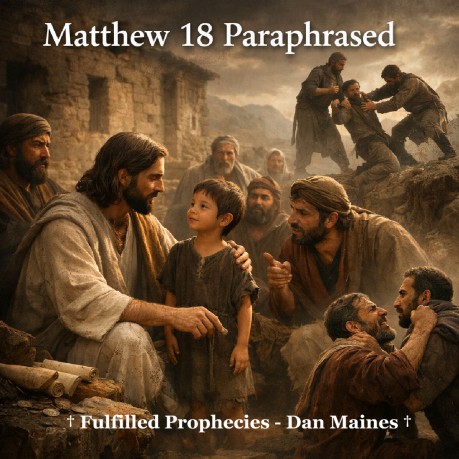
And He called a child to
Himself and set him before them.
† Jesus used
a real child as a living example to illustrate His teaching (Mark
9:36).
† In Jewish society children had
little social status, making the example powerful (Matthew
19:13-14).
† Christ often used simple
everyday examples to reveal deeper truth (Matthew 13:34).
and said, Truly I say to you,
unless you change and become like children, you will not enter the
kingdom of heaven.
† The call to change
refers to repentance and humility (Acts 3:19).
†
Entrance into the kingdom required humility rather than religious
pride (Matthew 5:3).
† Many leaders in Israel
refused this humility and rejected Christ (John 7:48).
Whoever then humbles himself as
this child, he is the greatest in the kingdom of heaven.
†
The kingdom reverses worldly standards of greatness (Luke 22:26).
†
Leadership in God's kingdom is measured by humility and service
(Matthew 23:11-12).
† The apostles later
taught this same principle to the early churches (1 Peter 5:5).
And whoever receives one such
child in My name receives Me.
† Receiving
humble believers is equal to receiving Christ Himself (Matthew
25:40).
† Jesus closely identifies Himself
with His followers (Acts 9:4).
† The kingdom
values those the world ignores (James 2:5).
but whoever causes one of these
little ones who believe in Me to stumble, it would be better for him
to have a heavy millstone hung around his neck, and to be drowned in
the depth of the sea.
† Jesus warns strongly
against leading believers into sin (Luke 17:1-2).
†
The image of a millstone shows the seriousness of the offense
(Matthew 23:15).
† Those who influence others
spiritually carry great responsibility (James 3:1).
Woe to the world because of its
stumbling blocks. For it is inevitable that stumbling blocks come,
but woe to that man through whom the stumbling block comes.
†
Sin exists in the world, but individuals are responsible for causing
others to fall (Romans 14:13).
† This warning
applied especially to corrupt religious leaders (Matthew 23:13).
†
Accountability before God remains certain.
If your hand or your foot
causes you to stumble, cut it off and throw it from you. It is better
for you to enter life crippled or lame, than to have two hands or two
feet and be cast into the eternal fire.
†
Jesus uses strong imagery to emphasize removing sin from one's life
(Matthew 5:29-30).
† Radical repentance
requires decisive action (Colossians 3:5).
†
Eternal consequences make obedience urgent.
If your eye causes you to
stumble, tear it out and throw it from you. It is better for you to
enter life with one eye, than to have two eyes and be cast into the
fiery hell.
† Christ continues emphasizing
the seriousness of sin (Romans 8:13).
†
Eternal life must be valued above temporary desires (Matthew
16:26).
† Judgment awaits those who refuse
repentance (Hebrews 10:26-27).
See that you do not despise
one of these little ones, for I say to you that their angels in
heaven continually see the face of My Father who is in heaven.
†
God places high value on humble believers (Luke 15:7).
†
Angels are described as serving and protecting God's people (Psalm
34:7).
† Even the least respected on earth
are valued by God.
For the Son of Man has come to
save that which was lost.
† This statement
summarizes Christ's mission (Luke 19:10).
†
Jesus came to restore those separated from God (John 3:17).
†
His ministry focused especially on the lost sheep of Israel (Matthew
15:24).
What do you think. If any man
has a hundred sheep, and one of them has gone astray, does he not
leave the ninety nine on the mountains and go and search for the one
that is straying.
† Shepherd imagery was
common in Israel and understood by the audience (Psalm 23:1).
†
God seeks those who wander from Him (Ezekiel 34:11).
†
Every individual matters to God.
If it turns out that he finds
it, truly I say to you, he rejoices over it more than over the ninety
nine which have not gone astray.
† Heaven
rejoices when someone returns to God (Luke 15:7).
†
Restoration produces joy rather than condemnation (Micah 7:18).
†
God's mercy is central to the gospel.
So it is not the will of your
Father who is in heaven that one of these little ones perish.
†
God desires salvation and preservation of His people (John 6:39).
†
Christ's mission is rooted in redemption (Isaiah 53:6).
†
The kingdom seeks restoration of the lost.
If your brother sins, go and
show him his fault in private. If he listens to you, you have gained
your brother.
† Jesus establishes the first
step of reconciliation (Galatians 6:1).
† The
goal is restoration, not humiliation (James 5:19-20).
†
Unity must be preserved within the covenant community (Ephesians
4:3).
But if he does not listen to
you, take one or two more with you, so that by the mouth of two or
three witnesses every fact may be confirmed.
†
This follows the legal principle established in the Law of Moses
(Deuteronomy 19:15).
† Witnesses provide
fairness and accountability (2 Corinthians 13:1).
†
Truth and justice remain central in resolving conflict.
If he refuses to listen to
them, tell it to the church, and if he refuses to listen even to the
church, let him be to you as a Gentile and a tax collector.
†
Persistent rebellion leads to separation from the community (1
Corinthians 5:11-13).
† The goal remains
repentance and restoration (2 Thessalonians 3:14-15).
†
Christ establishes authority within the gathered body.
Truly I say to you, whatever
you bind on earth shall have been bound in heaven, and whatever you
loose on earth shall have been loosed in heaven.
†
This language refers to decisions of discipline and forgiveness
within the community (Matthew 16:19).
† The
apostles exercised this authority in the early church (John 20:23).
†
Heaven affirms decisions made according to Christ's teaching.
Again I say to you, that if
two of you agree on earth about anything that they may ask, it shall
be done for them by My Father who is in heaven.
†
The context is unity and reconciliation (Matthew 5:24).
†
Agreement among believers reflects harmony in the body of Christ
(Philippians 2:2).
† God answers prayer
aligned with His will (1 John 5:14).
For where two or three have
gathered together in My name, I am there in their midst.
†
Christ promises His presence among believers gathered in His name
(John 14:23).
† Even small gatherings have
authority and significance (Matthew 28:20).
†
The focus is unity under Christ's authority.
Then Peter came and said to
Him, Lord, how often shall my brother sin against me and I forgive
him. Up to seven times.
† Jewish tradition
often suggested forgiving three times, so Peter thought seven was
generous (Amos 1:3).
† Peter still viewed
forgiveness as limited.
† Jesus responds by
removing limits entirely.
Jesus said to him, I do not
say to you up to seven times, but up to seventy seven times.
†
Jesus teaches unlimited forgiveness (Colossians 3:13).
†
The number symbolizes continual mercy rather than literal counting.
†
Believers forgive because they have been forgiven.
For this reason the kingdom of
heaven may be compared to a king who wished to settle accounts with
his slaves.
† Jesus introduces a parable to
illustrate forgiveness (Matthew 13:34).
†
Settling accounts reflects divine judgment and mercy.
†
Parables reveal spiritual truth through familiar stories.
When he had begun to settle
them, one who owed him ten thousand talents was brought to him.
†
Ten thousand talents represents an enormous impossible debt.
†
The figure symbolizes the magnitude of human sin (Romans 3:23).
†
The audience would immediately recognize the impossibility of
repayment.
But since he did not have the
means to repay, his lord commanded him to be sold, along with his
wife and children and all that he had, and repayment to be made.
†
Debt slavery existed in the ancient world.
†
The servant's situation reflects the hopelessness of sin's debt.
†
Humanity cannot repay its debt apart from God's mercy (Ephesians
2:8-9).
So the slave fell to the
ground and prostrated himself before him, saying, Have patience with
me and I will repay you everything.
† The
servant begs for mercy.
† Repayment is
actually impossible.
† This mirrors
humanity's need for divine grace.
And the lord of that slave
felt compassion and released him and forgave him the debt.
†
The king's compassion reflects God's mercy (Micah 7:18).
†
Forgiveness cancels the impossible debt.
†
Christ's sacrifice ultimately made that forgiveness possible
(Colossians 2:13-14).
But that slave went out and
found one of his fellow slaves who owed him one hundred denarii, and
he seized him and began to choke him, saying, Pay back what you
owe.
† The second debt is extremely small by
comparison.
† The servant's behavior reveals
a lack of gratitude.
† Jesus exposes
hypocrisy.
So his fellow slave fell to
the ground and began to plead with him, saying, Have patience with me
and I will repay you.
† The same plea for
mercy is repeated.
† The situation mirrors
the earlier scene.
† The servant now has the
opportunity to show mercy.
But he was unwilling and went
and threw him in prison until he should pay back what was owed.
†
Unforgiveness exposes a hardened heart.
†
Mercy received must produce mercy given (Ephesians 4:32).
†
Jesus warns against hypocrisy among believers.
So when his fellow slaves saw
what had happened, they were deeply grieved and came and reported to
their lord all that had happened.
† The
community recognized the injustice.
†
Unforgiveness disrupts fellowship.
†
Accountability exists within the covenant community.
Then summoning him, his lord
said to him, You wicked slave, I forgave you all that debt because
you pleaded with me.
† The king exposes the
servant's hypocrisy.
† God's mercy should
transform how believers treat others.
†
Refusing mercy contradicts the grace received.
Should you not also have had
mercy on your fellow slave, in the same way that I had mercy on
you.
† Forgiven people must forgive others.
†
Mercy must be extended just as it was received (Luke 6:36).
†
This reflects the character of God.
And his lord moved with anger
handed him over to the torturers until he should repay all that was
owed him.
† Judgment follows persistent
unforgiveness.
† The parable emphasizes the
seriousness of rejecting mercy.
† God's
justice remains certain.
My heavenly Father will also
do the same to you, if each of you does not forgive his brother from
your heart.
† Jesus ends with a direct
warning.
† True forgiveness must come from
the heart (Mark 11:25).
† The kingdom
community must reflect God's mercy.
†
Josephus described severe debt laws and punishments in the first
century, illustrating the realism of Jesus' parable.
†
Tertullian wrote that Christ's teaching on forgiveness distinguished
Christians from surrounding cultures.
†
Clement of Alexandria emphasized humility and forgiveness as defining
marks of Christian character.
†
Humility remains the foundation of the believer's life.
†
Sin must be addressed with the goal of restoration.
†
Forgiveness is essential because we have received mercy from God.
A Because humility and dependence on
God define greatness in the kingdom (Matthew 18:3-4).
A
Because believers are called to reflect the mercy they have received
from God (Matthew 18:22).
A The goal is restoration and
unity within the covenant community (Matthew 18:15).
A They were still thinking about
rank and authority in a physical kingdom, but Jesus redirected them
to humility as the true measure of greatness (Matthew 18:1-4; Matthew
20:25-27).
A It means humility,
dependence on God, and a willingness to submit to His authority
rather than seeking personal status (Matthew 18:3-4; James 4:10).
A
Stumbling blocks are actions or teachings that lead believers into
sin or away from faithfulness to God (Matthew 18:6-7; Romans 14:13).
A No, He used strong imagery
to show that removing sin from our lives must be treated with extreme
seriousness (Matthew 18:8-9; Matthew 5:29-30).
A It shows that God values
every believer and seeks restoration when someone strays (Matthew
18:12-14; Luke 15:4-7).
A He was
establishing a process that protects unity while seeking restoration
of the one who has sinned (Matthew 18:15-17; Galatians 6:1).
A It refers to decisions
regarding forgiveness, discipline, and restoration within the
covenant community according to Christ's teaching (Matthew 18:18;
Matthew 16:19).
A Christ
promises His presence and authority among believers who gather
together in unity under His authority (Matthew 18:20; John 14:23).
A
Jewish tradition often suggested forgiving three times, so Peter
believed seven times would be generous (Matthew 18:21; Amos 1:3).
A Those who receive mercy from
God must extend that same mercy to others (Matthew 18:23-35;
Colossians 3:13).
© Fulfilled Prophecies - Dan
Maines.
† Matthew
18:1-35
† Josephus Antiquities of the Jews,
Tertullian Apology, Clement of Alexandria Stromata
Links