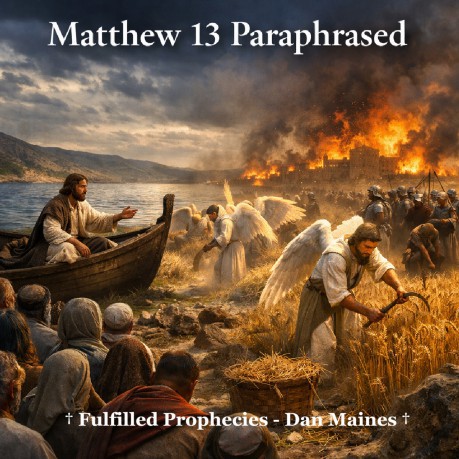
Matthew 13
Paraphrased
By Dan Maines
Introduction
†
Matthew 13 records a turning point in Jesus' ministry. From this
point forward he begins teaching the crowds in parables that reveal
the nature of the kingdom of heaven while exposing the blindness of
those rejecting him (Matthew 13:10-17).
† The
parables explain why many in Israel rejected the message while others
received it. The kingdom would grow quietly among the people until
the coming judgment that would separate the righteous from the wicked
(Matthew 13:39-43).
† Jesus was speaking
directly to the generation that would soon face covenant judgment.
The kingdom message was spreading throughout Israel before the
destruction that would come upon Jerusalem (Matthew 23:36; Matthew
24:34).
Matthew 13:1
That day Jesus went
out of the house and was sitting by the sea.
†
The Sea of Galilee was a common place where Jesus taught large crowds
because the shoreline created a natural gathering place (Mark 4:1).
†
The growing crowds show how widely the message of the kingdom was
spreading throughout Israel (Matthew 4:25).
†
This moment shows the public proclamation of the kingdom before the
coming judgment on that generation (Matthew 10:23).
Matthew
13:2
And large crowds gathered to Him, so He got into a
boat and sat down, and the whole crowd was standing on the beach.
†
Rabbis commonly sat while teaching, which showed authority and
instruction (Luke 5:3).
† The boat allowed
Jesus to speak clearly to the large crowd gathered along the shore.
†
The scene demonstrates how eager many were to hear his teaching even
though many would not accept its meaning (John 12:37).
Matthew
13:3
And He spoke many things to them in parables,
saying, Behold, the sower went out to sow.
†
A sower scattering seed was a familiar agricultural image in
Galilee.
† The seed represents the message of
the kingdom being spread throughout Israel (Luke 8:11).
†
The parable explains why people responded differently to the same
message.
Matthew 13:4
And as he sowed,
some seeds fell beside the road, and the birds came and ate them
up.
† The hardened path represents hearts
that refuse to receive the message (Matthew 13:19).
†
The birds symbolize the enemy removing truth before it takes root.
†
Many in Israel heard Jesus but rejected him immediately (John
1:11).
Matthew 13:5
Others fell on the
rocky places, where they did not have much soil, and immediately they
sprang up, because they had no depth of soil.
†
Rocky soil represents shallow belief without deep commitment (Matthew
13:20).
† Quick emotional responses often
fail when tested by hardship.
† Many
followers abandoned Jesus when his teaching became difficult (John
6:66).
Matthew 13:6
But when the sun had
risen, they were scorched, and because they had no root, they
withered away.
† The scorching sun represents
persecution or pressure (Matthew 13:21).
†
Faith that lacks roots cannot survive opposition.
†
Early believers experienced persecution as the gospel spread through
Israel (Acts 8:1).
Matthew 13:7
Others
fell among the thorns, and the thorns came up and choked them out.
†
Thorns represent the worries and distractions of the world (Matthew
13:22).
† Love of wealth and worldly concerns
often suffocate spiritual growth (Matthew 6:24).
†
Many religious leaders in Israel loved status and wealth more than
truth (Luke 16:14).
Matthew 13:8
And
others fell on the good soil and yielded a crop, some a hundredfold,
some sixty, and some thirty.
† Good soil
represents those who truly receive the message (Matthew 13:23).
†
The different yields show that fruitfulness varies among believers.
†
The gospel multiplied rapidly among receptive hearts in the first
century (Acts 6:7).
Matthew 13:9
The one
who has ears, let him hear.
† Jesus was
calling for spiritual understanding.
† Many
heard the words but refused the meaning.
†
True understanding requires humility before God.
Matthew
13:10
And the disciples came and said to Him, Why do
You speak to them in parables?
† The
disciples recognized that Jesus was intentionally teaching in
symbolic stories.
† They wanted to understand
the reason for this method.
† Jesus would
explain that parables both reveal and conceal truth.
Matthew
13:11
And Jesus answered them, To you it has been
granted to know the mysteries of the kingdom of heaven, but to them
it has not been granted.
† The mysteries
refer to truths about God's kingdom now being revealed (Ephesians
3:3-6).
† The disciples received
understanding because they followed Jesus.
†
Those rejecting him remained blind to the meaning.
Matthew
13:12
For whoever has, to him more shall be given, and
he will have an abundance, but whoever does not have, even what he
has shall be taken away from him.
† Those who
respond to truth gain deeper understanding.
†
Those who reject truth lose even the light they once had.
†
Israel's rejection of Christ resulted in the loss of covenant
privilege (Matthew 21:43).
Matthew 13:13
Therefore
I speak to them in parables, because while seeing they do not see,
and while hearing they do not hear, nor do they understand.
†
Israel's spiritual blindness prevented them from understanding the
message.
† Parables exposed the hardness of
their hearts.
† Their rejection fulfilled
prophetic warnings about the nation.
Matthew 13:14
And
in their case the prophecy of Isaiah is being fulfilled, which says,
You will keep on hearing, but will not understand, and you will keep
on seeing, but will not perceive.
† Jesus
applied Isaiah's prophecy directly to his generation.
†
Israel's leaders heard the truth yet refused to believe it.
†
Their rejection confirmed the prophetic warning of blindness (Isaiah
6:9-10).
Matthew 13:15
For the heart of
this people has become dull, with their ears they scarcely hear, and
they have closed their eyes, otherwise they would see with their
eyes, hear with their ears, understand with their heart and return,
and I would heal them.
† The problem was not
lack of evidence but hardened hearts.
†
Repentance would have brought restoration.
†
Israel's leadership hardened the nation against the Messiah.
Matthew
13:16
But blessed are your eyes because they see, and
your ears because they hear.
† The disciples
were witnessing the fulfillment of prophecy.
†
They saw the Messiah and the kingdom unfolding before them.
†
This was a privilege that earlier generations longed to see.
Matthew
13:17
For truly I say to you that many prophets and
righteous people longed to see what you see, and did not see it, and
to hear what you hear, and did not hear it.
†
Prophets spoke about the coming Messiah centuries earlier.
†
The disciples were living in the moment those prophecies were
fulfilled.
† The kingdom had arrived in their
generation.
Matthew 13:18
Hear then the
parable of the sower.
† Jesus now begins
explaining the meaning of the earlier story.
†
The explanation reveals the spiritual conditions of those hearing the
message.
† This interpretation shows that the
parable describes responses to the gospel.
Matthew
13:19
When anyone hears the word of the kingdom and
does not understand it, the evil one comes and snatches away what has
been sown in his heart. This is the one on whom seed was sown beside
the road.
† The hardened heart prevents truth
from taking root.
† The enemy quickly removes
the message from those who reject it.
† This
explains why some people hear the gospel but never respond.
Matthew
13:20
And the one on whom seed was sown on the rocky
places, this is the one who hears the word and immediately receives
it with joy.
† Emotional excitement can look
like genuine faith at first.
† Without strong
roots the faith will not endure trials.
†
Many temporary followers of Jesus eventually turned away.
Matthew
13:21
yet he has no firm root in himself, but is only
temporary, and when affliction or persecution arises because of the
word, immediately he falls away.
† Jesus
explains that shallow belief cannot survive suffering. When hardship
comes because of the message, temporary faith collapses (Matthew
10:22).
† Many in the first century believed
briefly but turned away when persecution began against the followers
of Christ (John 6:66).
† This shows the
difference between emotional excitement and true faith that endures
(James 1:12).
Matthew 13:22
And the one on
whom seed was sown among the thorns, this is the one who hears the
word, and the worry of the world and the deceitfulness of wealth
choke the word, and it becomes unfruitful.
†
Worldly anxiety and the pursuit of wealth often prevent spiritual
growth (Matthew 6:24-25).
† The Pharisees
were known for loving money while claiming to follow God (Luke
16:14).
† Jesus warns that devotion to
material things can suffocate the truth before it produces
fruit.
Matthew 13:23
And the one on whom
seed was sown on the good soil, this is the one who hears the word
and understands it, who indeed bears fruit and produces, some a
hundredfold, some sixty, and some thirty.
†
Good soil represents receptive hearts that truly receive the kingdom
message (Luke 8:15).
† Fruitfulness varies
among believers, but true faith always produces spiritual results
(John 15:5).
† The early church multiplied
rapidly because receptive hearts spread the gospel across the Roman
world (Acts 6:7).
Matthew 13:24
Jesus
presented another parable to them, saying, The kingdom of heaven may
be compared to a man who sowed good seed in his field.
†
This parable introduces another picture of the kingdom's growth and
conflict.
† The good seed represents those
belonging to the kingdom (Matthew 13:38).
†
The story prepares listeners to understand that evil will exist
alongside righteousness until judgment.
Matthew
13:25
But while his men were sleeping, his enemy came
and sowed weeds among the wheat, and left.
†
The enemy represents the devil working against the kingdom (Matthew
13:39).
† The weeds symbolize false followers
or corrupt influences among the people.
†
Jesus shows that opposition to the kingdom would arise even among
those claiming to belong to God's people.
Matthew
13:26
But when the wheat sprouted and bore grain, then
the weeds became evident also.
† At first the
difference between wheat and weeds may not appear obvious.
†
Over time the true nature of each becomes visible.
†
The same principle applies to spiritual fruit revealing genuine faith
(Galatians 5:22-23).
Matthew 13:27
And the
slaves of the landowner came and said to him, Sir, did you not sow
good seed in your field? How then does it have weeds?
†
The servants are confused because the field was originally planted
with good seed.
† Their question reflects the
common concern about why evil exists alongside good.
†
Jesus is preparing to explain the presence of false believers and
wicked influences.
Matthew 13:28
And he
said to them, An enemy has done this. The slaves said to him, Do you
want us, then, to go and gather them up?
†
The landowner identifies the enemy as the cause of the corruption.
†
The servants want to remove the weeds immediately.
†
This reflects the human desire to eliminate evil quickly without
understanding the consequences.
Matthew 13:29
But
he said, No, for while you are gathering up the weeds, you may uproot
the wheat with them.
† Premature judgment
could harm the faithful.
† The kingdom would
allow both the righteous and the wicked to exist together
temporarily.
† God's timing determines when
final separation will occur (Ecclesiastes 3:17).
Matthew
13:30
Allow both to grow together until the harvest,
and at the time of the harvest I will say to the reapers, First
gather up the weeds and bind them in bundles to burn them, but gather
the wheat into my barn.
† The harvest
represents a coming judgment where separation occurs (Matthew
13:39).
† In the fulfilled perspective, this
points to the covenant judgment that came upon Israel in that
generation.
† The righteous would be gathered
into the kingdom while the wicked would face destruction.
Matthew
13:31
He presented another parable to them, saying, The
kingdom of heaven is like a mustard seed, which a man took and sowed
in his field.
† The mustard seed was
extremely small yet capable of remarkable growth.
†
Jesus uses this image to show how the kingdom would begin quietly but
expand widely.
† The early church began with
a small group yet spread rapidly across the world (Acts 1:15; Acts
17:6).
Matthew 13:32
And this is smaller
than all other seeds, but when it is full grown, it is larger than
the garden plants and becomes a tree, so that the birds of the sky
come and nest in its branches.
† The dramatic
growth illustrates the expansion of God's kingdom.
†
The birds nesting in the branches symbolize the inclusion of the
nations (Ezekiel 17:23).
† What began as a
small movement among disciples would grow into a worldwide community
of believers.
Matthew 13:33
He spoke
another parable to them, The kingdom of heaven is like leaven, which
a woman took and hid in three measures of flour until it was all
leavened.
† Leaven spreads quietly but
completely through the dough.
† This
illustrates the hidden but powerful influence of the kingdom.
†
The gospel gradually transformed communities throughout the Roman
Empire (Colossians 1:6).
Matthew 13:34
All
these things Jesus spoke to the crowds in parables, and He did not
speak to them without a parable.
† Parables
became Jesus' primary method of public teaching during this period.
†
This approach revealed truth to sincere listeners while concealing it
from hardened hearts.
† The method fulfilled
prophetic expectations.
Matthew 13:35
This
was to fulfill what was spoken through the prophet: I will open My
mouth in parables, I will utter things hidden since the foundation of
the world.
† This prophecy comes from Psalm
78:2.
† Jesus revealed truths about the
kingdom that had been hidden for generations.
†
The Messiah was unveiling God's plan that had been unfolding since
the beginning.
Matthew 13:36
Then He left
the crowds and went into the house. And His disciples came to Him and
said, Explain to us the parable of the weeds of the field.
†
The disciples wanted a clearer explanation of the earlier story.
†
Private instruction allowed Jesus to reveal deeper meaning.
†
This moment shows the difference between the curious crowd and
committed followers.
Matthew 13:37
And He
said, The one who sows the good seed is the Son of Man.
†
Jesus identifies himself as the sower.
† The
Son of Man title connects to the prophecy of Daniel 7:13-14.
†
The kingdom message originates directly from Christ.
Matthew
13:38
And the field is the world, and as for the good
seed, these are the sons of the kingdom, and the weeds are the sons
of the evil one.
† The field represents the
broader world where the kingdom message spreads.
†
The good seed represents believers who belong to the kingdom.
†
The weeds represent those aligned with evil and opposed to God's
truth.
Matthew 13:39
and the enemy who
sowed them is the devil, and the harvest is the end of the age, and
the reapers are angels.
† The enemy is
clearly identified as the devil.
† The end of
the age refers to the close of the Old Covenant age that culminated
in the first century judgment (Matthew 24:3).
†
Angels act as agents carrying out God's judgment.
Matthew
13:40
So just as the weeds are gathered up and burned
with fire, so shall it be at the end of the age.
†
Jesus describes the final separation between the righteous and the
wicked.
† In the fulfilled perspective this
judgment corresponds to the destruction that came upon apostate
Israel.
† The imagery of fire represents
divine judgment against rebellion.
Matthew 13:41
The
Son of Man will send forth His angels, and they will gather out of
His kingdom all stumbling blocks, and those who commit lawlessness.
†
Jesus explains that a decisive separation would take place when the
Son of Man exercised judgment (Matthew 16:27-28).
†
Stumbling blocks refers to those who caused others to sin or who
opposed the truth of the kingdom (Matthew 18:7).
†
This gathering out points to the removal of corrupt leadership and
unbelief from among God's people during the covenant judgment that
came upon that generation (Matthew 23:36).
Matthew
13:42
and will throw them into the furnace of fire, in
that place there will be weeping and gnashing of teeth.
†
The furnace of fire is imagery used repeatedly by Jesus to describe
severe covenant judgment (Matthew 22:13).
†
Weeping and gnashing of teeth describes the anguish of those facing
the consequences of rejecting the Messiah (Luke 13:28).
†
In the fulfilled perspective this language reflects the devastating
judgment that fell upon Jerusalem in AD 70 (Matthew 24:21).
Matthew
13:43
Then the righteous will shine forth as the sun in
the kingdom of their Father. The one who has ears, let him hear.
†
This echoes Daniel 12:3 where the righteous shine like the brightness
of the heavens.
† The faithful would be
revealed openly as citizens of the kingdom after judgment removed the
corrupt system.
† Jesus again calls for
spiritual awareness, urging listeners to truly understand the
warning.
Matthew 13:44
The kingdom of
heaven is like a treasure hidden in the field, which a man found and
hid again, and from joy over it he goes and sells everything that he
has and buys that field.
† The kingdom is
portrayed as something so valuable that it surpasses all earthly
possessions (Philippians 3:8).
† The man
gladly sacrifices everything because he recognizes the incomparable
worth of what he found.
† Jesus is teaching
that entering the kingdom requires wholehearted commitment and
priority.
Matthew 13:45
Again, the kingdom
of heaven is like a merchant seeking fine pearls.
†
Merchants searched carefully for pearls of great value in the ancient
world.
† This picture represents someone
actively seeking truth and recognizing its worth.
†
The kingdom message draws those who sincerely search for God's wisdom
(Proverbs 2:4-5).
Matthew 13:46
and upon
finding one pearl of great value, he went and sold everything that he
had and bought it.
† The pearl represents the
priceless value of the kingdom.
† The
merchant's decision shows that gaining the kingdom outweighs all
other pursuits.
† True discipleship involves
surrendering everything for Christ (Luke 14:33).
Matthew
13:47
Again, the kingdom of heaven is like a dragnet
cast into the sea, and gathering fish of every kind.
†
The dragnet represents the wide reach of the gospel message.
†
The kingdom call would gather people from many backgrounds and
nations.
† Not everyone gathered would
ultimately belong to the kingdom.
Matthew 13:48
and
when it was filled, they drew it up on the beach, and they sat down
and gathered the good fish into containers, but the bad they threw
away.
† Fishermen sorted their catch after
pulling in the net.
† This sorting represents
the final separation between the righteous and the wicked.
†
Judgment reveals who truly belongs to the kingdom.
Matthew
13:49
So it will be at the end of the age, the angels
will come forth and take out the wicked from among the righteous.
†
Again Jesus refers to the end of the age, meaning the end of the Old
Covenant age (Matthew 24:3).
† Angels serve
as agents of divine judgment and separation.
†
The wicked would be removed from among God's people during the
covenant transition.
Matthew 13:50
and
will throw them into the furnace of fire, in that place there will be
weeping and gnashing of teeth.
† This repeats
the earlier imagery of judgment from verse 42.
†
Jesus emphasizes the seriousness of rejecting the kingdom.
†
The language reflects the catastrophic judgment that befell Jerusalem
and its leadership.
Matthew 13:51
Have you
understood all these things? They said to Him, Yes.
†
Jesus challenges the disciples to reflect on what they have
learned.
† Understanding these parables meant
recognizing how the kingdom would unfold.
†
Their answer shows growing comprehension of Jesus' teaching.
Matthew
13:52
And Jesus said to them, Therefore every scribe
who has become a disciple of the kingdom of heaven is like a head of
a household, who brings out of his treasure things new and old.
†
A disciple trained in the kingdom understands both the Old Testament
and the new revelation in Christ.
† The old
treasures represent the scriptures already given.
†
The new treasures represent the fulfillment revealed through
Jesus.
Matthew 13:53
When Jesus had
finished these parables, He departed from there.
†
This marks the conclusion of this extended teaching section.
†
Matthew often records transitions like this when one teaching block
ends (Matthew 7:28).
† Jesus now moves to
another location as his ministry continues.
Matthew
13:54
He came to His hometown and began teaching them
in their synagogue, so that they were astonished, and said, Where did
this man get this wisdom and these miraculous powers?
†
Jesus returned to Nazareth where he had grown up.
†
The people recognized his wisdom but struggled to accept his
authority.
† Familiarity often led people to
dismiss his true identity (Luke 4:22).
Matthew 13:55
Is
this not the carpenter's son? Is His mother not called Mary, and His
brothers, James and Joseph and Simon and Judas?
†
The townspeople focused on Jesus' earthly family instead of
recognizing his divine mission.
† Knowing his
background caused them to underestimate him.
†
This reflects how human expectations often obscure spiritual
truth.
Matthew 13:56
And His sisters, are
they not all with us? Where then did this man get all these things?
†
Their question shows their disbelief that someone they knew could
possess such wisdom.
† Instead of accepting
the evidence, they questioned his authority.
†
This skepticism reveals the hardness of unbelief.
Matthew
13:57
And they took offense at Him. But Jesus said to
them, A prophet is not without honor except in his hometown and in
his own household.
† Jesus states a principle
seen throughout history.
† Prophets were
often rejected by those closest to them (Jeremiah 11:21).
†
Familiarity caused the people of Nazareth to overlook who he truly
was.
Matthew 13:58
And He did not do many
miracles there because of their unbelief.
†
Unbelief limited their willingness to receive what Jesus offered.
†
The lack of faith prevented them from experiencing the full
demonstration of his power.
† This verse
highlights how rejection closes the door to the blessings of the
kingdom.
Historical References
†
Josephus described the widespread expectation of God's kingdom during
the first century and the turmoil that followed leading up to the
destruction of Jerusalem.
† Eusebius wrote
that early Christians understood Jesus' warnings about judgment as
referring to the events surrounding the fall of Jerusalem.
†
Clement of Alexandria explained that the parables of Jesus revealed
spiritual truth to believers while exposing the blindness of
unbelievers.
How It Applies To Us Today
†
The parables remind us that hearing the message of the kingdom
requires a sincere and receptive heart.
† We
must guard against distractions, shallow belief, and worldly
priorities that can choke spiritual growth.
†
The kingdom remains the greatest treasure we can pursue, worth more
than anything this world offers.
Q & A Appendix
Q
What does the end of the age mean in Matthew 13?
A
The end of the age refers to the close of the Old Covenant age that
culminated in the judgment upon Jerusalem, as Jesus described in
Matthew 24:3 and Matthew 24:34.
Q Why did Jesus
use parables?
A Jesus used parables to reveal
truth to receptive hearts while concealing it from hardened
listeners, fulfilling the prophecy of Isaiah 6:9-10.
Q
What does the harvest represent?
A The harvest
represents the time of separation when God judges the wicked and
gathers the righteous, as explained in Matthew 13:39-43.
Q
Share on Facebook
Links