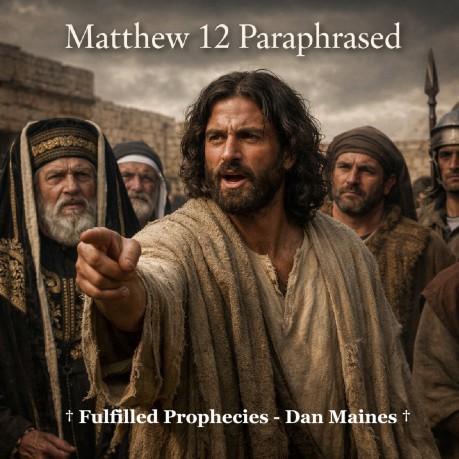
Matthew 12 Paraphrased Introduction † Matthew 12 shows the rising conflict between
Jesus and the religious leaders of Israel. Their rejection of Him
reveals the hardness of that generation that would soon face covenant
judgment (Matthew 23:36). † In this chapter Jesus reveals His authority
over the Sabbath, exposes the hypocrisy of the Pharisees, warns about
blaspheming the Spirit, and identifies the true family of God
(Matthew 12:8; Matthew 12:31-32; Matthew 12:50). † These events are part of the unfolding
confrontation that would ultimately lead to the destruction of
Jerusalem in AD 70, exactly as Jesus foretold (Matthew 24:2, 34). Lord Of The Sabbath Matthew 12:1 † The Law allowed travelers to eat from a
neighbor's field by hand, so the disciples weren't stealing
(Deuteronomy 23:25). † The Pharisees had built strict traditions
around the Sabbath that went far beyond what God required (Mark
2:27). † This moment begins another confrontation
showing that they valued tradition over God's intent (Isaiah 29:13). Matthew 12:2 † Their accusation came from tradition, not the
written Law (Colossians 2:20-22). † They judged outward actions while ignoring
mercy and justice (Matthew 23:23). † This pattern of accusation appears repeatedly
throughout the Gospels (John 5:16). Matthew 12:3 † Jesus points them back to scripture rather
than human tradition (1 Samuel 21:1-6). † David's example shows that preserving life
took priority over ceremonial rules. † Jesus also subtly points to His identity as
the greater Son of David (Matthew 22:42). Matthew 12:4 † The showbread was normally reserved for
priests (Leviticus 24:5-9). † Yet the priest allowed David to eat it
because of necessity. † Jesus shows that mercy has always been
central to God's Law (Hosea 6:6). Matthew 12:5 † Temple service required work even on the
Sabbath (Numbers 28:9-10). † This proves the Sabbath wasn't meant to
prevent acts of service. † Jesus is leading them to see that something
greater than the temple is present. Matthew 12:6 † Jesus declares that He Himself surpasses the
temple. † The temple pointed forward to the true
dwelling place of God among men (John 1:14). † This statement challenged the very foundation
of the Pharisees' authority. Matthew 12:7 † Jesus quotes Hosea to reveal the heart of
God's Law (Hosea 6:6). † The leaders emphasized ritual while
neglecting mercy. † Their misunderstanding led them to condemn
innocent people. Matthew 12:8 † Jesus claims authority over the Sabbath
itself. † Only the one who instituted the Sabbath could
make such a claim. † The Sabbath ultimately pointed to the rest
found in Christ (Hebrews 4:9-10). The Man With The Withered Hand Matthew 12:9 † Synagogues were the primary centers for
teaching scripture in Jewish communities (Luke 4:16). † Jesus often taught in synagogues throughout
Galilee (Matthew 4:23). † These gatherings frequently became places of
confrontation with the religious leaders. Matthew 12:10 † Their motive wasn't learning but accusation
(Mark 3:2). † The leaders were searching for grounds to
discredit Jesus. † This reveals the hardness of their hearts. Matthew 12:11 † Jesus exposes their inconsistency using a
common example. † Even their traditions allowed helping animals
in danger. † This demonstrates that mercy was already
understood in practice. Matthew 12:12 † Human life carries far greater value than
animals (Genesis 1:27). † Therefore acts of mercy are always lawful. † Jesus clarifies the true purpose of the
Sabbath. Matthew 12:13 † The miracle confirms Jesus' authority. † His word alone brings restoration. † These signs validated His identity as the
Messiah (Acts 2:22). Matthew 12:14 † Instead of celebrating the healing, they
planned His death. † Their hatred exposed the spiritual blindness
of Israel's leadership. † This plot would eventually lead to the
crucifixion (Acts 4:27). Matthew 12:15 † Jesus often withdrew to avoid premature
confrontation. † Yet the crowds continued to follow Him
because of His works. † His ministry continued despite the
opposition. Matthew 12:16 † Jesus often limited public declarations of
His identity. † This prevented political misunderstandings
about the nature of His mission. † His kingdom wasn't a political revolt. Matthew 12:17 † Matthew regularly shows how Jesus fulfills
Old Testament prophecy. † Isaiah had foretold the character of the
Messiah centuries earlier. † The fulfillment demonstrates the divine plan
unfolding. Matthew 12:18 † This prophecy comes from Isaiah 42:1. † It reveals the Messiah's mission extending
beyond Israel. † The Gospel would reach the nations. Matthew 12:19 † The Messiah's ministry wouldn't be driven by
political agitation. † His authority would be shown through truth
and works. † This contrasts sharply with revolutionary
movements of that era. Matthew 12:20 † The Messiah would deal gently with the weak. † His mission includes restoration rather than
destruction. † Yet His justice would ultimately prevail. Matthew 12:21 † This reveals the universal scope of Christ's
kingdom. † The nations would place their hope in Him. † This fulfills promises given to Abraham
(Genesis 12:3). A House Divided Matthew 12:22 † Deliverance from demonic oppression
demonstrated the authority of God's kingdom. † Miracles confirmed the arrival of the
Messiah. † Jesus restored both sight and speech. Matthew 12:23 † The title Son of David refers to the promised
Messiah. † The crowds were beginning to recognize the
significance of Jesus. † His works forced people to consider His
identity. Matthew 12:24 † Unable to deny the miracle, they attempted to
discredit it. † Their accusation was that Jesus worked
through demonic power. † This charge revealed the depth of their
hostility. Matthew 12:25 † Jesus responds with a logical argument. † A divided kingdom cannot survive. † Their accusation was internally inconsistent. Matthew 12:26 † The argument exposes the absurdity of their
claim. † Satan wouldn't undermine his own power. † The miracle clearly pointed to divine
authority. Matthew 12:27 † Some Jews claimed to practice exorcism. † Jesus points out their inconsistency. † Their own practices contradict their
accusation. Matthew 12:28 † The miracles demonstrated the arrival of
God's kingdom. † The Pharisees were witnessing its power
firsthand. † Yet they refused to recognize it. Matthew 12:29 † Satan is the strong man in this illustration. † Jesus shows that His authority proves Satan
is being restrained. † The Messiah is reclaiming what was under the
power of darkness. Matthew 12:30 † Neutrality toward Christ isn't possible. † People either stand with Him or oppose Him. † This statement exposes the Pharisees' true
position. Matthew 12:31 † The warning addresses those who knowingly
rejected the work of God. † The Pharisees were attributing the Spirit's
work to Satan. † This hardened rejection had serious
consequences. Matthew 12:32 † This statement refers to the covenant age
transition happening in that generation. † The leaders were witnessing undeniable
evidence yet rejecting it. † Their hardened resistance would lead to
national judgment. Matthew 12:33 † Jesus explains that actions reveal the true
nature of the heart (Luke 6:43-44). Matthew 12:34 † Jesus directly confronts the hypocrisy of the
religious leaders (Matthew 23:33). Matthew 12:35 † Jesus contrasts two types of people, those
whose hearts are transformed and those whose hearts remain corrupt. Matthew 12:36 † Jesus warns that words matter because they
reveal the condition of the heart (Ecclesiastes 12:14). Matthew 12:37 † Words testify about what a person truly
believes. The Demand For A Sign Matthew 12:38 † Even after witnessing many miracles, they
demanded more proof. Matthew 12:39 † Jesus rebukes the religious leaders for
demanding another sign even after witnessing many miracles. Their
request wasn't about seeking truth but about testing Him (Matthew
16:1). † By calling them an evil and adulterous
generation, Jesus is using covenant language from the Old Testament
where unfaithfulness to God was described as spiritual adultery
(Jeremiah 3:20; Ezekiel 16:32). † The sign of Jonah refers to the coming death
and resurrection of Christ, which would become the ultimate
confirmation of His authority (Jonah 1:17; Matthew 12:40). † Despite receiving this sign, many of the
leaders of that generation would still refuse to believe, fulfilling
the pattern of hardened hearts seen throughout Israel's history
(Isaiah 6:9-10). † This rebuke also exposes the deeper issue,
they weren't lacking evidence, they were rejecting the evidence
already given (John 12:37). Matthew 12:40 † Jesus identifies the sign of Jonah as a
prophetic picture of His death and resurrection (Jonah 1:17). Matthew 12:41 † Nineveh repented after hearing Jonah's
warning (Jonah 3:5). Matthew 12:42 † The Queen of Sheba traveled great distances
to hear Solomon's wisdom (1 Kings 10:1). Matthew 12:43 † Jesus illustrates the spiritual condition of
Israel through this example. Matthew 12:44 † Israel had experienced periods of outward
reform but not true repentance. Matthew 12:45 † Jesus directly applies the illustration to
the generation rejecting Him. The True Family Of Jesus Matthew 12:46 † Jesus' family arrives while He is teaching. Matthew 12:47 † The crowd informs Jesus about His family's
arrival. Matthew 12:48 † Jesus uses the question to draw attention to
a deeper truth. Matthew 12:49 † Jesus identifies His disciples as His true
family. Matthew 12:50 † Obedience to God defines true belonging in
the kingdom. Historical References † Josephus records the deep corruption and
internal conflict within the leadership of Jerusalem in the first
century (Josephus, Antiquities of the Jews, Book 20). How It Applies To Us Today † True faith isn't defined by tradition or
heritage but by obedience to God's will. Q & A Appendix Q: What is the sign of Jonah that Jesus referred
to? Q: Why did Jesus say the men of Nineveh would
condemn that generation? Q: Who belongs to the true family of Jesus? † This is the fulfilled perspective we proclaim at
Fulfilled Prophecies † Source Index † Matthew 12:1-50; Deuteronomy 23:25; Hosea
6:6; Genesis 12:3; Jonah 1:17; Jonah 3:5; 1 Kings 10:1 † Josephus, Antiquities of the Jews, Book 20;
Eusebius, Ecclesiastical History 3.5; Tacitus, Histories 5.13
By Dan Maines
At that time Jesus went through
the grainfields on the Sabbath, and His disciples became hungry and
began to pick the heads of grain and eat.
But when the Pharisees saw
this, they said to Him, Look, Your disciples are doing what isn't
lawful to do on a Sabbath.
But He said to them, Haven't
you read what David did when he became hungry, he and his companions?
How he entered the house of
God, and they ate the consecrated bread, which wasn't lawful for him
to eat nor for those with him, but for the priests alone?
Or haven't you read in the Law,
that on the Sabbath the priests in the temple break the Sabbath and
are innocent?
But I say to you that something
greater than the temple is here.
But if you had known what this
means, I desire compassion, and not sacrifice, you wouldn't have
condemned the innocent.
For the Son of Man is Lord of
the Sabbath.
Departing from there, He went
into their synagogue.
And a man was there whose hand
was withered. And they questioned Jesus, asking, Is it lawful to heal
on the Sabbath? so that they might accuse Him.
And He said to them, What man
is there among you who has a sheep, and if it falls into a pit on the
Sabbath, won't he take hold of it and lift it out?
How much more valuable then is
a man than a sheep! So then, it is lawful to do good on the Sabbath.
Then He said to the man,
Stretch out your hand. He stretched it out, and it was restored to
normal, like the other.
But the Pharisees went out and
conspired against Him, as to how they might destroy Him.
But Jesus, aware of this,
withdrew from there. Many followed Him, and He healed them all.
And He warned them not to tell
who He was.
This happened so that what was
spoken through Isaiah the prophet would be fulfilled:
Look, My Servant whom I have
chosen, My Beloved in whom My soul delights. I will put My Spirit
upon Him, and He will proclaim justice to the Gentiles.
He won't quarrel nor cry out,
nor will anyone hear His voice in the streets.
A battered reed He won't break
off, and a smoldering wick He won't put out, until He leads justice
to victory.
And in His name the Gentiles
will hope.
Then a demon possessed man who
was blind and unable to speak was brought to Jesus, and He healed
him, so that the man spoke and saw.
And all the crowds were
amazed, and were saying, This man isn't the Son of David, is he?
But when the Pharisees heard
this, they said, This man casts out demons only by Beelzebul the
ruler of the demons.
And knowing their thoughts
Jesus said to them, Any kingdom divided against itself is laid waste,
and any city or house divided against itself won't stand.
If Satan casts out Satan, he
is divided against himself, how then will his kingdom stand?
If I cast out demons by
Beelzebul, by whom do your sons cast them out? For this reason they
will be your judges.
But if I cast out demons by
the Spirit of God, then the kingdom of God has come upon you.
Or how can anyone enter the
strong man's house and carry off his property, unless he first binds
the strong man? And then he will plunder his house.
The one who isn't with Me is
against Me, and the one who doesn't gather with Me scatters.
For this reason I say to you,
every sin and blasphemy will be forgiven people, but blasphemy
against the Spirit won't be forgiven.
Whoever speaks a word against
the Son of Man, it will be forgiven him, but whoever speaks against
the Holy Spirit, it won't be forgiven him, either in this age or in
the age to come.
Either assume the tree to be
good as well as its fruit good, or assume the tree to be bad as well
as its fruit bad, for the tree is known by its fruit.
† The
Pharisees' words exposed the corruption within them (Matthew
12:34).
† A person's character is ultimately
revealed through their speech and conduct (James 3:10-12).
You offspring of vipers, how
can you, being evil, express any good things? For the mouth speaks
from that which fills the heart.
† Their
accusations revealed the evil that filled their hearts.
†
Words are the overflow of what truly lives inside a person (Luke
6:45).
The good person brings out of
his good treasure what is good, and the evil person brings out of his
evil treasure what is evil.
†
The Pharisees stored up evil through pride and hypocrisy (Matthew
23:27-28).
† True righteousness begins in the
heart and then appears in actions (Proverbs 4:23).
But I tell you that for every
careless word that people speak, they will give an account of it on
the day of judgment.
†
The religious leaders would be held accountable for their false
accusations.
† Judgment was approaching that
generation because of their hardened rejection (Matthew 23:36).
For by your words you will be
justified, and by your words you will be condemned.
† The Pharisees condemned
themselves through their accusations against Jesus.
†
Speech reflects faith or unbelief within the heart (Romans 10:9-10).
Then some of the scribes and
Pharisees said to Him, Teacher, we want to see a sign from You.
† Their request wasn't
sincere, it was an attempt to test Him (Matthew 16:1).
†
This revealed their unwillingness to believe despite overwhelming
evidence.
But He answered and said to
them, An evil and adulterous generation craves for a sign, and yet no
sign will be given to it but the sign of Jonah the prophet,
for just as Jonah was in the
stomach of the sea monster for three days and three nights, so will
the Son of Man be in the heart of the earth for three days and three
nights.
†
The resurrection would become the ultimate confirmation of His
authority (Acts 2:24).
† Even this sign would
not persuade the hardened leadership of Israel.
The men of Nineveh will stand
up with this generation at the judgment, and will condemn it because
they repented at the preaching of Jonah, and behold, something
greater than Jonah is here.
† Yet the generation
hearing Jesus refused to repent despite far greater revelation.
†
Their rejection revealed the depth of Israel's spiritual blindness.
The Queen of the South will
rise up with this generation at the judgment and will condemn it,
because she came from the ends of the earth to hear the wisdom of
Solomon, and behold, something greater than Solomon is here.
†
Yet Israel rejected the one who was greater than Solomon.
†
Jesus emphasizes the seriousness of their rejection.
Now when the unclean spirit
comes out of a person, it passes through waterless places seeking
rest and doesn't find it.
† Temporary
reform without true transformation leaves a person vulnerable.
†
Spiritual emptiness invites greater corruption.
Then it says, I will return to
my house from which I came, and when it comes, it finds it
unoccupied, swept, and put in order.
† Without the
presence of God, the condition remained empty.
†
The nation remained spiritually vulnerable.
Then it goes and brings with
it seven other spirits more evil than itself, and they go in and live
there, and the last state of that person becomes worse than the
first. That is the way it will also be with this evil generation.
† Their
spiritual condition would become worse than before.
†
This warning pointed toward the coming judgment on that generation
(Matthew 23:36).
While He was still speaking to
the crowds, behold, His mother and brothers were standing outside
seeking to speak to Him.
†
The moment becomes an opportunity to teach about the true family of
God.
† Spiritual relationships take priority
over physical ties.
Someone said to Him, Look,
Your mother and Your brothers are standing outside seeking to speak
to You.
† This sets the stage for a teaching
about discipleship.
† Jesus responds by
redefining the meaning of family.
But Jesus answered the one who
was telling Him and said, Who is My mother and who are My brothers?
† The kingdom of God forms a
new spiritual family.
† Faith, not bloodline,
defines membership in that family.
And stretching out His hand
toward His disciples, He said, Look, My mother and My brothers.
† Those who follow Him share a deeper
relationship than biological ties.
† The
kingdom forms a new community centered around obedience to God.
For whoever does the will of
My Father who is in heaven, he is My brother and sister and mother.
† Jesus establishes a spiritual
family made up of those who follow the Father's will.
†
This teaching prepares the way for the new covenant community.
†
Eusebius records that believers remembered the warnings of Jesus and
fled Jerusalem before its destruction (Eusebius, Ecclesiastical
History 3.5).
† Tacitus confirms the Roman
destruction of Jerusalem under Titus in AD 70 (Tacitus, Histories
5.13).
†
Words reveal the condition of the heart and therefore matter
greatly.
† Christ forms a spiritual family
made up of those who follow the Father.
A: It refers to His death and resurrection
after three days (Matthew 12:40).
A: Because Nineveh
repented at Jonah's message while Israel rejected someone greater
than Jonah (Matthew 12:41).
A:
Those who do the will of the Father in heaven (Matthew 12:50).
© Fulfilled Prophecies - Dan
Maines.
Links