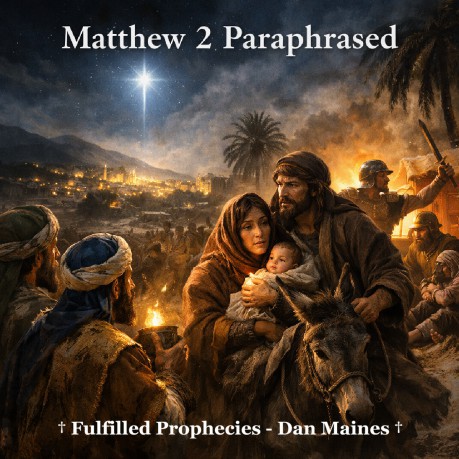
Matthew 2 Paraphrased Introduction † Matthew chapter 2 records the early events
surrounding Jesus after His birth, showing how even as a child He was
already the focus of prophecy, political fear, and divine
protection. Matthew 2:1 † Bethlehem was a small town south of
Jerusalem, but it was the very place the prophet Micah said the
Messiah would come from (Micah 5:2). Matthew 2:2 † Their question immediately threatened Herod
because Rome had appointed him king, yet these foreigners were
searching for another king. Matthew 2:3 † Herod feared losing power, so the news of a
rival king terrified him. Matthew 2:4 † The religious leaders knew the scriptures
well enough to answer Herod's question quickly. Matthew 2:5 † The prophecy they quoted came from Micah and
clearly identified Bethlehem as the birthplace of the ruler God
promised. Matthew 2:6 † The Messiah would not only rule but shepherd
the people, reflecting God's care and leadership. Matthew 2:7 † Herod's secrecy shows he was planning
something deceptive. Matthew 2:8 † Herod pretended to want to honor the child,
but his real intention was murder. Matthew 2:9 † The star guided them directly to Jesus,
showing God's active direction in the event. Matthew 2:10 † Their long journey ended with confirmation
that they had found the promised king. Matthew 2:11 † Gold symbolized kingship, frankincense was
connected with worship, and myrrh was often used in burial
preparation. Matthew 2:12 † God intervened to protect the child from
Herod's plan. Matthew 2:13 † Joseph was repeatedly guided by dreams,
showing God's protection over Jesus' early life. Matthew 2:14 † Joseph obeyed immediately without delay. Matthew 2:15 † Matthew connects Jesus' life to Israel's
story, showing He represents the true Son of God. Matthew 2:16 † This brutal act reveals Herod's extreme fear
of losing power. Matthew 2:17 † Matthew again shows prophecy being fulfilled
through historical events. Matthew 2:18 † Rachel symbolically represents the mothers of
Israel grieving their lost children. Matthew 2:19 † Herod died around 4 BC, ending the immediate
threat to Jesus. Matthew 2:20 † With Herod gone, the danger had passed. Matthew 2:21 † Again Joseph responded with immediate
obedience. Matthew 2:22 † Archelaus was known for cruelty similar to
his father. Matthew 2:23 † Nazareth was a small and unimpressive town,
showing the humble beginnings of Jesus' life. Historical References † Josephus describes Herod's violent paranoia
and the killing of rivals (Antiquities of the Jews 16-17). How It Applies To Us Today † Matthew 2 shows that God was guiding events
long before anyone understood the full plan. Q And A Appendix Q Why did Gentile wise men recognize Jesus while
many in Israel did not? Q Why did Matthew emphasize prophecy so heavily
in this chapter? Q Why was Egypt part of Jesus' early life? Q Why did God warn Joseph through dreams instead
of direct appearance? Q Why didn't the religious leaders go to
Bethlehem when they knew the prophecy? Q What does the massacre of the children in
Bethlehem show about the conflict surrounding Jesus' arrival? Q Why did Jesus grow up in Nazareth instead of
Bethlehem where He was born? † This is the fulfilled perspective we proclaim at
Fulfilled Prophecies † Source Index † Matthew 2:1-23; Micah 5:2; Numbers 24:17;
Isaiah 60:3; Psalm 2:2; Psalm 19:1; Luke 2:10; Hosea 11:1; Jeremiah
31:15; Isaiah 53:3; Luke 24:44 † Josephus, Antiquities of the Jews; Tacitus,
Histories 5.13; Eusebius, Ecclesiastical History 1.8
By Dan Maines
† The visit of the Magi, the rage
of Herod, the escape to Egypt, and the return to Nazareth all
happened exactly as the prophets had spoken long before.
†
Matthew repeatedly shows that what happened to Jesus was not random
history, it was the unfolding of God's plan that had been written
centuries earlier (Matthew 1:22, Luke 24:44).
After Jesus was born in
Bethlehem of Judea during the days of King Herod, wise men from the
east arrived in Jerusalem.
† Herod
the Great ruled Judea under Rome and was known for paranoia and
violence, even executing members of his own family to protect his
throne (Josephus, Antiquities 17.6.5).
† The
wise men were likely eastern scholars who studied the stars and
ancient writings, possibly familiar with Jewish prophecy from the
time of the exile (Daniel 2:48).
They were asking, Where is the
one who has been born king of the Jews? We saw His star in the east
and have come to honor Him.
† Balaam had
spoken centuries earlier that a star would rise out of Jacob, which
many connect with the sign these men saw (Numbers 24:17).
†
The fact that Gentile seekers came to honor Jesus shows from the
beginning that the Messiah's mission included the nations (Isaiah
60:3).
When King Herod heard this, he
was deeply troubled, and all Jerusalem with him.
† Jerusalem was
troubled because the people knew how violently Herod reacted to
threats.
† History records Herod ordering
executions to protect his throne, which explains the fear spreading
through the city (Josephus, Antiquities 16.11).
He gathered together the chief
priests and scribes of the people and asked them where the Messiah
was supposed to be born.
†
Ironically, they understood the prophecy but did not go to see the
Messiah themselves.
† This shows knowledge of
scripture alone does not guarantee faith or obedience (James 1:22).
They told him, In Bethlehem of
Judea, because this is what the prophet wrote.
† This proves the location of
Jesus' birth was known among Jewish scholars long before it
happened.
† Matthew highlights prophecy
fulfillment to show Jesus is the promised Messiah (Micah 5:2).
And you, Bethlehem, land of
Judah, are certainly not the least among the rulers of Judah, because
out of you will come a ruler who will shepherd My people Israel.
†
This language echoes the promise that a shepherd king like David
would rise again (Ezekiel 34:23).
† Jesus
later described Himself as the good shepherd who gives His life for
the sheep (John 10:11).
Then Herod secretly called the
wise men and carefully asked them when the star had appeared.
† By learning the time
of the star, he could estimate the age of the child.
†
This information later shaped the cruel order he would give.
He sent them to Bethlehem and
said, Go search carefully for the child, and when you find Him,
report back to me so that I can also come and honor Him.
† This
shows how rulers often feared losing power when confronted with God's
authority.
† Scripture repeatedly shows
wicked leaders opposing God's chosen servants (Psalm 2:2).
After hearing the king, they
went on their way, and the star they had seen earlier went ahead of
them until it came to rest over the place where the child was.
†
This was not an ordinary astronomical object because it moved and
stopped in a specific place.
† God used
creation itself to announce the arrival of the Messiah (Psalm 19:1).
When they saw the star, they
were filled with great joy.
† Joy
is a constant response when people encounter the work of God.
†
Luke also records great joy surrounding Jesus' birth among the
shepherds (Luke 2:10).
They entered the house, saw the
child with His mother Mary, and they bowed down and honored Him. They
opened their treasures and presented gifts of gold, frankincense, and
myrrh.
† These gifts pointed toward
Jesus as king, priest, and the one who would die for His people.
†
The act of bowing shows they recognized His authority.
After being warned in a dream
not to return to Herod, they went back to their country by another
route.
† Dreams were often used in
scripture to deliver divine warnings (Genesis 20:3).
†
This event shows God's control over events surrounding the Messiah.
After they left, an angel of
the Lord appeared to Joseph in a dream and said, Get up, take the
child and His mother, escape to Egypt, and stay there until I tell
you, because Herod is about to search for the child to kill Him.
†
Egypt had a large Jewish population where they could remain
unnoticed.
† This event also fulfilled
prophecy connected to Israel's history (Hosea 11:1).
So Joseph got up, took the
child and His mother during the night, and left for Egypt.
†
His obedience protected the life of the child who would later save
the world.
† Scripture often highlights the
importance of immediate obedience to God's direction.
They remained there until Herod
died. This fulfilled what the Lord had spoken through the prophet,
Out of Egypt I called My Son.
†
Hosea originally spoke of Israel coming out of Egypt, but Matthew
shows the deeper fulfillment in Christ (Hosea 11:1).
†
Jesus fulfills and completes the story of Israel.
When Herod realized the wise
men had not returned, he became furious. He ordered that all the boys
in Bethlehem and its surrounding area two years old and under be
killed, based on the time he had learned from the wise men.
† Historical records confirm
Herod was capable of such cruelty (Josephus, Antiquities 17).
†
Satan has always attempted to destroy God's chosen deliverer
throughout biblical history.
Then what had been spoken
through the prophet Jeremiah was fulfilled.
† The suffering in
Bethlehem echoed earlier national grief experienced in Israel's
past.
† Prophecy often carried both
historical and future significance.
A voice was heard in Ramah,
weeping and great mourning, Rachel crying for her children, and she
refused to be comforted because they were gone.
†
Jeremiah originally spoke these words during the Babylonian exile
(Jeremiah 31:15).
† Matthew shows how that
sorrow echoed again during this tragedy.
After Herod died, an angel of
the Lord appeared in a dream to Joseph in Egypt.
† Once again God directed
Joseph through a dream.
† God's protection
continued until the time of Jesus' public ministry.
The angel said, Get up, take
the child and His mother, and return to the land of Israel, because
those who were trying to kill the child are dead.
†
This moment parallels Israel leaving danger and returning to their
land.
† God's timing always moves according
to His plan.
Joseph got up, took the child
and His mother, and returned to the land of Israel.
† This obedience played a key role
in preserving Jesus' life.
† Faith is often
shown through simple obedience.
But when he heard that
Archelaus was ruling Judea in place of his father Herod, he was
afraid to go there. After being warned in a dream, he went to the
region of Galilee.
† Galilee was considered a
quieter region and safer for the family.
†
God's warning again protected the child.
They settled in a town called
Nazareth, fulfilling what was spoken through the prophets, that He
would be called a Nazarene.
†
The prophets described the Messiah as humble and despised, which
Nazareth symbolized (Isaiah 53:3).
† Jesus
later became widely known as Jesus of Nazareth.
†
Tacitus records Roman political conditions in Judea during the period
surrounding Herod's rule (Histories 5.13).
†
Eusebius later wrote about the early traditions surrounding Jesus'
childhood events (Ecclesiastical History 1.8).
†
Even when rulers opposed God's purposes, His plan continued without
interruption.
† The chapter reminds us that
prophecy, history, and God's protection all work together in His
unfolding plan.
A Scripture shows the
nations would seek the Messiah. Isaiah 60:3 says nations will come to
your light, and kings to the brightness of your rising.
A Matthew wanted readers to
see that Jesus fulfilled the scriptures. Luke 24:44 explains that
everything written in the Law, Prophets, and Psalms concerning Christ
had to be fulfilled.
A
Matthew connects it to prophecy and to Israel's history. Hosea 11:1
says Out of Egypt I called My Son, showing Jesus fulfilling Israel's
story.
A Scripture shows God
often used dreams to guide and protect His people. Genesis 37:5
records Joseph receiving dreams that revealed God's plans, and
Matthew 1:20 shows Joseph already being guided by a dream concerning
Jesus' birth.
A
Knowledge alone does not produce faith. They understood the prophecy
of Micah 5:2 but did not act on it. James 1:22 teaches that people
must be doers of the word and not merely hearers.
A
From the moment Jesus entered the world, earthly rulers opposed Him.
Psalm 2:2 says the kings of the earth take their stand against the
Lord and His Anointed.
A God directed
Joseph to Nazareth for safety and to fulfill what the prophets said
about the Messiah being despised and humble. Isaiah 53:3 describes
Him as despised and rejected among men.
© Fulfilled Prophecies - Dan
Maines.
Links