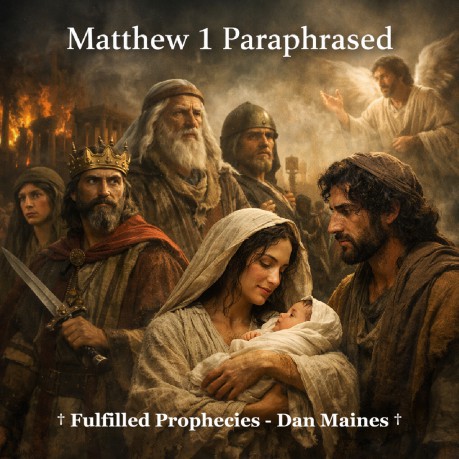
Matthew 1 Paraphrased Introduction † Matthew begins by showing that Jesus did not appear randomly
in history, He came through the exact family line God promised
throughout the Old Testament (Genesis 12:3, 2 Samuel 7:12-13). † The genealogy proves that Jesus is both the promised Son of
Abraham and the rightful heir to David's throne, fulfilling the
covenant promises made centuries earlier (Genesis 22:18, Psalm
132:11). † This opening chapter also shows that God works through real
history, real families, and even broken people to accomplish His plan
of redemption (Romans 11:29). Matthew 1:1 The record of the family line of Jesus the Messiah, the descendant
of David, the descendant of Abraham. † Matthew immediately identifies Jesus as the promised Messiah
who fulfills the covenant promises given to Abraham and David
(Genesis 12:3). † Calling Him the son of David shows His legal right to the
throne of Israel (2 Samuel 7:12-13). † The title Messiah means the anointed one promised throughout
the prophets (Isaiah 61:1). Matthew 1:2 Abraham became the father of Isaac, Isaac became the father of
Jacob, and Jacob became the father of Judah and his brothers. † The line begins with Abraham because God promised that through
his offspring all nations would be blessed (Genesis 22:18). † Judah is highlighted because the royal line was prophesied to
come through him (Genesis 49:10). † This shows that God's promises were carried through specific
generations exactly as foretold. Matthew 1:3 Judah became the father of Perez and Zerah by Tamar, Perez became
the father of Hezron, and Hezron became the father of Ram. † Tamar's inclusion reminds us that God often works through
difficult and unexpected circumstances (Genesis 38:27-30). † Perez became the continuation of the royal line leading toward
David (Ruth 4:18-22). † Even flawed people were used by God to carry forward His
covenant purposes. Matthew 1:4 Ram became the father of Amminadab, Amminadab became the father of
Nahshon, and Nahshon became the father of Salmon. † Nahshon was a leader of the tribe of Judah during the
wilderness period (Numbers 1:7). † This shows the continuity between the Exodus generation and
the royal line. † God's covenant plan continued through Israel's national
history. Matthew 1:5 Salmon became the father of Boaz by Rahab, Boaz became the father
of Obed by Ruth, and Obed became the father of Jesse. † Rahab was a Gentile who believed the God of Israel and was
brought into the covenant people (Joshua 2:9-11). † Ruth was also a Gentile who joined Israel through faith and
loyalty (Ruth 1:16). † Their presence in the genealogy shows that God's plan always
included the nations. Matthew 1:6 Jesse became the father of David the king. David became the father
of Solomon by the wife of Uriah. † David is called the king because the covenant promise of an
eternal throne was given to him (2 Samuel 7:12-13). † The mention of Uriah's wife reminds readers of David's sin,
yet God's covenant promises still continued (2 Samuel 11:3-4). † God's grace works even through human failure. Matthew 1:7 Solomon became the father of Rehoboam, Rehoboam became the father
of Abijah, and Abijah became the father of Asa. † This section traces the royal line of Judah after David. † These kings ruled in Jerusalem, preserving the Davidic throne. † Despite spiritual decline in many of these kings, God's
promise to David remained. Matthew 1:8 Asa became the father of Jehoshaphat, Jehoshaphat became the
father of Joram, and Joram became the father of Uzziah. † Jehoshaphat was known for seeking the Lord and bringing
reforms to Judah (2 Chronicles 17:3-4). † This genealogy compresses some generations, a common Jewish
practice in genealogical records. † The key purpose is to trace the royal authority leading to the
Messiah. Matthew 1:9 Uzziah became the father of Jotham, Jotham became the father of
Ahaz, and Ahaz became the father of Hezekiah. † Hezekiah was a king who brought major spiritual reform in
Judah (2 Kings 18:3-6). † These kings lived during the time when many prophets warned
Israel and Judah about coming judgment. † The Davidic line continued even during times of national
crisis. Matthew 1:10 Hezekiah became the father of Manasseh, Manasseh became the father
of Amon, and Amon became the father of Josiah. † Manasseh was one of Judah's most wicked kings, yet God still
preserved the covenant line (2 Kings 21:1-2). † Josiah later led one of the greatest reforms in Judah's
history (2 Kings 23:25). † This demonstrates God's faithfulness even when leaders failed. Matthew 1:11 Josiah became the father of Jeconiah and his brothers at the time
of the deportation to Babylon. † The Babylonian exile marked the end of Judah's independent
monarchy (2 Kings 24:14). † This event fulfilled prophetic warnings given by Jeremiah
(Jeremiah 25:11). † Even through exile, God preserved the lineage that would lead
to the Messiah. Matthew 1:12 After the deportation to Babylon, Jeconiah became the father of
Shealtiel, and Shealtiel became the father of Zerubbabel. † Zerubbabel later led the return from exile and helped rebuild
the temple (Ezra 3:8). † His leadership signaled that God's promises to Israel were
still moving forward. † The messianic line continued even in foreign lands. Matthew 1:13 Zerubbabel became the father of Abiud, Abiud became the father of
Eliakim, and Eliakim became the father of Azor. † These generations lived during the long period between the Old
Testament prophets and the birth of Christ. † Though the scriptures are mostly silent about them, God was
still guiding history. † The Messiah's arrival was quietly approaching. Matthew 1:14 Azor became the father of Zadok, Zadok became the father of Achim,
and Achim became the father of Eliud. † These lesser known generations remind us that God's plan often
unfolds quietly across centuries. † Each generation carried the promise forward. † None of these names were accidental in God's unfolding
purpose. Matthew 1:15 Eliud became the father of Eleazar, Eleazar became the father of
Matthan, and Matthan became the father of Jacob. † These final generations lead directly to Joseph, the legal
father of Jesus. † The genealogy shows an unbroken legal line leading to the
Messiah. † God's promise had now reached its appointed moment. Matthew 1:16 Jacob became the father of Joseph, the husband of Mary, by whom
Jesus was born, who is called the Messiah. † Jesus is not described as Joseph's biological son,
highlighting the miraculous nature of His birth. † Joseph provided the legal Davidic lineage. † Mary provided the human birth through which the Messiah
entered the world. Matthew 1:17 So all the generations from Abraham to David are fourteen
generations, from David to the deportation to Babylon fourteen
generations, and from the deportation to Babylon to the Messiah
fourteen generations. † Matthew organizes the genealogy to highlight three major
periods of Israel's history. † Abraham to David represents the rise of the covenant nation. † David to exile represents the fall of the kingdom. † Exile to Christ represents the arrival of the promised
restoration. Matthew 1:18 Now the birth of Jesus the Messiah happened in this way. When His
mother Mary had been promised in marriage to Joseph, before they came
together she was found to be pregnant through the Holy Spirit. † This reveals the supernatural nature of Jesus' conception. † The child was not the result of human union but of God's
direct action. † This fulfills the prophetic expectation of a miraculous birth
(Isaiah 7:14). Matthew 1:19 Joseph her husband, being a righteous man and not wanting to
disgrace her publicly, decided to end the engagement quietly. † Joseph's reaction shows both his righteousness and his
compassion. † According to the law, Mary could have faced severe punishment
(Deuteronomy 22:23-24). † Instead, Joseph chose mercy. Matthew 1:20 But while he was thinking about these things, an angel of the Lord
appeared to him in a dream and said Joseph, son of David, do not be
afraid to take Mary as your wife, because the child conceived in her
is from the Holy Spirit. † The angel addresses Joseph as son of David, confirming the
royal lineage. † This divine message assures Joseph that the pregnancy is God's
work. † The Messiah was entering the world exactly according to God's
plan. Matthew 1:21 She will give birth to a son, and you will name Him Jesus, because
He will save His people from their sins. † The name Jesus means the Lord saves. † His mission is clearly stated, salvation from sin. † This salvation would be accomplished through His death and
resurrection. Matthew 1:22 All this happened to fulfill what the Lord had spoken through the
prophet. † Matthew constantly connects events in Jesus' life to Old
Testament prophecy. † This emphasizes that nothing in the gospel story is
accidental. † Everything unfolded according to God's revealed plan. Matthew 1:23 Look, the virgin will become pregnant and give birth to a son, and
they will call His name Immanuel, which means God with us. † This prophecy comes from Isaiah 7:14. † Immanuel describes the presence of God among His people. † In Jesus, God entered human history directly. Matthew 1:24 When Joseph woke from sleep, he did exactly as the angel of the
Lord instructed him and took Mary as his wife. † Joseph's obedience demonstrates faithful submission to God's
will. † His actions protected Mary and ensured the child would be
raised within the Davidic household. † Obedience to God often requires trust in difficult
circumstances. Matthew 1:25 But he did not have marital relations with her until she gave
birth to a son, and he named Him Jesus. † This confirms the virgin birth. † Joseph faithfully followed the angel's instruction. † The child received the name that revealed His mission,
salvation. Historical References † Justin Martyr wrote that Jesus fulfilled the prophecies
concerning the lineage of David and the virgin birth in his Dialogue
with Trypho. † Irenaeus explained that the genealogy proves Jesus came
through the historical line promised to Abraham and David in Against
Heresies. † Eusebius documented the preserved genealogical records of
Jewish families confirming the royal lineage in Ecclesiastical
History. How It Applies To Us Today † God keeps His promises even when centuries pass between the
promise and the fulfillment (2 Peter 3:9). † The genealogy reminds us that God works through ordinary
people and imperfect lives to accomplish His purposes (Romans 8:28). † Jesus entering history proves that salvation was part of God's
plan from the very beginning. Q & A Appendix Q: Why does Matthew start with a genealogy? A: Because it proves Jesus is the promised
descendant of Abraham and David, fulfilling God's covenant promises
(Genesis 22:18; 2 Samuel 7:12-13). Q: Why are Gentile women included in the
genealogy? A: Their inclusion shows that God's plan of
redemption was always intended for the nations, not just Israel
(Isaiah 49:6). Q: Why does Matthew emphasize the virgin birth? A: Because it fulfills prophecy and confirms that
Jesus' origin is divine, not merely human (Isaiah 7:14). Q: Why does Matthew divide the genealogy into
three groups of fourteen generations? A: Matthew highlights three major periods in
Israel's history, the rise of the kingdom from Abraham to David, the
decline from David to the Babylonian exile, and the restoration
leading to the Messiah. This structure shows that history was moving
toward the arrival of Christ exactly as God planned (Daniel 9:24-25). Q: Why is Joseph listed in the genealogy if Jesus
was born of a virgin? A: Joseph provides the legal right to David's
throne. In Jewish law, legal descent passed through the father, so
Joseph adopting and naming Jesus established His rightful claim as
the Son of David (Matthew 1:20-21). Q: Why are sinful people included in the
Messiah's family line? A: The genealogy openly shows flawed individuals
like David and others because God's plan of redemption works through
real human history. It demonstrates God's mercy and faithfulness, not
human perfection (Romans 5:8). † This is the fulfilled perspective we proclaim at
Fulfilled Prophecies † Source Index † Genesis 12:3; Genesis 22:18; Genesis 49:10; 2
Samuel 7:12-13; Isaiah 7:14; Isaiah 61:1; Jeremiah 25:11; 2 Kings
24:14; Ruth 4:18-22; Joshua 2:9-11; Ezra 3:8; Romans 11:29; Romans
8:28; 2 Peter 3:9 † Justin Martyr, Dialogue with Trypho;
Irenaeus, Against Heresies; Eusebius, Ecclesiastical History.
By Dan Maines
© Fulfilled Prophecies - Dan
Maines.
Links