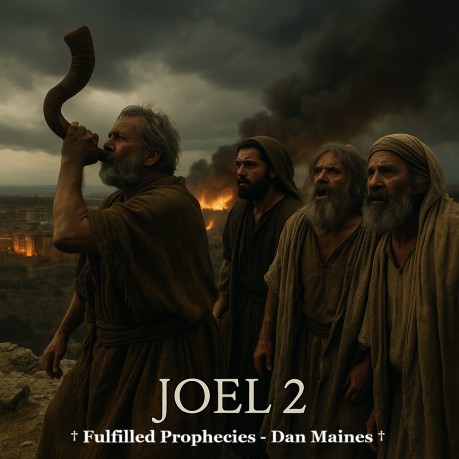
Joel 2 Joel 2:1-2 † The trumpet call announces judgment
approaching the covenant people. Joel 2:3-5 † Joel's imagery of fire and horses reveals
both natural and military devastation. Joel 2:6-9 † This precise imagery parallels the Roman
legions' discipline and power. Joel 2:10-11 † Cosmic signs symbolize the fall of national
Israel - the end of the old heavens and earth. Joel 2:12-14 † God's mercy is extended even in judgment,
calling for genuine repentance. Joel 2:15-17 † The renewed trumpet call invites intercession
and repentance for the whole nation. Joel 2:18-20 † God's compassion restores blessing after
judgment is complete. Joel 2:21-23 † Joy and restoration follow repentance and
divine mercy. Joel 2:24-27 † The restoration of abundance represents
covenant renewal after judgment. Joel 2:28-29 † This prophecy was directly fulfilled in Acts
2 at Pentecost. Joel 2:30-32 † The cosmic signs accompany the end of the old
covenant world, not the physical universe. How it applies to us today † Joel 2 shows that judgment and mercy work
together in God's redemptive plan. † This is the fulfilled perspective we proclaim at
Fulfilled Prophecies † Source Index
By Dan Maines
Blow a trumpet in Zion, and sound
an alarm on My holy mountain! Let all the inhabitants of the land
tremble, for the day of the Lord is coming; surely it is near, a day
of darkness and gloom, a day of clouds and thick darkness. As the
dawn is spread over the mountains, so there is a great and mighty
people; there has never been anything like it, nor will there be
again after it to the years of many generations.
†
Historically, this describes the terror of invading armies that
consumed the land.
† Prophetically, the day
of the Lord here points to the Roman siege of Jerusalem in AD 70,
fulfilling both Joel and Jesus' words in Matthew 24.
†
Eusebius recorded that the destruction surpassed all former
desolations.
† In the fulfilled kingdom, the
day of wrath has passed, replaced by the dawn of eternal peace in
Christ.
A fire consumes before them and
behind them a flame burns. The land is like the garden of Eden before
them but a desolate wilderness behind them, and nothing at all
escapes them. Their appearance is like the appearance of horses, and
like war horses, so they run. With a noise as of chariots they leap
on the tops of the mountains, like the crackling of a flame of fire
consuming the stubble, like a mighty people arranged for battle.
†
Historically, it evokes the locust armies that stripped the land
bare.
† Prophetically, it foreshadows Rome's
disciplined forces advancing upon Judea.
†
Jerome said this vivid description symbolizes divine judgment through
human instruments.
† In the fulfilled
kingdom, judgment has ended, and the desolation is replaced by
spiritual fruitfulness.
Before them the people are in
anguish; all faces turn pale. They run like mighty men, they climb
the wall like soldiers; and they each march in line, nor do they
deviate from their paths. They do not crowd each other, they march
everyone in his path; when they burst through the defenses, they do
not break ranks. They rush on the city, they run on the wall; they
climb into the houses, they enter through the windows like a thief.
†
Historically, Jerusalem's inhabitants were overwhelmed by fear and
hopelessness.
† Prophetically, the invasion
fulfilled God's warning that the day of the Lord would come suddenly
and irresistibly.
† Josephus described Roman
soldiers moving with such unity that none broke formation.
†
In the fulfilled kingdom, the thief-like judgment is past, and Christ
now reigns as the everlasting defender.
Before them the earth quakes,
the heavens tremble, the sun and the moon grow dark and the stars
lose their brightness. The Lord utters His voice before His army;
surely His camp is very great, for strong is He who carries out His
word. The day of the Lord is indeed great and very awesome, and who
can endure it?
†
Historically, similar language appears in Isaiah 13 and Matthew 24,
describing political and covenantal collapse.
†
Prophetically, this marks the full transition from the Mosaic age to
the Messianic kingdom.
† Jerome said the
shaking of heaven and earth reveals the removal of what was
temporary.
† In the fulfilled kingdom, the
unshakable new creation stands forever under Christ's rule.
Yet even now, declares the
Lord, return to Me with all your heart, and with fasting, weeping,
and mourning; and rend your heart and not your garments. Now return
to the Lord your God, for He is gracious and compassionate, slow to
anger, abounding in lovingkindness and relenting of evil. Who knows
whether He will not turn and relent and leave a blessing behind Him,
even a grain offering and a drink offering for the Lord your God?
†
Historically, the call to rend hearts revealed the need for inner
renewal, not outward ritual.
† Prophetically,
this prefigures Christ's invitation to repentance before Jerusalem's
fall.
† Eusebius wrote that the Lord's
compassion remained open to those who turned from the old covenant to
Christ.
† In the fulfilled kingdom, true
repentance brings restoration, not wrath.
Blow a trumpet in Zion,
consecrate a fast, proclaim a solemn assembly, gather the people,
sanctify the congregation, assemble the elders, gather the children
and the nursing infants. Let the bridegroom come out of his room and
the bride out of her bridal chamber. Let the priests, the Lord's
ministers, weep between the porch and the altar, and let them say,
Spare Your people, O Lord, and do not make Your inheritance a
reproach, a byword among the nations. Why should they among the
peoples say, Where is their God?
†
Historically, priests stood between the altar and the porch to plead
for mercy.
† Prophetically, this moment
reflects the final opportunity for Israel to turn before
destruction.
† Jerome said this plea shows
God's mercy even in the face of impending judgment.
†
In the fulfilled kingdom, God's people are no longer reproached, for
His presence abides forever.
Then the Lord will be zealous
for His land and will have pity on His people. The Lord will answer
and say to His people, Behold, I am going to send you grain, new wine
and oil, and you will be satisfied in full with them; and I will
never again make you a reproach among the nations. But I will remove
the northern army far from you, and I will drive it into a parched
and desolate land.
† Historically, this
refers to the end of the invading armies and the renewal of the
land.
† Prophetically, it pictures the
restoration of spiritual nourishment in Christ.
†
Eusebius connected the outpouring of grace after destruction to the
birth of the church.
† In the fulfilled
kingdom, the northern army's removal symbolizes eternal deliverance
from oppression.
Do not fear, O land, rejoice
and be glad, for the Lord has done great things. Do not fear, beasts
of the field, for the pastures of the wilderness have turned green,
for the tree has borne its fruit, the fig tree and the vine have
yielded in full. So rejoice, O sons of Zion, and be glad in the Lord
your God; for He has given you the early rain for your vindication,
and He has poured down for you the rain, the early and latter rain as
before.
† Historically, the renewal of
crops signified the end of famine and curse.
†
Prophetically, the "rain" represents the outpouring of the
Spirit fulfilled at Pentecost.
† Jerome
identified this rain as the teaching and blessing of the gospel.
†
In the fulfilled kingdom, the Spirit continues to nourish the land of
the living.
The threshing floors will be
full of grain, and the vats will overflow with new wine and oil. Then
I will make up to you for the years that the swarming locust has
eaten, the creeping locust, the stripping locust, and the gnawing
locust, My great army which I sent among you. You will have plenty to
eat and be satisfied and praise the name of the Lord your God. Then
My people will never be put to shame.
†
Historically, the land revived following devastation, testifying to
God's faithfulness.
† Prophetically, this
restoration finds its fulfillment in Christ's redemptive work
restoring all that was lost.
† Jerome said
that the promise of "no more shame" points to the eternal
security of believers in the kingdom.
† In
the fulfilled kingdom, the years lost to sin are fully restored in
eternal life.
It will come about after this
that I will pour out My Spirit on all mankind; and your sons and
daughters will prophesy, your old men will dream dreams, your young
men will see visions. Even on the male and female servants I will
pour out My Spirit in those days.
† Historically, Peter
identified this as the beginning of the last days of the old
covenant.
† Prophetically, it shows the
Spirit's universal work through all believers, not just prophets or
priests.
† Eusebius declared that Joel's
prophecy proved the shift from old covenant exclusivity to new
covenant inclusiveness.
† In the fulfilled
kingdom, the Spirit indwells all, empowering the eternal people of
God.
I will display wonders in the
sky and on the earth, blood, fire and columns of smoke. The sun will
be turned into darkness and the moon into blood before the great and
awesome day of the Lord comes. And it will come about that whoever
calls on the name of the Lord will be delivered; for on Mount Zion
and in Jerusalem there will be those who escape, as the Lord has
said, even among the survivors whom the Lord calls.
†
Historically, these signs appeared during Jerusalem's destruction,
confirmed by Josephus.
† Prophetically,
calling upon the Lord now signifies salvation in the new covenant
kingdom.
† Jerome said that the survivors
represent those who believed in Christ and escaped the judgment.
†
In the fulfilled kingdom, all who call on His name live in eternal
deliverance.
† The
outpouring of the Spirit fulfilled Joel's prophecy entirely in the
first century.
† The old heavens and earth
passed away, and the new creation began in Christ.
†
The people of God now live under the continual rain of His Spirit.
†
Our role is to rejoice, proclaim, and live in the abundance of His
fulfilled kingdom.
† The Holy
Bible, NASB
† Josephus, The Wars of the Jews,
Book 6
† Eusebius, Ecclesiastical History,
Book 3
† Jerome, Commentary on Joel
†
Clement of Rome, 1 Clement
† Tertullian,
Against Marcion, Book 4
† Hippolytus,
Commentary on Joel
Links