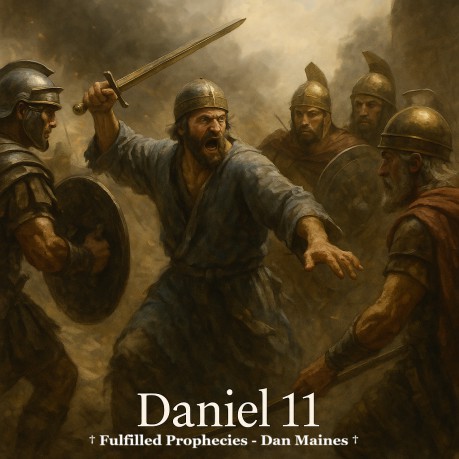
Daniel 11 Daniel 11:1-2 † The angel continues from chapter 10, assuring
Daniel that divine purpose directs the rise of nations. Daniel 11:3-4 † The "mighty king" is Alexander the
Great, whose empire swiftly conquered Persia. Daniel 11:5-6 † The "king of the South" refers to
Ptolemy I of Egypt; the "king of the North" to Seleucus I
of Syria. Daniel 11:7-9 † Ptolemy III, Berenice's brother, avenged her
death by invading Syria. Daniel 11:10-12 † The sons of Seleucus II were Seleucus III and
Antiochus III, who sought to retake lost territory. Daniel 11:13-15 † Antiochus III renewed his campaigns and
gained the upper hand over Egypt. Daniel 11:16-17 † Antiochus III conquered Judea, called “the
Beautiful Land,” symbolizing Israel's territory. Daniel 11:18-19 † Antiochus III attempted to invade Greece but
was defeated by the Romans under Lucius Scipio. Daniel 11:20 † This refers to Seleucus IV, who taxed heavily
to pay Rome's tribute. Daniel 11:21-22 † The “despicable person” is Antiochus IV
Epiphanes, infamous for persecuting the Jews. Daniel 11:23-24 † Antiochus IV deceived his allies and
strengthened himself through manipulation and bribery. Daniel 11:25-27 † Antiochus IV waged war against Egypt and
triumphed through deceit. Daniel 11:28-30 † Antiochus' rage turned toward Jerusalem after
Roman forces (ships of Kittim) repelled him. Daniel 11:31-32 † Antiochus IV desecrated the temple by
offering swine on the altar and erecting an idol to Zeus. Daniel 11:33-35 † The wise among Israel suffered but
strengthened others through their witness. Daniel 11:36-39 † This section portrays Antiochus IV's pride
and self-deification. Daniel 11:40-45 † Antiochus' final campaign into Egypt failed;
he died suddenly in Persia. How it applies to us today † Daniel 11 traces the rise and fall of empires
under divine control. † This is the fulfilled perspective we proclaim at
Fulfilled Prophecies † Source Index
By Dan Maines
In the first year of Darius
the Mede, I arose to be an encouragement and a protection for him.
And now I will tell you the truth. Behold, three more kings are going
to arise in Persia. Then a fourth will gain far more riches than all
of them; as soon as he becomes strong through his riches, he will
arouse the whole empire against the realm of Greece.
†
Historically, the three kings after Cyrus were Cambyses,
Pseudo-Smerdis, and Darius I; the fourth, Xerxes I, provoked
Greece.
† Prophetically, Persia's aggression
begins the sequence leading to Greece's dominance under Alexander.
†
Jerome noted that the angel's precision proved prophecy's
reliability.
† In the fulfilled kingdom,
these empires testify that God rules over all human history.
Then a mighty king will arise,
and he will rule with great authority and do as he pleases. But as
soon as he has arisen, his kingdom will be broken up and parceled out
toward the four points of the compass, though not to his own
descendants, nor according to his authority which he wielded, for his
sovereignty will be uprooted and given to others besides them.
†
Historically, his realm was divided among four generals after his
death in 323 BC.
† Prophetically, this sets
the stage for the northern and southern kingdoms that affect Israel's
land.
† Josephus confirmed the Jews welcomed
Alexander, who spared Jerusalem.
† In the
fulfilled kingdom, earthly power rises and falls, but Christ's reign
endures.
Then the king of the South
will grow strong, along with one of his princes who will gain
ascendancy over him and obtain dominion; his domain will be a great
dominion indeed. After some years they will form an alliance, and the
daughter of the king of the South will come to the king of the North
to carry out a peaceful arrangement. But she will not retain her
position of power, nor will he remain with his power, but she will be
given up, along with those who brought her in and the one who sired
her and he who supported her in those times.
† Historically, Ptolemy's daughter
Berenice married Antiochus II to secure peace, but she and her
supporters were murdered, reigniting conflict.
†
Prophetically, these struggles show how alliances fail apart from
divine will.
† Jerome identified this
prophecy as proof of scripture's historical accuracy.
†
In the fulfilled kingdom, temporary treaties are replaced by Christ's
eternal peace.
But one of the descendants of
her line will arise in his place, and he will come against their army
and enter the fortress of the king of the North, and he will deal
with them and display great strength. Also, their gods with their
metal images and their precious vessels of silver and gold he will
take into captivity to Egypt, and he on his part will refrain from
attacking the king of the North for some years. Then the latter will
enter the realm of the king of the South, but will return to his own
land.
† Historically, he
captured great wealth and returned to Egypt triumphantly.
†
Prophetically, this shows divine justice executed among earthly
kingdoms.
† Jerome said the detail of looted
idols proved the literal accuracy of prophecy.
†
In the fulfilled kingdom, vengeance belongs to God alone, and His
justice prevails.
His sons will mobilize and
assemble a multitude of great forces, and one of them will keep on
coming and overflow and pass through, that he may again wage war up
to his very fortress. Then the king of the South will be enraged and
go forth and fight with the king of the North. Then the latter will
raise a great multitude, but that multitude will be given into the
hand of the former. When the multitude is carried away, his heart
will be lifted up, and he will cause tens of thousands to fall; yet
he will not prevail.
†
Historically, Antiochus III fought Ptolemy IV but was defeated at
Raphia.
† Prophetically, these wars represent
the ongoing struggle between North and South before Rome's rise.
†
Eusebius noted that even victories of kings end in pride and
downfall.
† In the fulfilled kingdom, earthly
pride collapses under Christ's eternal authority.
For the king of the North
will again raise a greater multitude than the former, and after an
interval of some years he will press on with a great army and much
equipment. Now in those times many will rise up against the king of
the South; the violent ones among your people will also lift
themselves up in order to fulfill the vision, but they will fall
down. Then the king of the North will come, cast up a siege ramp, and
capture a well-fortified city; and the forces of the South will not
stand their ground, not even their choicest troops, for there will be
no strength to make a stand.
†
Historically, this refers to the Battle of Panium in 198 BC, when the
Seleucids captured Judea.
† Prophetically,
this signified Judea's subjection to foreign rule until Christ.
†
Jerome said these shifts of power fulfilled the words exactly as
Daniel foresaw.
† In the fulfilled kingdom,
the nations serve under the dominion of Christ, not earthly kings.
But he who comes against him
will do as he pleases, and no one will be able to withstand him; he
will also stay for a time in the Beautiful Land, with destruction in
his hand. He will set his face to come with the power of his whole
kingdom, bringing with him a proposal of peace which he will put into
effect; he will also give him the daughter of women to ruin it. But
she will not take a stand for him or be on his side.
†
Historically, he tried to ally with Egypt by giving his daughter
Cleopatra to Ptolemy V.
† Prophetically, his
deceit failed, showing how man's plans oppose divine purpose.
†
Jerome confirmed Cleopatra sided with Egypt, not her father.
†
In the fulfilled kingdom, deceit and manipulation are replaced by the
truth of Christ's reign.
Then he will turn his face
to the coastlands and capture many. But a commander will put a stop
to his scorn against him; moreover, he will repay him for his scorn.
So he will turn his face toward the fortresses of his own land, but
he will stumble and fall and be found no more.
†
Historically, he retreated to his own land and was later killed in
Persia.
† Prophetically, this fall marks the
decline of the Seleucid power.
† Eusebius
wrote that arrogance against Rome fulfilled Daniel's vision of
downfall.
† In the fulfilled kingdom, all
proud rulers fall, but Christ's kingdom endures forever.
Then in his place one will
arise who will send an oppressor through the Jewel of his kingdom;
yet within a few days he will be shattered, though not in anger nor
in battle.
† Historically, he
sent his treasurer Heliodorus to plunder the temple in Jerusalem.
†
Prophetically, this represents the corruption that provoked divine
judgment.
† Jerome said Seleucus' mysterious
death was divine retribution for defiling sacred things.
†
In the fulfilled kingdom, Christ alone is the true temple that cannot
be plundered.
In his place a despicable
person will arise, on whom the honor of kingship has not been
conferred, but he will come in a time of tranquility and seize the
kingdom by intrigue. The overflowing forces will be flooded away
before him and shattered, and also the prince of the covenant.
†
Historically, he usurped the throne and attacked the high priesthood
in Jerusalem.
† Prophetically, his acts
foreshadowed the abomination that causes desolation.
†
Josephus records Antiochus' cruelty and defilement of the altar.
†
In the fulfilled kingdom, persecution gives way to the triumph of the
saints through Christ.
After an alliance is made
with him, he will practice deception, and he will go up and gain
power with a small force of people. In a time of tranquility he will
enter the richest parts of the realm, and he will accomplish what his
fathers never did, nor his ancestors; he will distribute plunder,
booty, and possessions among them, and he will devise his schemes
against strongholds, but only for a time.
†
Historically, he redistributed wealth to secure loyalty.
†
Prophetically, his reign illustrates the temporary nature of
deceitful power.
† Jerome said that even his
successes were limited by God's decree.
† In
the fulfilled kingdom, deceit ends, and justice reigns under the
eternal King.
He will stir up his strength
and courage against the king of the South with a large army; so the
king of the South will mobilize an extremely large and mighty army
for war; but he will not stand, for schemes will be devised against
him. Those who eat his choice food will destroy him, and his army
will overflow, but many will fall down slain. As for both kings,
their hearts will be intent on evil, and they will speak lies to each
other at the same table; but it will not succeed, for the end is
still to come at the appointed time.
† Historically,
Ptolemy VI was betrayed by his own counselors.
†
Prophetically, the lying kings reflect the futility of human
schemes.
† Eusebius noted that prophecy
exposes both rulers as tools of divine providence.
†
In the fulfilled kingdom, truth and righteousness have replaced
deceitful thrones.
Then he will return to his
land with much plunder; but his heart will be set against the holy
covenant, and he will take action and then return to his own land. At
the appointed time he will return and come into the South, but this
last time it will not turn out the way it did before. For ships of
Kittim will come against him; therefore he will be disheartened and
will return and become enraged at the holy covenant and take action;
so he will come back and show regard for those who forsake the holy
covenant.
†
Historically, this refers to the intervention of Rome in 168 BC.
†
Prophetically, his wrath against the covenant people fulfills the
pattern of persecution before redemption.
†
Jerome explained that those who forsook the covenant joined Antiochus
in desecrating the temple.
† In the fulfilled
kingdom, external persecution could not destroy God's true spiritual
temple.
Forces from him will arise,
desecrate the sanctuary fortress, and do away with the regular
sacrifice. And they will set up the abomination of desolation. By
smooth words he will turn to godlessness those who act wickedly
toward the covenant, but the people who know their God will display
strength and take action.
†
Historically, this led to the Maccabean revolt.
†
Prophetically, Jesus later referred to this same event as typifying
Jerusalem's coming destruction in AD 70.
†
Eusebius identified Antiochus as the prototype of the final
persecutor.
† In the fulfilled kingdom, the
true sacrifice is complete in Christ, ending all temple offerings.
Those who have insight among
the people will give understanding to the many; yet they will fall by
sword and by flame, by captivity and by plunder for many days. Now
when they fall they will be granted a little help, and many will join
with them in hypocrisy. Some of those who have insight will fall, in
order to refine, purge, and make them pure until the end time;
because it is still to come at the appointed time.
†
Historically, faithful Jews endured martyrdom under Antiochus'
oppression.
† Prophetically, these trials
refined the faithful before the new covenant's arrival.
†
Jerome wrote that purification comes through suffering ordained by
God.
† In the fulfilled kingdom, suffering
produces maturity and spiritual victory through Christ.
Then the king will do as he
pleases, and he will exalt and magnify himself above every god and
will speak monstrous things against the God of gods; and he will
prosper until the indignation is finished, for that which is decreed
will be done. He will show no regard for the gods of his fathers or
for the desire of women, nor will he show regard for any other god;
for he will magnify himself above them all. But instead he will honor
a god of fortresses, a god whom his fathers did not know; he will
honor him with gold, silver, costly stones, and treasures. He will
take action against the strongest of fortresses with the help of a
foreign god; he will give great honor to those who acknowledge him
and will cause them to rule over the many and will parcel out land
for a price.
† Historically, he
declared himself “God Manifest” and enforced Hellenistic
worship.
† Prophetically, his arrogance
typified the ultimate rebellion that ended with the old covenant
age.
† Hippolytus saw Antiochus' fall as the
foreshadowing of the final judgment upon apostate Jerusalem.
†
In the fulfilled kingdom, pride and blasphemy are silenced under the
rule of Christ.
At the end time the king of
the South will collide with him, and the king of the North will storm
against him with chariots, with horsemen, and with many ships; and he
will enter countries, overflow them and pass through. He will also
enter the Beautiful Land, and many countries will fall; but these
will be rescued out of his hand: Edom, Moab, and the foremost of the
sons of Ammon. Then he will stretch out his hand against other
countries, and the land of Egypt will not escape. But he will gain
control over the hidden treasures of gold and silver and over all the
precious things of Egypt; and Libyans and Ethiopians will follow at
his heels. But rumors from the East and from the North will disturb
him, and he will go forth with great wrath to destroy and annihilate
many. He will pitch the tents of his royal pavilion between the seas
and the beautiful Holy Mountain; yet he will come to his end, and no
one will help him.
† Historically,
this marks the close of Seleucid dominance.
†
Prophetically, his downfall symbolizes the end of human rebellion
before divine rule.
† Eusebius said his death
prefigured the destruction of Jerusalem's persecutors.
†
In the fulfilled kingdom, all earthly empires end, but Christ's
dominion is everlasting.
† Every conflict and
betrayal fulfilled prophecy, proving God's sovereignty.
†
The abomination of desolation was historically fulfilled, ending
temple worship.
† The faithful were refined
to usher in the new covenant through Christ.
†
We now live in the everlasting peace of His fulfilled kingdom.
© Fulfilled Prophecies - Dan
Maines.
† The Holy
Bible, NASB
† Josephus, Antiquities of the
Jews, Book 12
† Eusebius, Ecclesiastical
History, Book 9
† Tertullian, Against
Marcion, Book 4
† Clement of Rome, 1
Clement
† Jerome, Commentary on Daniel
†
Theodotion, Greek Version of Daniel
†
Hippolytus, Commentary on Daniel
Links