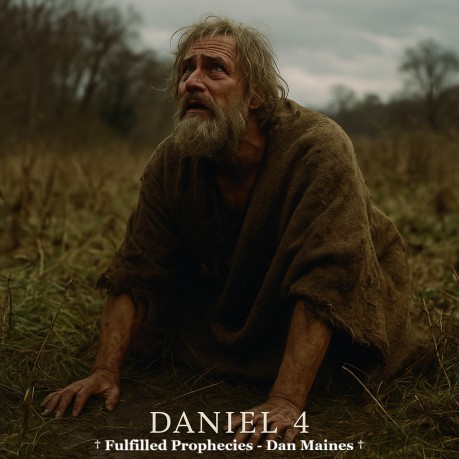
Daniel 4 Daniel 4:1–3 † Nebuchadnezzar begins this chapter as a
witness of God's power after experiencing His judgment and mercy. Daniel 4:4–5 † The king's comfort preceded his downfall,
showing how pride leads to divine correction. Daniel 4:6–7 † Once again, the futility of human wisdom is
exposed. Daniel 4:8–9 † Daniel's reputation was known even among
idolaters, revealing that true wisdom stands out in every age. Daniel 4:10–12 † The great tree symbolizes Babylon's empire
and Nebuchadnezzar's power over the nations. Daniel 4:13–15 † The watcher's command shows divine judgment
mixed with mercy, the tree is cut but not destroyed. Daniel 4:16–18 † The king's humiliation would teach the
nations that God alone rules over men. Daniel 4:19–22 † Daniel's sorrow reveals compassion even
toward those under judgment. Daniel 4:23–25 † The king's fall was decreed so that pride
would give way to repentance. Daniel 4:26–27 † God's mercy provided a chance for repentance
before judgment fell. Daniel 4:28–33 † Pride immediately brought divine
correction. Daniel 4:34–37 † Nebuchadnezzar's restoration shows that
repentance restores reason and relationship with God. How it applies to us today † Daniel 4 shows that pride is the root of
spiritual downfall, but humility brings restoration. † This is the fulfilled perspective we proclaim at
Fulfilled Prophecies † Source Index
By Dan Maines
Nebuchadnezzar the king to
all the peoples, nations, and men of every language that live in all
the earth: "May your peace abound! It has seemed good to me to
declare the signs and wonders which the Most High God has done for
me. How great are His signs and how mighty are His wonders! His
kingdom is an everlasting kingdom and His dominion is from generation
to generation."
†
Historically, royal proclamations like this were inscribed to glorify
the king's god, but here Nebuchadnezzar honors the Most High.
†
Prophetically, this foreshadows the spread of God's kingdom through
all nations, not just Israel.
† Jerome wrote
that Nebuchadnezzar's confession showed the conversion of a Gentile
heart to recognize divine sovereignty.
† In
the fulfilled kingdom, every tongue confesses that Christ reigns, and
His dominion has no end.
"I, Nebuchadnezzar, was
at ease in my house and flourishing in my palace. I saw a dream and
it made me fearful; and these fantasies as I lay on my bed and the
visions in my mind kept alarming me."
†
Historically, Babylon's wealth and splendor were unmatched, but they
bred arrogance.
† Prophetically, this dream
warns that human power without humility brings ruin.
†
Hippolytus wrote that the king's fear shows how worldly security
collapses before divine truth.
† In the
fulfilled kingdom, pride is replaced by humility, as Christ's reign
brings peace through surrender.
"So I gave orders to
bring into my presence all the wise men of Babylon, that they might
make known to me the interpretation of the dream. Then the magicians,
the conjurers, the Chaldeans and the diviners came in and I related
the dream to them, but they could not make its interpretation known
to me."
† Historically, Babylon's magicians
failed repeatedly when confronted by divine revelation.
†
Prophetically, this shows that no earthly system can interpret the
mysteries of God's kingdom.
† Eusebius
compared this to the silence of pagan oracles before the gospel's
light.
† In the fulfilled kingdom, all
mysteries are revealed in Christ, who is the wisdom of God.
"But finally Daniel came
in before me, whose name is Belteshazzar according to the name of my
god, and in whom is a spirit of the holy gods; and I related the
dream to him, saying, 'O Belteshazzar, chief of the magicians, since
I know that a spirit of the holy gods is in you and no mystery
baffles you, tell me the visions of my dream which I have seen, along
with its interpretation.'"
†
Historically, the king still used Daniel's Babylonian name, showing
that his understanding was partial.
†
Prophetically, Daniel prefigures Christ, the true interpreter of
God's mysteries to the nations.
† Theodotion
noted that Daniel's insight proved that divine knowledge surpasses
human philosophy.
† In the fulfilled kingdom,
Christ's Spirit reveals all truth to those who seek God sincerely.
"Now these were the
visions in my mind as I lay on my bed: I was looking, and behold,
there was a tree in the midst of the earth and its height was great.
The tree grew large and became strong and its height reached to the
sky, and it was visible to the end of the whole earth. Its foliage
was beautiful and its fruit abundant, and in it was food for all. The
beasts of the field found shade under it, and the birds of the sky
dwelt in its branches, and all living creatures fed themselves from
it."
†
Historically, ancient kings were often likened to trees giving
shelter to peoples and nations.
†
Prophetically, this image later reappears in Christ's parable of the
mustard seed, showing the true kingdom's growth.
†
Jerome saw this as a contrast between temporary earthly empires and
God's eternal one.
† In the fulfilled
kingdom, Christ alone provides lasting shelter and nourishment to all
nations.
"I was looking in the
visions of my mind as I lay on my bed, and behold, an angelic
watcher, a holy one, descended from heaven. He shouted out and spoke
as follows: 'Chop down the tree and cut off its branches, strip off
its foliage and scatter its fruit; let the beasts flee from under it
and the birds from its branches. Yet leave the stump with its roots
in the ground, but with a band of iron and bronze around it in the
new grass of the field; and let him be drenched with the dew of
heaven, and let him share with the beasts in the grass of the
earth.'"
†
Historically, this represents Nebuchadnezzar's temporary fall rather
than total ruin.
† Prophetically, this
reflects how God humbles rulers but preserves their place for
repentance.
† Clement taught that God's
correction is not for destruction but for restoration.
†
In the fulfilled kingdom, judgment always leads to redemption through
humility and repentance.
"Let his mind be
changed from that of a man and let a beast's mind be given to him,
and let seven periods of time pass over him. This sentence is by the
decree of the angelic watchers and the decision is a command of the
holy ones, in order that the living may know that the Most High is
ruler over the realm of mankind, and bestows it on whom He wishes and
sets over it the lowliest of men. This is the dream which I, King
Nebuchadnezzar, have seen. Now you, Belteshazzar, tell me its
interpretation, inasmuch as none of the wise men of my kingdom is
able to make known to me the interpretation; but you are able, for a
spirit of the holy gods is in you."
†
Historically, "seven periods of time" refers to a complete
cycle of divine discipline.
† Prophetically,
this mirrors how God removed Israel's pride before establishing His
everlasting kingdom.
† Hippolytus wrote that
the "lowliest of men" ultimately refers to Christ, who
reigns after humbling Himself.
† In the
fulfilled kingdom, all authority belongs to the humble King who rules
forever.
Then Daniel, whose name is
Belteshazzar, was appalled for a while as his thoughts alarmed him...
"The tree that you saw, which became large and grew strong,
whose height reached to the sky and was visible to all the earth...
it is you, O king, for you have become great and grown strong, and
your majesty has become great and reached to the sky and your
dominion to the end of the earth."
† Historically,
Nebuchadnezzar's dominion extended across the ancient Near East,
confirming the vision's scope.
†
Prophetically, the greatness of the tree represents the temporary
glory of earthly kingdoms.
† Eusebius noted
that Daniel's respect for authority did not silence truth.
†
In the fulfilled kingdom, we speak truth with compassion, knowing
judgment serves God's purpose.
"And in that the king
saw an angelic watcher... saying, 'Chop down the tree...' that it is
you, O king, that will be driven away from mankind and your dwelling
place will be with the beasts of the field... until you recognize
that the Most High is ruler over the realm of mankind and bestows it
on whomever He wishes."
† Historically,
Nebuchadnezzar's madness lasted until he acknowledged divine
authority.
† Prophetically, this shows that
even the greatest powers are subject to God's correction.
†
Jerome said this story teaches that pride dethrones kings, while
humility restores them.
† In the fulfilled
kingdom, all dominion belongs to Christ, who rules through
righteousness and humility.
"And in that it was
commanded to leave the stump with the roots of the tree, your kingdom
will be assured to you after you recognize that it is Heaven that
rules. Therefore, O king, may my advice be pleasing to you: break
away now from your sins by doing righteousness and from your
iniquities by showing mercy to the poor, in case there may be a
prolonging of your prosperity."
† Historically,
Daniel's counsel urged the king to humble himself through justice and
compassion.
† Prophetically, this reflects
the gospel's call to repentance before destruction came upon
Jerusalem.
† Clement emphasized that mercy to
the poor is the fruit of true repentance.
†
In the fulfilled kingdom, repentance restores life and establishes
lasting peace.
All this happened to
Nebuchadnezzar the king... while the word was in the king's mouth, a
voice came from heaven, saying, "King Nebuchadnezzar, to you it
is declared: sovereignty has been removed from you!"
† Historically, Nebuchadnezzar's
loss of reason is consistent with known descriptions of madness and
isolation.
† Prophetically, his fall mirrors
Israel's humbling before God raised up the true kingdom in Christ.
†
Hippolytus and Jerome both wrote that this event showed how God
resists the proud and exalts the humble.
† In
the fulfilled kingdom, pride falls, but grace restores those who bow
before God's rule.
"But at the end of
that period I, Nebuchadnezzar, raised my eyes toward heaven and my
reason returned to me, and I blessed the Most High... Now I,
Nebuchadnezzar, praise, exalt and honor the King of heaven, for all
His works are true and His ways just, and He is able to humble those
who walk in pride."
†
Historically, the king's public confession was unprecedented among
ancient monarchs.
† Prophetically, his
renewal prefigures the Gentile world turning from idolatry to
acknowledge the true God.
† Eusebius and
Jerome recorded this confession as a symbol of nations submitting to
divine truth.
† In the fulfilled kingdom,
those once proud are transformed into witnesses of God's eternal
reign.
†
God still rules over nations, exalting and humbling as He wills.
†
The story proves that repentance brings renewed understanding and
blessing.
† Christ reigns as the everlasting
King who replaces all temporary thrones of men.
†
In the fulfilled kingdom, the humble walk in wisdom, giving glory to
God alone.
© Fulfilled Prophecies - Dan
Maines.
† The Holy
Bible, NASB
† Josephus, Antiquities of the
Jews, Book 10
† Eusebius, Ecclesiastical
History, Book 9
† Tertullian, Against
Marcion, Book 4
† Clement of Rome, 1
Clement
† Jerome, Commentary on Daniel
†
Theodotion, Greek Version of Daniel
†
Hippolytus, Commentary on Daniel
Links