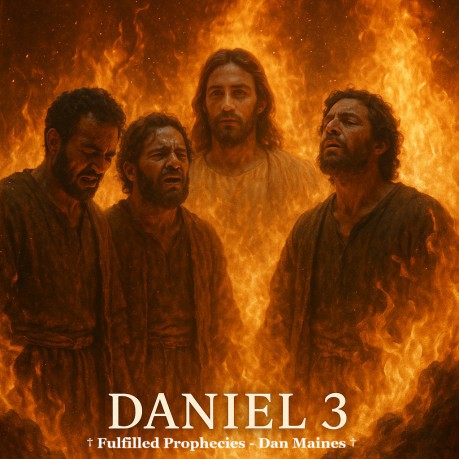
Daniel 3 Daniel 3:1 † The golden image symbolized Nebuchadnezzar's
pride and rebellion against the God who revealed his dream. Daniel 3:2–3 † The repetition of titles emphasizes the
vastness of Babylon's empire and its demand for total allegiance. Daniel 3:4–6 † The decree demanded universal worship,
uniting politics and religion under one idol. Daniel 3:7 † The mass obedience revealed the fear and
conformity of men without conviction. Daniel 3:8–12 † Envy drove the Chaldeans to accuse the
faithful, revealing the conflict between obedience to God and
allegiance to man. Daniel 3:13–15 † The king's arrogance challenged God directly,
testing His power to save. Daniel 3:16–18 † Their unwavering faith stands as one of the
greatest testimonies of loyalty to God in scripture. Daniel 3:19–23 † The fire represents both judgment and
purification, showing that faith is tested by tribulation. Daniel 3:24–25 † The fourth man in the fire reveals the
presence of Christ protecting His faithful servants. Daniel 3:26–27 † The miracle proved that God's power
transcends physical law and human judgment. Daniel 3:28–30 † The king's confession glorified the true God
before all nations, just as Daniel's revelation had done earlier. How it applies to us today † Daniel 3 teaches that faithfulness to God
overcomes every trial of persecution and conformity. † This is the fulfilled perspective we proclaim at
Fulfilled Prophecies † Source Index
By Dan Maines
Nebuchadnezzar the king made an
image of gold, the height of which was sixty cubits and its width six
cubits; he set it up on the plain of Dura in the province of Babylon.
†
Historically, ancient kings often built colossal statues to assert
divine authority, representing their kingdoms as everlasting.
†
Prophetically, this act reflected the arrogance of worldly powers
that oppose God's kingdom.
† Josephus
recorded that Nebuchadnezzar's image was likely dedicated to Bel, his
national deity.
† In the fulfilled kingdom,
this image represents man's attempt to replace God's rule with human
dominion, which Christ destroyed.
Then Nebuchadnezzar the king
sent word to assemble the satraps, the prefects, and the governors,
the counselors, the treasurers, the judges, the magistrates, and all
the rulers of the provinces to come to the dedication of the image.
Then the satraps, the prefects, the governors, the counselors, the
treasurers, the judges, the magistrates, and all the rulers of the
provinces were assembled for the dedication of the image that
Nebuchadnezzar had set up; and they stood before the image that
Nebuchadnezzar had set up.
†
Historically, Nebuchadnezzar gathered every class of official to
ensure political and religious unity under his rule.
†
Prophetically, this mirrors the first-century persecution against
those who would not bow to Rome's imperial cult.
†
Jerome saw in this passage a warning against earthly governments
demanding worship due only to God.
† In the
fulfilled kingdom, the saints bow only to Christ, the true King, not
to any earthly power.
Then the herald loudly
proclaimed: "To you the command is given, O peoples, nations,
and men of every language, that at the moment you hear the sound of
the horn, flute, lyre, trigon, psaltery, bagpipe and all kinds of
music, you are to fall down and worship the golden image that
Nebuchadnezzar the king has set up. But whoever does not fall down
and worship shall immediately be cast into the midst of a furnace of
blazing fire."
†
Historically, such decrees served to prove loyalty to the king rather
than sincere faith.
† Prophetically, this
anticipates the Beast of Revelation, enforcing worship through threat
of death under Rome.
† Eusebius compared this
command to the persecution of Christians who refused to burn incense
to Caesar.
† In the fulfilled kingdom, the
fire of persecution purifies faith rather than destroys it.
Therefore at that time, when all
the people heard the sound of the horn, flute, lyre, trigon,
psaltery, bagpipe, and all kinds of music, all the peoples, nations,
and men of every language fell down and worshiped the golden image
that Nebuchadnezzar the king had set up.
†
Historically, Babylon's empire was vast, stretching across many
languages and cultures.
† Prophetically, this
represents worldly submission to corrupt power when truth is
absent.
† Theodotion noted that the language
of "every nation" anticipates the contrast of Pentecost,
when every tongue glorified God instead.
† In
the fulfilled kingdom, believers from every nation now bow to Christ,
not to earthly idols.
For this reason at that time
certain Chaldeans came forward and brought charges against the
Jews... They said, "There are certain Jews whom you have
appointed over the administration of the province of Babylon, namely
Shadrach, Meshach and Abed-nego; these men, O king, have disregarded
you; they do not serve your gods or worship the golden image which
you have set up."
† Historically, Jews often
faced jealousy when God's favor elevated them within pagan nations.
†
Prophetically, this parallels the accusations against the apostles
who refused to obey men rather than God.
†
Clement wrote that the righteous are always accused by those who fear
their integrity.
† In the fulfilled kingdom,
persecution still arises when truth exposes false authority.
Then Nebuchadnezzar in rage
and anger gave orders to bring Shadrach, Meshach and Abed-nego; then
these men were brought before the king. Nebuchadnezzar responded and
said to them, "Is it true, Shadrach, Meshach and Abed-nego, that
you do not serve my gods or worship the golden image that I have set
up? Now if you are ready, at the moment you hear the sound of the
horn, flute, lyre, trigon, psaltery and bagpipe and all kinds of
music, to fall down and worship the image that I have made, very
well. But if you do not worship, you will immediately be cast into
the midst of a furnace of blazing fire; and what god is there who can
deliver you out of my hands?"
† Historically,
Nebuchadnezzar's words reveal the pride that blinded rulers to God's
sovereignty.
† Prophetically, his threat
symbolizes the persecution believers endured from Rome, which also
questioned who could deliver them.
† Jerome
said Nebuchadnezzar's boast was crushed by the miracle that
followed.
† In the fulfilled kingdom, the
faithful fear no threat, knowing Christ has already conquered death.
Shadrach, Meshach and
Abed-nego replied to the king, "O Nebuchadnezzar, we do not need
to give you an answer concerning this matter. If it be so, our God
whom we serve is able to deliver us from the furnace of blazing fire;
and He will deliver us out of your hand, O king. But even if He does
not, let it be known to you, O king, that we are not going to serve
your gods or worship the golden image that you have set up."
†
Historically, this bold declaration was a public rejection of
Babylon's authority over conscience.
†
Prophetically, this represents the faith of early martyrs who faced
death rather than deny Christ.
† Tertullian
praised this courage as the same spirit that sustained Christians
under Roman persecution.
† In the fulfilled
kingdom, true faith stands firm even when deliverance is unseen,
trusting in eternal victory.
Then Nebuchadnezzar was
filled with wrath, and his facial expression was altered toward
Shadrach, Meshach and Abed-nego. He answered by giving orders to heat
the furnace seven times more than it was usually heated... these men
were tied up in their trousers, their coats, their caps and their
other clothes, and were cast into the midst of the furnace of blazing
fire.
†
Historically, Babylonian furnaces were used for smelting and
punishment, reaching extreme temperatures.
†
Prophetically, the sevenfold fire symbolizes complete testing, which
only strengthens true faith.
† Jerome
observed that their garments were preserved to prove divine
intervention beyond natural cause.
† In the
fulfilled kingdom, believers pass through spiritual fire, refined and
unharmed by the world's wrath.
Then Nebuchadnezzar the
king was astounded and stood up in haste; he said to his high
officials, "Was it not three men we cast bound into the midst of
the fire?"... "Look! I see four men loosed and walking
about in the midst of the fire without harm, and the appearance of
the fourth is like a son of the gods!"
†
Historically, the king's astonishment showed that divine power
triumphed over earthly judgment.
†
Prophetically, this scene prefigures Christ's deliverance of His
people through His presence in suffering.
†
Hippolytus identified the fourth man as the Word of God appearing in
visible form.
† In the fulfilled kingdom,
Christ remains present with His people in every trial, ensuring
victory through faith.
Then Nebuchadnezzar came
near to the door of the furnace of blazing fire; he responded and
said, "Shadrach, Meshach and Abed-nego, come out, you servants
of the Most High God, and come here!"... The satraps, the
prefects, the governors, and the king's high officials gathered
around and saw in regard to these men that the fire had no effect on
their bodies, nor was the hair of their head singed, nor were their
trousers damaged, nor had the smell of fire even come upon them.
†
Historically, the preservation of their bodies and clothing
emphasized total divine protection.
†
Prophetically, this symbolizes resurrection and deliverance from
destruction through faith.
† Eusebius
compared this miracle to the indestructibility of Christ's body,
which overcame death itself.
† In the
fulfilled kingdom, the faithful emerge from trials untouched, clothed
in righteousness.
Nebuchadnezzar responded
and said, "Blessed be the God of Shadrach, Meshach and
Abed-nego, who has sent His angel and delivered His servants who put
their trust in Him... Therefore I make a decree that any people,
nation or tongue that speaks anything offensive against the God of
Shadrach, Meshach and Abed-nego shall be torn limb from limb and
their houses reduced to a rubbish heap." Then the king caused
Shadrach, Meshach and Abed-nego to prosper in the province of
Babylon.
†
Historically, Nebuchadnezzar's decree acknowledged divine supremacy
though his heart remained proud.
†
Prophetically, this anticipates the nations confessing Christ's name
after His victory over death.
† Jerome noted
that though Nebuchadnezzar confessed truth, full faith came only
later through humility.
† In the fulfilled
kingdom, the name of Christ is confessed among every nation, and His
servants reign with Him.
†
The fire represents trials that reveal the genuineness of faith, not
its destruction.
† Christ walks with His
people through every furnace of life, ensuring complete victory.
†
The kingdoms of men still demand allegiance, but the believer's
loyalty belongs to Christ alone.
† In the
fulfilled kingdom, the saints reign with the Son of God who delivers
from every fire of affliction.
© Fulfilled Prophecies - Dan
Maines.
† The Holy
Bible, NASB
† Josephus, Antiquities of the
Jews, Book 10
† Eusebius, Ecclesiastical
History, Book 9
† Tertullian, Against
Marcion, Book 4
† Clement of Rome, 1
Clement
† Jerome, Commentary on Daniel
†
Theodotion, Greek Version of Daniel
†
Hippolytus, Commentary on Daniel
Links