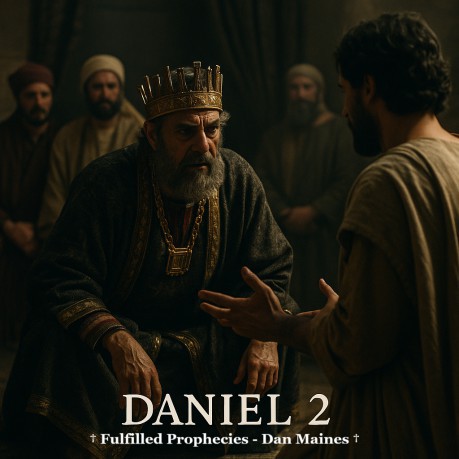
Daniel 2 Daniel 2:1 † God used a dream to unsettle the king,
revealing His control even over Gentile rulers. Daniel 2:2 † The king turned first to human wisdom, which
always fails before divine revelation. Daniel 2:3 † Nebuchadnezzar's anxiety shows how earthly
power cannot bring peace without understanding God's purpose. Daniel 2:4–5 † The king's demand revealed his distrust of
their wisdom, testing whether they had real divine insight. Daniel 2:6–7 † The wise men's hesitation showed their
dependence on guesswork rather than revelation. Daniel 2:8–9 † The king exposed their deceit, showing how
human wisdom fails when faced with divine testing. Daniel 2:10–11 † Their confession revealed truth without
understanding—they admitted that no man could do it. Daniel 2:12–13 † Earthly kings react in wrath when human
wisdom fails them, yet God turns wrath to His purpose. Daniel 2:14–16 † Daniel's calm wisdom shows faith in God's
power, not fear of man. Daniel 2:17–18 † Daniel's first response was prayer, showing
total reliance on God for revelation. Daniel 2:19–20 † God revealed what no human could discover,
proving His sovereignty over all wisdom. Daniel 2:21–23 † Daniel recognized God's rule over time,
kings, and revelation. Daniel 2:24–28 † Daniel's humility gave glory to God, not
himself, showing true prophetic character. Daniel 2:29–35 † The statue represented successive world
empires, each inferior to the one before. Daniel 2:36–45 † Daniel clearly declared that God Himself
establishes all kingdoms. Daniel 2:46–49 † The pagan king acknowledged the supremacy of
Israel's God, fulfilling the purpose of revelation. How it applies to us today † Daniel 2 reveals that all human power is
temporary, but God's kingdom is eternal. † This is the fulfilled perspective we proclaim at
Fulfilled Prophecies † Source Index
By Dan Maines
Now in the second year of the
reign of Nebuchadnezzar, Nebuchadnezzar had dreams; and his spirit
was troubled and his sleep left him.
†
Historically, Babylonian kings believed their dreams came from the
gods and sought interpretation from magicians.
†
Prophetically, this begins the revelation of the coming succession of
kingdoms leading to Christ's eternal reign.
†
Jerome noted that God allowed the dream to awaken the king's fear of
divine purpose.
† In the fulfilled kingdom,
this shows that Christ's dominion began as God revealed His plan to
the nations.
Then the king gave orders to call
in the magicians, the conjurers, the sorcerers and the Chaldeans to
tell the king his dreams. So they came in and stood before the king.
†
Historically, Babylon's wise men formed a priestly class devoted to
astrology and divination.
† This contrasts
the false wisdom of men with the true wisdom revealed through God's
servants.
† Eusebius compared the failure of
these men to the fading power of pagan religion before Christ.
†
In the fulfilled kingdom, only revelation through Christ gives true
understanding of God's mysteries.
The king said to them, "I
had a dream and my spirit is anxious to understand the dream."
†
Historically, dreams were central to Babylonian religion, but the
king demanded more than flattery.
†
Prophetically, this mirrors humanity's search for truth apart from
God, which ends in confusion.
† Tertullian
wrote that spiritual unrest drives man to seek revelation from the
Creator alone.
† In the fulfilled kingdom,
peace comes only through Christ, the full revelation of God's
mystery.
Then the Chaldeans spoke to
the king in Aramaic: "O king, live forever! Tell the dream to
your servants, and we will declare the interpretation." The king
replied to the Chaldeans, "The command from me is firm: if you
do not make known to me the dream and its interpretation, you will be
torn limb from limb and your houses will be made a rubbish heap."
†
Historically, this switch to Aramaic marks the beginning of the
Aramaic section of Daniel, showing a message for all nations.
†
Prophetically, it foreshadows the revelation of God's kingdom to the
Gentiles through the gospel.
† Jerome
observed that this shift of language showed God's message leaving the
Jews for the nations.
† In the fulfilled
kingdom, all peoples now hear the divine message in their own
language through Christ.
"But if you declare the
dream and its interpretation, you will receive from me gifts and a
reward and great honor; therefore declare to me the dream and its
interpretation." They answered a second time and said, "Let
the king tell the dream to his servants, and we will declare the
interpretation."
†
Historically, Babylonian interpreters relied on symbols and omens,
not divine inspiration.
† Prophetically,
their failure prefigures the futility of human wisdom apart from
God's Spirit.
† Clement wrote that human
reasoning is powerless without divine truth guiding it.
†
In the fulfilled kingdom, understanding comes only through the Spirit
who reveals Christ's completed work.
The king replied, "I
know for certain that you are bargaining for time, inasmuch as you
have seen that the command from me is firm, that if you do not make
the dream known to me, there is only one decree for you. For you have
agreed together to speak lying and corrupt words before me until the
situation is changed; therefore tell me the dream, that I may know
that you can declare to me its interpretation."
†
Historically, Babylonian kings often distrusted their counselors
because of flattery and false promises.
†
Prophetically, this exposes the emptiness of religious systems that
claim knowledge without revelation.
†
Eusebius compared this scene to the collapse of pagan oracles after
Christ's coming.
† In the fulfilled kingdom,
truth stands revealed, and false wisdom is silenced before divine
revelation.
The Chaldeans answered the
king and said, "There is not a man on earth who could declare
the matter for the king, inasmuch as no great king or ruler has ever
asked anything like this of any magician, conjurer, or Chaldean.
Moreover, the thing which the king demands is difficult, and there is
no one else who could declare it to the king except gods, whose
dwelling place is not with mortal flesh."
†
Historically, this acknowledgment paved the way for Daniel to show
the true God's power.
† Prophetically, it
points to Christ, God made manifest among men, whose Spirit reveals
all truth.
† Theodotion noted that even
pagans sensed their limitation and the need for divine revelation.
†
In the fulfilled kingdom, God's dwelling is now with His people
through Christ's Spirit.
Because of this the king
became indignant and very furious and gave orders to destroy all the
wise men of Babylon. So the decree went forth that the wise men
should be slain; and they looked for Daniel and his friends to kill
them.
†
Historically, mass executions of counselors were not uncommon in
ancient courts.
† Prophetically, this
anticipates the persecution of the righteous before the revelation of
the kingdom.
† Jerome recorded that this
crisis tested Daniel's faith and prepared for divine intervention.
†
In the fulfilled kingdom, persecution often precedes deliverance and
greater revelation of truth.
Then Daniel replied with
discretion and discernment to Arioch, the captain of the king's
bodyguard, who had gone forth to slay the wise men of Babylon; he
said to Arioch, "For what reason is the decree from the king so
urgent?" Then Arioch informed Daniel about the matter. So Daniel
went in and requested of the king that he would give him time, in
order that he might declare the interpretation to the king.
† Historically,
Daniel's boldness was rare before a ruler known for cruelty.
†
Prophetically, his intercession prefigures Christ standing before
rulers with divine authority.
† Clement
praised Daniel's courage as an example of faith under threat of
death.
† In the fulfilled kingdom, believers
trust that divine wisdom overcomes every decree of men.
Then Daniel went to his
house and informed his friends, Hananiah, Mishael, and Azariah, about
the matter, so that they might request compassion from the God of
heaven concerning this mystery, so that Daniel and his friends would
not be destroyed with the rest of the wise men of Babylon.
†
Historically, intercession among the faithful remnant was a pattern
of covenant obedience.
† Prophetically, this
prayer reflects the unity of believers seeking God's mercy for
revelation.
† Eusebius taught that the
prayers of the righteous often changed the course of nations.
†
In the fulfilled kingdom, the saints continue in prayer, seeking
understanding through the Spirit.
Then the mystery was
revealed to Daniel in a night vision. Then Daniel blessed the God of
heaven; Daniel said, "Let the name of God be blessed forever and
ever, for wisdom and power belong to Him."
†
Historically, night visions were divine revelations distinct from
dreams of confusion.
† Prophetically, this
foreshadows Christ's revelation of the kingdom's mysteries to His
apostles.
† Jerome said that Daniel's praise
was the model for giving glory to God before men.
†
In the fulfilled kingdom, revelation has come fully through Christ,
and believers bless His name eternally.
"It is He who changes
the times and the epochs; He removes kings and establishes kings; He
gives wisdom to wise men and knowledge to men of understanding. It is
He who reveals the profound and hidden things; He knows what is in
the darkness, and the light dwells with Him. To You, O God of my
fathers, I give thanks and praise, for You have given me wisdom and
power; even now You have made known to me what we requested of You,
for You have made known to us the king's matter."
† Historically, this
declaration affirmed that no kingdom rises apart from divine
decree.
† Prophetically, it foretells the
transition of world empires until Christ's eternal kingdom.
†
Hippolytus taught that Daniel's words describe the succession of
empires fulfilled in history.
† In the
fulfilled kingdom, Christ reigns forever, the light that exposes all
darkness.
Therefore, Daniel went in
to Arioch, whom the king had appointed to destroy the wise men of
Babylon; he went and spoke to him as follows: "Do not destroy
the wise men of Babylon! Take me into the king's presence, and I will
declare the interpretation to the king." Arioch hurriedly
brought Daniel into the king's presence and spoke to him as follows:
"I have found a man among the exiles from Judah who can make the
interpretation known to the king!" The king said to Daniel,
whose name was Belteshazzar, "Are you able to make known to me
the dream which I have seen and its interpretation?" Daniel
answered before the king and said, "As for the mystery about
which the king has inquired, neither wise men, conjurers, magicians
nor diviners are able to declare it to the king. However, there is a
God in heaven who reveals mysteries, and He has made known to King
Nebuchadnezzar what will take place in the latter days."
†
Historically, the phrase "latter days" referred to the
coming of God's kingdom.
† Prophetically,
this dream revealed the full timeline of empires leading to Christ's
reign.
† Jerome affirmed that this prophecy
was fulfilled in the first century under the Roman empire.
†
In the fulfilled kingdom, we see the outcome of all that Daniel
foresaw—the reign of Christ forever.
Daniel described the king's
dream of a great statue made of gold, silver, bronze, iron, and clay,
which was struck by a stone cut without hands that crushed it and
became a great mountain filling the whole earth.
†
Historically, Babylon, Medo-Persia, Greece, and Rome fulfilled this
succession.
† Prophetically, the stone cut
without hands represents Christ's kingdom, not of human origin.
†
Hippolytus and Jerome both confirmed that the stone is Christ whose
kingdom filled the earth after Rome.
† In the
fulfilled kingdom, that stone has become the eternal mountain—the
unending reign of Christ.
"This was the dream;
now we will tell its interpretation before the king. You, O king, are
the king of kings, to whom the God of heaven has given the kingdom,
the power, the strength, and the glory... And in the days of those
kings the God of heaven will set up a kingdom which will never be
destroyed."
† Historically,
this prophecy was fulfilled as each empire rose and fell in
sequence.
† Prophetically, "in the days
of those kings" points to the Roman period when Christ
established His kingdom.
† Eusebius testified
that this prophecy was fulfilled when Christ's eternal kingdom
replaced all earthly rule.
† In the fulfilled
kingdom, there is no future kingdom to come—Christ reigns
eternally.
Then King Nebuchadnezzar
fell on his face and paid homage to Daniel and gave orders to present
to him an offering and fragrant incense. The king answered Daniel and
said, "Surely your God is a God of gods and a Lord of kings and
a revealer of mysteries, since you have been able to reveal this
mystery." Then the king promoted Daniel and gave him many great
gifts, and he made him ruler over the whole province of Babylon and
chief prefect over all the wise men of Babylon. And Daniel made
request of the king, and he appointed Shadrach, Meshach, and
Abed-nego over the administration of the province of Babylon, while
Daniel was at the king's court.
†
Historically, Daniel's exaltation shows how God honors faithfulness
even among Gentiles.
† Prophetically, this
prefigures the nations confessing Christ's rule under His everlasting
kingdom.
† Jerome and Hippolytus both saw
Nebuchadnezzar's confession as a foretaste of Gentile conversion.
†
In the fulfilled kingdom, every tongue confesses that Jesus Christ is
Lord to the glory of God the Father.
†
Christ's kingdom, the stone cut without hands, already fills the
whole earth.
† This chapter proves the
complete fulfillment of God's plan through Christ's reign in the
first century.
† Believers today live within
that mountain kingdom, secure under the eternal rule of Christ.
†
The empires have fallen, but the fulfilled kingdom stands forever in
righteousness and peace.
© Fulfilled Prophecies - Dan
Maines.
† The Holy
Bible, NASB
† Josephus, Antiquities of the
Jews, Book 10
† Eusebius, Ecclesiastical
History, Book 9
† Tertullian, Against
Marcion, Book 4
† Clement of Rome, 1
Clement
† Jerome, Commentary on Daniel
†
Theodotion, Greek Version of Daniel
†
Hippolytus, Commentary on Daniel
Links