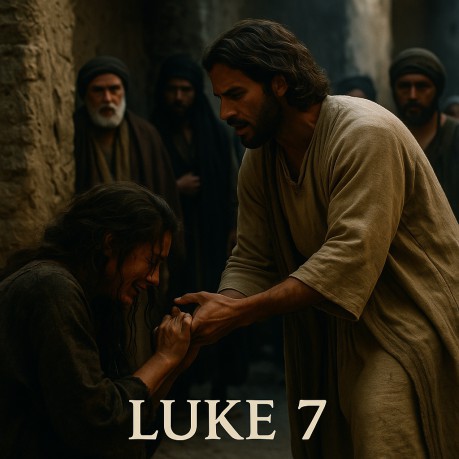
Luke 7 Luke 7:1-10 † The centurion's humility and faith surpassed
that of Israel. Luke 7:11-17 † Jesus displayed divine compassion in raising
the widow's son. Luke 7:18-35 When the messengers of John had left, He began to speak to the
crowds about John: "What did you go out into the wilderness to
see? A reed shaken by the wind? But what did you go out to see? A man
dressed in soft clothing? Those who are splendidly clothed and live
in luxury are found in royal palaces! But what did you go out to see?
A prophet? Yes, I say to you, and one who is more than a prophet.
This is the one about whom it is written: ‘Behold, I am sending My
messenger ahead of You, Who will prepare Your way before You.' I say
to you, among those born of women there is no one greater than John;
yet the one who is least in the kingdom of God is greater than he." And when all the people and the tax collectors heard this, they
acknowledged God's justice, having been baptized with the baptism of
John. But the Pharisees and the lawyers rejected God's purpose for
themselves, not having been baptized by John. "To what then shall I compare the people of this generation,
and what are they like? They are like children who sit in the
marketplace and call to one another, and they say, ‘We played the
flute for you, and you did not dance; we sang a song of mourning, and
you did not weep.' For John the Baptist has come neither eating bread
nor drinking wine, and you say, ‘He has a demon!' The Son of Man
has come eating and drinking, and you say, ‘Behold, a gluttonous
man and a heavy drinker, a friend of tax collectors and sinners!' And
yet wisdom is vindicated by all her children." † John's doubt revealed the tension of waiting
for fulfillment, yet Christ's works confirmed Him as Messiah. Luke 7:36-50 And Jesus responded and said to him, "Simon, I have something
to say to you." And he replied, "Say it, Teacher." "A
moneylender had two debtors: the one owed five hundred denarii, and
the other, fifty. When they were unable to repay, he graciously
forgave them both. So which of them will love him more?" Simon
answered and said, "I assume the one for whom he graciously
forgave more." And He said to him, "You have judged
correctly." And turning toward the woman, He said to Simon, "Do
you see this woman? I entered your house; you gave Me no water for My
feet, but she has wet My feet with her tears and wiped them with her
hair. You gave Me no kiss; but she has not stopped kissing My feet
since the time I came in. You did not anoint My head with oil, but
she anointed My feet with perfume. For this reason I say to you, her
sins, which are many, have been forgiven, for she loved much; but the
one who is forgiven little, loves little." Then He said to her,
"Your sins have been forgiven." And then those who were
reclining at the table with Him began saying to themselves, "Who
is this man who even forgives sins?" And He said to the woman,
"Your faith has saved you; go in peace." † The sinful woman's devotion contrasted with
the Pharisee's coldness. How it applies to us today: † This is the fulfilled perspective we proclaim at
Fulfilled Prophecies † Source Index
By Dan Maines
When He had completed all His
teaching in the hearing of the people, He went to Capernaum. Now a
centurion's slave, who was highly regarded by him, was sick and about
to die. When he heard about Jesus, he sent some Jewish elders to Him,
asking Him to come and save the life of his slave. And when they came
to Jesus, they strongly pleaded with Him, saying, "He is worthy
for You to grant this to him; for he loves our nation, and it was he
who built us our synagogue." Now Jesus was not far from the
house, when the centurion sent friends, saying to Him, "Lord, do
not trouble Yourself further, for I am not worthy for You to come
under my roof; for that reason I did not even consider myself worthy
to come to You, but just say the word, and my servant shall be
healed. For I also am a man placed under authority, with soldiers
under myself; and I say to this one, ‘Go!' and he goes, and to
another, ‘Come!' and he comes, and to my slave, ‘Do this!' and he
does it." Now when Jesus heard this, He was amazed at him, and
turned and said to the crowd that was following Him, "I say to
you, not even in Israel have I found such great faith." And when
those who had been sent returned to the house, they found the slave
in good health.
† His recognition of
authority showed true understanding of Christ's power.
†
Jesus marveled at his faith, a sign of Gentiles entering the kingdom.
Soon afterward He went to a
city called Nain; and His disciples were going along with Him,
accompanied by a large crowd. Now as He approached the gate of the
city, a dead man was being carried out, the only son of his mother,
and she was a widow; and a sizeable crowd from the city was with her.
When the Lord saw her, He felt compassion for her, and said to her,
"Do not go on weeping." And He came up and touched the
coffin; and the bearers came to a halt. And He said, "Young man,
I say to you, arise!" And the dead man sat up and began to
speak. And Jesus gave him back to his mother. Fear gripped them all,
and they began glorifying God, saying, "A great prophet has
appeared among us!" and, "God has visited His people!"
And this report about Him spread throughout Judea and in all the
surrounding region.
† This miracle foreshadowed
His power over death itself.
† The people
recognized God's visitation, echoing Old Testament prophetic acts.
The disciples of John also
reported to him about all these things. Summoning two of his
disciples, John sent them to the Lord, saying, "Are You the
Coming One, or are we to look for someone else?" When the men
came to Him, they said, "John the Baptist has sent us to You, to
ask, ‘Are You the Coming One, or are we to look for someone else?'"
At that very time He cured many people of diseases, afflictions, and
evil spirits; and He gave sight to many who were blind. And He
answered and said to them, "Go and report to John what you have
seen and heard: people who were blind receive sight, people who
limped walk, people with leprosy are cleansed, and people who were
deaf hear, dead people are raised up, and poor people have the gospel
preached to them. And blessed is anyone who does not take offense at
Me."
†
Jesus honored John as the forerunner, yet showed the greater glory of
the kingdom.
† The generation's rejection
revealed hardened hearts against both John and Christ.
Now one of the Pharisees was
requesting Him to dine with him, and He entered the Pharisee's house
and reclined at the table. And there was a woman in the city who was
a sinner; and when she learned that He was reclining at the table in
the Pharisee's house, she brought an alabaster vial of perfume, and
standing behind Him at His feet, weeping, she began to wet His feet
with her tears, and she wiped them with the hair of her head, and
began kissing His feet and anointing them with the perfume. Now when
the Pharisee who had invited Him saw this, he said to himself, "If
this man were a prophet, He would know who and what sort of person
this woman is who is touching Him, that she is a sinner!"
† Forgiveness
produces love, while self-righteousness produces pride.
†
Jesus' authority to forgive sins revealed His divine mission.
†
Luke 7 reveals faith, compassion, authority, and forgiveness. The
fulfilled perspective reminds us that Christ's miracles and words
confirmed His identity, and His kingdom has been vindicated in
history. For us today, this chapter calls us to trust Him with faith
like the centurion, receive His compassion, and love much because we
have been forgiven much.
† Josephus,
Antiquities 18.5.2
† Philo, On the Special
Laws 2.167
† Tacitus, Annals 15.44
†
Irenaeus, Against Heresies 3.9.3
Links