Luke 6 Luke 6:1-5 † Jesus defended His disciples with Scripture,
showing mercy over ritual. Luke 6:6-11 † The Pharisees valued tradition above
compassion. Luke 6:12-16 † Jesus chose the twelve as the foundation of
the New Israel. Luke 6:17-26 † The blessings and woes contrasted eternal
values with temporary ones. Luke 6:27-36 † Kingdom ethics go beyond natural love to
supernatural mercy. Luke 6:37-42 † Christ's call was not to abandon discernment
but hypocrisy. Luke 6:43-49 † True discipleship produces fruit in word and
deed. How it applies to us today: † This is the fulfilled perspective we proclaim at
Fulfilled Prophecies † Source Index
By Dan Maines
Now it happened that He was
passing through some grainfields on a Sabbath, and His disciples were
picking the heads of grain, rubbing them in their hands, and eating
them. But some of the Pharisees said, "Why are you doing what is
not lawful on the Sabbath?" And Jesus, answering them, said,
"Have you not even read what David did when he was hungry, he
and those who were with him, how he entered the house of God, and
took and ate the consecrated bread, which is not lawful for any to
eat except the priests alone, and gave it to his companions?"
And He was saying to them, "The Son of Man is Lord of the
Sabbath."
† By declaring
Himself Lord of the Sabbath, He revealed His divine authority.
†
The Sabbath pointed to Him, and its true fulfillment was found in
Him.
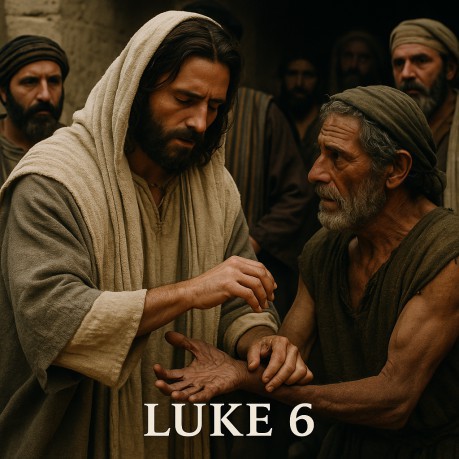
On another Sabbath He entered
the synagogue and taught; and a man was there whose right hand was
withered. Now the scribes and the Pharisees were watching Him closely
to see if He healed on the Sabbath, so that they might find grounds
to accuse Him. But He knew what they were thinking, and He said to
the man with the withered hand, "Get up and come forward!"
And he got up and came forward. And Jesus said to them, "I ask
you: is it lawful to do good on the Sabbath, or to do harm, to save a
life or to destroy it?" And after looking around at them all, He
said to him, "Stretch out your hand!" And he did so; and
his hand was restored. But they themselves were filled with rage, and
discussed together what they might do to Jesus.
† Jesus exposed their hardness of
heart by healing on the Sabbath.
† His power
restored both body and dignity, fulfilling the law's intent.
Now it was at this time that He
went off to the mountain to pray, and He spent the whole night in
prayer with God. And when day came, He called His disciples to Him
and chose twelve of them, whom He also named as apostles: Simon, whom
He also named Peter, and Andrew his brother; and James and John; and
Philip and Bartholomew; and Matthew and Thomas; James the son of
Alphaeus, and Simon who was called the Zealot; Judas the son of
James, and Judas Iscariot, who also became a traitor.
† His night of prayer
emphasized dependence on the Father in major decisions.
†
Even Judas' inclusion showed God's plan would prevail through
betrayal.
And Jesus came down with them
and stood on a level place; and there was a large crowd of His
disciples, and a great multitude of people from all Judea, Jerusalem,
and the coastal region of Tyre and Sidon, who had come to hear Him
and to be healed of their diseases; and those who were troubled by
unclean spirits were being cured. And all the people were trying to
touch Him, because power was coming from Him and healing them all.
And He raised His eyes toward His disciples and began saying,
"Blessed are you who are poor, for yours is the kingdom of God.
Blessed are you who are hungry now, for you will be satisfied.
Blessed are you who weep now, for you will laugh. Blessed are you
when the people hate you, and when they exclude you, and insult you,
and scorn your name as evil, on account of the Son of Man. Rejoice on
that day and jump for joy, for behold, your reward is great in
heaven. For their fathers used to treat the prophets the same way.
But woe to you who are rich, for you are receiving your comfort in
full. Woe to you who are well-fed now, for you will be hungry. Woe to
you who laugh now, for you will mourn and weep. Woe to you when all
the people speak well of you; for their fathers used to treat the
false prophets the same way."
† Christ exalted
the humble and warned the self-satisfied.
†
The kingdom brought reversal of worldly expectations.
"But I say to you who
hear, love your enemies, do good to those who hate you, bless those
who curse you, pray for those who mistreat you. Whoever hits you on
the cheek, offer him the other also; and whoever takes away your
cloak, do not withhold your tunic from him either. Give to everyone
who asks of you, and whoever takes away what is yours, do not demand
it back. Treat people the same way you want them to treat you. If you
love those who love you, what credit is that to you? For even sinners
love those who love them. And if you do good to those who do good to
you, what credit is that to you? For even sinners do the same. And if
you lend to those from whom you expect to receive, what credit is
that to you? Even sinners lend to sinners in order to receive back
the same amount. But love your enemies, and do good, and lend,
expecting nothing in return; and your reward will be great, and you
will be sons of the Most High; for He Himself is kind to ungrateful
and evil people. Be merciful, just as your Father is merciful."
† Loving enemies
displayed God's character.
† Mercy marked
disciples as true children of the Father.
"Do not judge, and you
will not be judged; and do not condemn, and you will not be
condemned; pardon, and you will be pardoned. Give, and it will be
given to you. They will pour into your lap a good measure—pressed
down, shaken together, and running over. For by your standard of
measure it will be measured to you in return." Now He also told
them a parable: "A person who is blind cannot guide another who
is blind, can he? Will they not both fall into a pit? A disciple is
not above the teacher; but everyone, when he has been fully trained,
will be like his teacher. Why do you look at the speck that is in
your brother's eye, but do not notice the log that is in your own
eye? How can you say to your brother, ‘Brother, let me take out the
speck that is in your eye,' when you yourself do not see the log that
is in your own eye? You hypocrite, first take the log out of your own
eye, and then you will see clearly to take out the speck that is in
your brother's eye."
† The measure of mercy we
extend will be returned to us.
† True
discipleship required humility and self-examination.
"For there is no good tree
that produces bad fruit, nor, on the other hand, a bad tree that
produces good fruit. For each tree is known by its own fruit. For
people do not gather figs from thorns, nor do they pick grapes from a
briar bush. The good person out of the good treasure of his heart
brings forth what is good; and the evil person out of the evil
treasure brings forth what is evil; for his mouth speaks from that
which fills his heart. Now why do you call Me, ‘Lord, Lord,' and do
not do what I say? Everyone who comes to Me and hears My words and
acts on them, I will show you whom he is like: he is like a man
building a house, who dug deep and laid a foundation on the rock; and
when a flood occurred, the torrent burst against that house and yet
it could not shake it, because it had been well built. But the one
who has heard and has not acted accordingly, is like a man who built
a house on the ground without any foundation; and the torrent burst
against it, and immediately it collapsed, and the ruin of that house
was great."
† Calling Jesus "Lord"
without obedience is empty.
† The secure
foundation is hearing and obeying Christ's words.
†
Luke 6 reveals the kingdom ethic of Christ, a radical call to mercy,
humility, obedience, and fruit-bearing. The fulfilled perspective
reminds us that His words shaped the New Covenant people, who endured
tribulation yet inherited the kingdom in AD 70. For us today, this
chapter calls us to build on Christ's foundation, live mercifully,
and embody His kingdom ethic in a broken world.
† Josephus,
Antiquities 13.10.6
† Philo, On the Special
Laws 2.163
† Tacitus, Annals 15.44
†
Irenaeus, Against Heresies 3.18.1
Links