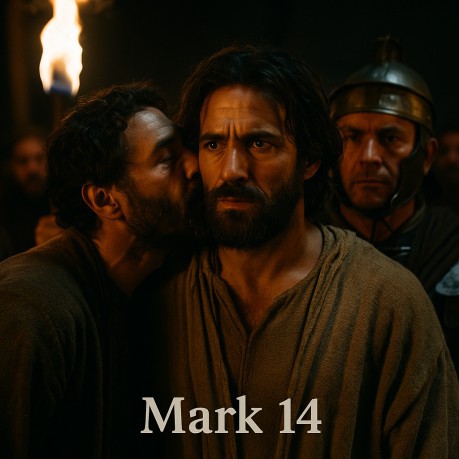
Mark 14 Mark 14:1-2 † The religious leaders plotted to kill Jesus,
fearing the people more than God. Mark 14:3-9 † The woman's act of devotion foreshadowed
Jesus' burial. Mark 14:10-11 † Judas' betrayal fulfilled prophecy (Psalm
41:9). Mark 14:12-21 † Jesus revealed His foreknowledge of Judas'
betrayal. Mark 14:22-25 † Jesus instituted the New Covenant meal at
Passover. Mark 14:26-31 † Jesus fulfilled Zechariah 13:7, showing the
scattering of the disciples. Mark 14:32-42 † Jesus revealed His deep anguish, yet
submitted fully to the Father's will. Mark 14:43-52 † Judas betrayed with a kiss, the ultimate sign
of false friendship. Mark 14:53-65 † The trial was filled with false witnesses,
but Jesus' silence fulfilled Isaiah 53:7. Mark 14:66-72 † Peter's denial fulfilled Jesus' prophecy. How it applies to us today: † This is the fulfilled perspective we proclaim at
Fulfilled Prophecies † Source Index
By Dan Maines
Now the Passover and Unleavened
Bread were two days away; and the chief priests and the scribes were
seeking how to arrest Him covertly and kill Him; for they were
saying, "Not during the festival, otherwise there will be a riot
of the people."
† Their
hypocrisy exposed the corruption of Israel's leadership.
†
The timing at Passover foreshadowed Jesus as the true Lamb of God.
While He was in Bethany at the
home of Simon the leper, and reclining at the table, a woman came
with an alabaster vial of very expensive perfume of pure nard; and
she broke the vial and poured it over His head. But some were
indignantly remarking to one another, "Why has this perfume been
wasted? For this perfume could have been sold for over three hundred
denarii, and the money given to the poor." And they were
scolding her. But Jesus said, "Leave her alone! Why are you
bothering her? She has done a good deed for Me. For you always have
the poor with you, and whenever you want, you can do good to them;
but you do not always have Me. She has done what she could; she has
anointed My body beforehand for the burial. Truly I say to you,
wherever the gospel is preached in the entire world, what this woman
has done will also be told in memory of her."
† Her sacrificial love
contrasted with the disciples' misunderstanding.
†
Her story became part of the eternal witness of the gospel.
Then Judas Iscariot, who was
one of the twelve, went off to the chief priests in order to betray
Him to them. They were delighted when they heard this, and promised
to give him money. And he began seeking how to betray Him at an
opportune time.
† Greed and disillusionment opened the
door to treachery.
† Even betrayal served
God's sovereign plan.
On the first day of Unleavened
Bread, when the Passover lamb was being sacrificed, His disciples
said to Him, "Where do You want us to go and prepare for You to
eat the Passover?" And He sent two of His disciples, and said to
them, "Go into the city, and a man carrying a pitcher of water
will meet you; follow him; and wherever he enters, say to the owner
of the house, ‘The Teacher says, "Where is My guest room in
which I may eat the Passover with My disciples?"' And he himself
will show you a large upstairs room furnished and ready; prepare for
us there." The disciples left and came to the city, and found
everything just as He had told them; and they prepared the Passover.
When it was evening He came with the twelve. And as they were
reclining at the table and eating, Jesus said, "Truly I say to
you that one of you will betray Me—the one who is eating with Me."
They began to be grieved, and to say to Him one by one, "Surely
not I?" Yet He said to them, "It is one of the twelve, the
one who dips bread with Me in the bowl. For the Son of Man is going
away just as it is written about Him; but woe to that man by whom the
Son of Man is betrayed! It would have been better for that man if he
had not been born."
† The betrayal occurred during
Passover, tying Him to the sacrificial lamb.
†
Divine sovereignty and human responsibility intersected in Judas'
choice.
While they were eating, He
took some bread, and after a blessing He broke it, and gave it to
them, and said, "Take it; this is My body." And when He had
taken a cup and given thanks, He gave it to them, and they all drank
from it. And He said to them, "This is My blood of the covenant,
which is being poured out for many. Truly I say to you, I will not
drink of the fruit of the vine again until that day when I drink it
new in the kingdom of God."
† The bread and cup symbolized His
body and blood, fulfilling sacrificial imagery.
†
The promise of drinking anew pointed to the kingdom's arrival.
After singing a hymn, they
went out to the Mount of Olives. And Jesus said to them, "You
will all fall away, because it is written: ‘I will strike the
Shepherd, and the sheep will be scattered.' But after I have been
raised, I will go ahead of you to Galilee." But Peter said to
Him, "Even if they all fall away, yet I will not!" And
Jesus said to him, "Truly I say to you, that this very night,
before a rooster crows twice, you yourself will deny Me three times."
But Peter repeatedly said insistently, "Even if I have to die
with You, I will not deny You!" And they all were saying the
same thing as well.
† Peter's zeal
blinded him to his coming weakness.
† Human
promises fail, but Christ's word proves true.
They came to a place named
Gethsemane; and He said to His disciples, "Sit here until I have
prayed." And He took with Him Peter, James, and John, and began
to be very distressed and troubled. And He said to them, "My
soul is deeply grieved, to the point of death; remain here and keep
watch." And He went a little beyond them, and fell to the ground
and began praying that if it were possible, the hour might pass by
Him. And He was saying, "Abba! Father! All things are possible
for You; remove this cup from Me; yet not what I will, but what You
will." And He came and found them sleeping, and said to Peter,
"Simon, are you asleep? Could you not keep watch for one hour?
Keep watching and praying, so that you will not come into temptation;
the spirit is willing, but the flesh is weak." Again He went
away and prayed, saying the same words. And again He came and found
them sleeping, for their eyes were heavy; and they did not know what
to say in reply to Him. And He came the third time, and said to them,
"Are you still sleeping and resting? It is enough; the hour has
come; behold, the Son of Man is being betrayed into the hands of
sinners. Get up, let's go; behold, the one who is betraying Me is
near!"
† The
disciples failed in prayer, showing weakness of the flesh.
†
The "cup" symbolized God's wrath, which Christ would bear.
And immediately, while He was
still speaking, Judas, one of the twelve, came up, accompanied by a
crowd with swords and clubs, who were from the chief priests, the
scribes, and the elders. Now he who was betraying Him had given them
a signal, saying, "Whomever I kiss, He is the one; arrest Him
and lead Him away under guard." And after coming, Judas
immediately went to Him and said, "Rabbi!" and kissed Him.
And they laid hands on Him and arrested Him. But one of those who
stood by drew his sword and struck the slave of the high priest, and
cut off his ear. And Jesus said to them, "Have you come out with
swords and clubs to arrest Me, as you would against a man inciting a
revolt? Every day I was with you within the temple grounds teaching,
and you did not arrest Me; but this has taken place so that the
Scriptures will be fulfilled." And His disciples all left Him
and fled. A young man was following Him, wearing nothing but a linen
sheet over his naked body; and they seized him. But he pulled free of
the linen sheet and escaped naked.
† Jesus submitted to
arrest to fulfill Scripture.
† All His
followers fled, leaving Him alone to face trial.
They led Jesus away to the
high priest; and all the chief priests, the elders, and the scribes
gathered together. Peter followed Him at a distance, right into the
courtyard of the high priest; and he was sitting with the officers
and warming himself at the fire. Now the chief priests and the entire
Council were trying to obtain testimony against Jesus to put Him to
death, and they were not finding any. For many people were giving
false testimony against Him, and so their testimonies were not
consistent. And then some stood up and began giving false testimony
against Him, saying, "We heard Him say, ‘I will destroy this
temple that was made by hands, and in three days I will build another
made without hands.'" And not even in this respect was their
testimony consistent. And then the high priest stood up and came
forward and questioned Jesus, saying, "Do You not offer any
answer for what these men are testifying against You?" But He
kept silent and did not offer any answer. Again the high priest was
questioning Him, and said to Him, "Are You the Christ, the Son
of the Blessed One?" And Jesus said, "I am; and you shall
see the Son of Man sitting at the right hand of power, and coming
with the clouds of heaven." Tearing his clothes, the high priest
said, "What further need do we have of witnesses? You have heard
the blasphemy; how does it seem to you?" And they all condemned
Him as deserving of death. And some began to spit on Him, and to
blindfold Him, and to beat Him with their fists, and to say to Him,
"Prophesy!" Then the officers took custody of Him and
slapped Him in the face.
†
His declaration of Daniel 7:13-14 ("coming with the clouds")
foretold His vindication in judgment.
† The
leaders condemned Him for the very truth that proved His Messiahship.
And while Peter was below in
the courtyard, one of the slave women of the high priest came by.
When she saw Peter warming himself, she looked at him and said, "You
also were with Jesus the Nazarene." But he denied it, saying, "I
neither know, nor understand what you are talking about." And he
went out onto the porch. The slave woman saw him, and began once more
to say to the bystanders, "This is one of them!" But again
he denied it. And after a little while, the bystanders were again
saying to Peter, "You are in fact one of them, for you are a
Galilean as well." But he began to curse himself and to swear,
"I do not know this man of whom you speak!" And immediately
a rooster crowed a second time. And Peter remembered how Jesus had
made the remark to him, "Before a rooster crows twice, you will
deny Me three times." And he hurried on and began to weep.
†
Fear overcame his earlier boldness.
† His
bitter weeping revealed remorse and the beginning of restoration.
†
Mark 14 shows betrayal, devotion, covenant, weakness, prayer, trial,
and denial. The fulfilled perspective reveals Christ's sovereignty
even in suffering, His establishment of the New Covenant, and His
vindication in judgment. For us today, this chapter calls us to
faithfulness in devotion, courage in trials, and trust in the Lamb
who fulfilled all righteousness.
† Josephus,
Wars 6.5.3
† Philo, On the Special Laws
1.192
† Tacitus, Annals 15.44
†
Irenaeus, Against Heresies 4.22.1
Links