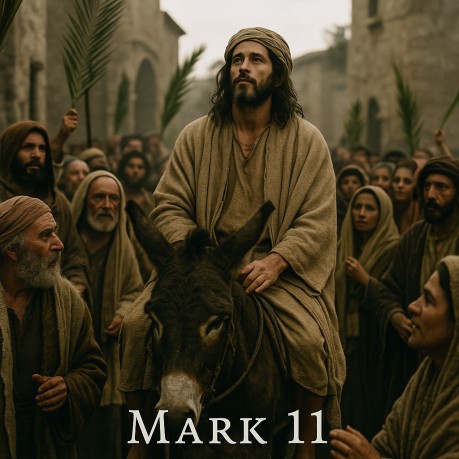
Mark 11 Mark 11:1-11 † The triumphal entry fulfilled Zechariah 9:9,
declaring Jesus as the humble yet victorious King. Mark 11:12-14 † The fig tree symbolized fruitless Israel,
outwardly alive but barren. Mark 11:15-19 † The cleansing of the temple exposed its
corruption and misuse. Mark 11:20-26 † The withered tree confirmed the fate of
fruitless Israel. Mark 11:27-33 † The leaders' refusal to answer exposed their
cowardice and unbelief. How it applies to us today: † This is the fulfilled perspective we proclaim at
Fulfilled Prophecies † Source Index
By Dan Maines
When they approached Jerusalem,
at Bethphage and Bethany, near the Mount of Olives, He sent two of
His disciples, and said to them, "Go into the village opposite
you, and immediately as you enter it, you will find a colt tied
there, on which no one has yet sat; untie it and bring it here. And
if anyone says to you, ‘Why are you doing this?' say, ‘The Lord
has need of it'; and immediately he will send it back here."
They went away and found a colt tied at the door, outside in the
street; and they untied it. And some of the bystanders were saying to
them, "What are you doing, untying the colt?" And they told
them just as Jesus had said, and they gave them permission. They
brought the colt to Jesus and put their cloaks on it; and He sat on
it. And many people spread their cloaks on the road, and others
spread leafy branches which they had cut from the fields. And those
who went in front and those who followed were shouting: "Hosanna!
Blessed is He who comes in the name of the Lord; Blessed is the
coming kingdom of our father David; Hosanna in the highest!" And
Jesus entered Jerusalem, and came into the temple; and after looking
around at everything, He left for Bethany with the twelve, since it
was already late.
†
The people shouted for salvation, yet many would soon reject Him.
†
His entrance into the temple signaled coming judgment on its
corruption.
On the next day, when they had
left Bethany, He became hungry. Seeing from a distance a fig tree in
leaf, He went to see if perhaps He would find anything on it; and
when He came to it, He found nothing but leaves, for it was not the
season for figs. And He said to it, "May no one ever eat fruit
from you again!" And His disciples were listening.
† The curse
foreshadowed the judgment coming upon Jerusalem.
†
This acted parable pointed to the end of the Old Covenant age.
Then they came to Jerusalem.
And He entered the temple and began to drive out those who were
selling and buying on the temple grounds, and He overturned the
tables of the money changers and the seats of those who were selling
doves; and He would not allow anyone to carry merchandise through the
temple grounds. And He began to teach and say to them, "Is it
not written: ‘My house will be called a house of prayer for all the
nations'? But you have made it a den of robbers." And the chief
priests and the scribes heard this, and they began seeking how to put
Him to death; for they were afraid of Him, because the entire crowd
was astonished at His teaching. And whenever evening came, they would
leave the city.
† His actions directly
challenged the authority of the religious leaders.
†
This was a prophetic act of judgment against the temple system.
As they were passing by in the
morning, they saw the fig tree withered from the roots up. And being
reminded, Peter said to Him, "Rabbi, look, the fig tree that You
cursed has withered." And Jesus answered and said to them, "Have
faith in God. Truly I say to you, whoever says to this mountain, ‘Be
taken up and thrown into the sea,' and does not doubt in his heart,
but believes that what he says is going to happen, it will be granted
to him. Therefore, I say to you, all things for which you pray and
ask, believe that you have received them, and they will be granted to
you. Whenever you stand praying, forgive, if you have anything
against anyone, so that your Father who is in heaven will also
forgive you your offenses."
† Faith could move
mountains — including the looming obstacle of the temple system.
†
Forgiveness marked the new covenant community in contrast to the
hard-hearted leaders.
They came again to Jerusalem,
and as He was walking in the temple area, the chief priests, the
scribes, and the elders came to Him, and began saying to Him, "By
what authority are You doing these things, or who gave You this
authority to do these things?" But Jesus said to them, "I
will ask you one question, and you answer Me, and then I will tell
you by what authority I do these things. Was the baptism of John from
heaven, or from men? Answer Me." They began discussing this
among themselves, saying, "If we say, ‘From heaven,' He will
say, ‘Then why did you not believe him?' But shall we say, ‘From
men'?"—they were afraid of the people, for they all considered
John to have been a real prophet. Answering Jesus, they said, "We
do not know." And Jesus said to them, "Neither am I telling
you by what authority I do these things."
† They feared people
more than God, revealing their hypocrisy.
†
Jesus' authority stood self-evident, confirmed by His works and
fulfillment of prophecy.
†
Mark 11 reveals Jesus as the King who entered Jerusalem, judged the
temple, and declared the coming end of fruitless religion. The
fulfilled perspective shows us that His warnings were realized in AD
70, when the temple was destroyed. For us today, this chapter calls
us to bear fruit in His kingdom, trust His authority, and live by
faith that forgives and overcomes.
† Josephus,
Wars 6.4.3
† Philo, On the Embassy to Gaius
300
† Tacitus, Histories 5.13
†
Irenaeus, Against Heresies 4.36.1
Links