Mark 8 Mark 8:1-10 † The feeding of the four thousand paralleled
the earlier miracle but emphasized Gentile inclusion, as this took
place in Decapolis. Mark 8:11-13 † The Pharisees hardened their hearts, refusing
to believe despite clear evidence. Mark 8:14-21 † The disciples misunderstood, worrying about
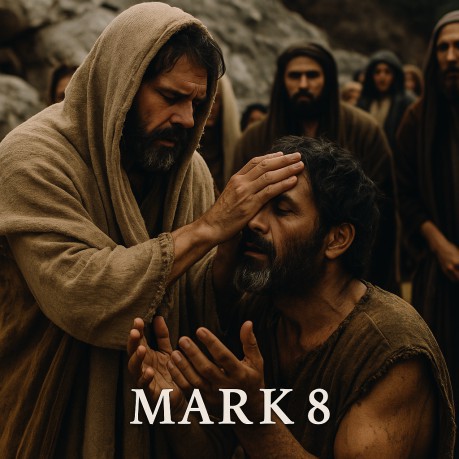
bread while missing His spiritual warning. Mark 8:22-26 † This two-stage healing symbolized the
disciples' partial understanding of Jesus, which would soon become
clear. Mark 8:27-33 † Peter confessed Jesus as the Christ, yet
misunderstood His mission. Mark 8:34-38 † True discipleship meant self-denial and
cross-bearing. How it applies to us today: † This is the fulfilled perspective we proclaim at
Fulfilled Prophecies † Source Index
By Dan Maines
In those days, when there was
again a large crowd and they had nothing to eat, Jesus summoned His
disciples and said to them, "I feel compassion for the people
because they have remained with Me for three days already and have
nothing to eat. If I send them away hungry to their homes, they will
faint on the way; and some of them have come from a great distance."
And His disciples replied to Him, "Where will anyone be able to
find enough bread here in this desolate place to satisfy these
people?" And He was asking them, "How many loaves do you
have?" They said, "Seven." And He directed the people
to recline on the ground; and taking the seven loaves, He gave thanks
and broke them, and started giving them to His disciples to serve to
them, and they served them to the people. They also had a few small
fish; and after He had blessed them, He told the disciples to serve
these as well. And they ate and were satisfied; and they picked up
seven large baskets of what was left over of the broken pieces. About
four thousand men were there; and He dismissed them. And immediately
He got into the boat with His disciples, and came to the region of
Dalmanutha.
† Seven baskets
symbolized fullness, pointing to completion beyond Israel alone.
†
Christ revealed Himself as the true provider for all nations.
And the Pharisees came out and
began to argue with Him, demanding from Him a sign from heaven, to
test Him. Sighing deeply in His spirit, He said, "Why does this
generation demand a sign? Truly I say to you, no sign will be given
to this generation!" Leaving them, He again embarked and went
away to the other side.
† Jesus
denied them further signs, for their blindness was willful.
†
The generation that demanded proof was the one soon to face covenant
judgment.
And they had forgotten to take
bread, and did not have more than one loaf in the boat with them. And
He was giving orders to them, saying, "Watch out! Beware of the
leaven of the Pharisees and the leaven of Herod." They began to
discuss with one another the fact that they had no bread. And Jesus,
aware of this, said to them, "Why do you discuss the fact that
you have no bread? Do you not yet comprehend or understand? Do you
still have your heart hardened? Having eyes, do you not see? And
having ears, do you not hear? And do you not remember, when I broke
the five loaves for the five thousand, how many baskets full of
broken pieces you picked up?" They said to Him, "Twelve."
"When I broke the seven for the four thousand, how many large
baskets full of broken pieces did you pick up?" And they said to
Him, "Seven." And He was saying to them, "Do you not
yet understand?"
†
The leaven symbolized corrupt teaching and worldly compromise.
†
They were called to remember His miraculous provision and trust Him
fully.
And they came to Bethsaida. And
some people brought a man who was blind to Jesus, and begged Him to
touch him. Taking the man by the hand, He brought him out of the
village; and after spitting in his eyes and laying His hands on him,
He asked him, "Do you see anything?" And he looked up and
said, "I see people, for I see them like trees, walking around."
Then He again laid His hands on his eyes; and he looked intently and
was restored, and began to see everything clearly. And He sent him to
his home, saying, "Do not even enter the village."
† Spiritual blindness required divine
touch to be removed.
† Christ alone gives
true sight, both physically and spiritually.
Jesus went out, along with His
disciples, to the villages of Caesarea Philippi; and on the way He
questioned His disciples, saying to them, "Who do people say
that I am?" They told Him, saying, "John the Baptist; and
others say Elijah; and others, one of the prophets." And He
continued questioning them: "But who do you say that I am?"
Peter answered and said to Him, "You are the Christ." And
He warned them to tell no one about Him. And He began to teach them
that the Son of Man must suffer many things and be rejected by the
elders, chief priests, and the scribes, and be killed, and after
three days rise from the dead. And He was stating the matter plainly.
And Peter took Him aside and began to rebuke Him. But turning around
and seeing His disciples, He rebuked Peter and said, "Get behind
Me, Satan; for you are not setting your mind on God's purposes, but
on man's."
† The path of
Messiah was suffering, death, and resurrection, not earthly
triumph.
† Peter's rebuke revealed a human
mindset, and Jesus rebuked him sharply.
And He summoned the crowd
together with His disciples, and said to them, "If anyone wants
to come after Me, he must deny himself, take up his cross, and follow
Me. For whoever wants to save his life will lose it, but whoever
loses his life for My sake and the gospel's will save it. For what
does it benefit a person to gain the whole world, and forfeit his
soul? For what could a person give in exchange for his soul? For
whoever is ashamed of Me and My words in this adulterous and sinful
generation, the Son of Man will also be ashamed of him when He comes
in the glory of His Father with the holy angels."
† Worldly gain was worthless
compared to eternal life.
† Judgment was
coming upon that generation, when Christ would be revealed in glory.
†
Mark 8 shows Jesus as provider, revealer, healer, and suffering
Messiah. The fulfilled perspective reminds us that the warnings of
judgment and calls to discipleship were fulfilled in that generation.
For us today, this chapter calls us to trust His provision, embrace
the cross, reject worldly compromise, and live boldly as His
disciples in His kingdom.
† Josephus,
Wars 2.13.4
† Philo, On the Virtues 77
†
Tacitus, Annals 15.44
† Irenaeus, Against
Heresies 3.16.5
Links