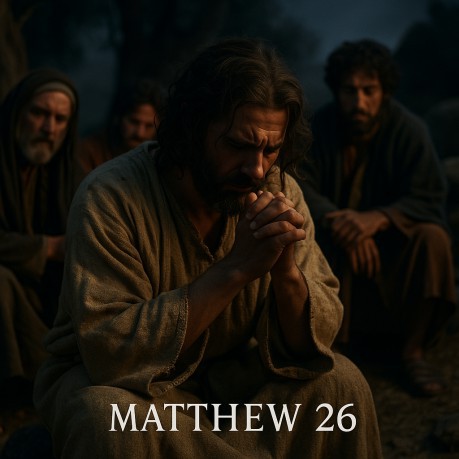
Matthew 26 Matthew 26:1-5 † Jesus clearly predicted the timing of His
crucifixion, showing He was in control of events. Matthew 26:6-13 † The anointing at Bethany symbolized
preparation for His burial. Matthew 26:14-16 † Judas' betrayal fulfilled Zechariah's
prophecy of thirty pieces of silver (Zechariah 11:12-13). Matthew 26:17-25 † Jesus arranged the Passover in divine timing,
showing His sovereignty even in betrayal. Matthew 26:26-30 † Jesus instituted the New Covenant in His body
and blood. Matthew 26:31-35 † Jesus predicted their falling away, quoting
Zechariah 13:7. Matthew 26:36-46 † In Gethsemane, Jesus submitted fully to the
Father's will. How it applies to us today: † This is the fulfilled perspective we proclaim at
Fulfilled Prophecies † Source Index
By Dan Maines
When Jesus had finished all
these words, He said to His disciples, "You know that after two
days the Passover is coming, and the Son of Man is to be handed over
for crucifixion." Then the chief priests and the elders of the
people were gathered together in the courtyard of the high priest,
named Caiaphas; and they plotted together to arrest Jesus covertly
and kill Him. But they were saying, "Not during the festival,
otherwise a riot might occur among the people."
†
The leaders plotted in secrecy, fearing the crowds, yet fulfilling
prophecy.
† Josephus records the corruption
and political fear of the priestly elite (Antiquities 20.9).
Now when Jesus was in
Bethany, at the home of Simon the Leper, a woman came to Him with an
alabaster vial of very expensive perfume, and she poured it on His
head as He reclined at the table. But the disciples were indignant
when they saw this, and said, "Why this waste? For this perfume
could have been sold for a high price and the money given to the
poor." But Jesus, aware of this, said to them, "Why are you
bothering the woman? For she has done a good deed for Me. For you
always have the poor with you; but you do not always have Me. For
when she poured this perfume on My body, she did it to prepare Me for
burial. Truly I say to you, wherever this gospel is preached in the
whole world, what this woman has done will also be told in memory of
her."
† The disciples
misunderstood the act, but Jesus revealed its prophetic
significance.
† This woman's devotion stands
as a lasting testimony of faith.
Then one of the twelve,
named Judas Iscariot, went to the chief priests and said, "What
are you willing to give me to betray Him to you?" And they set
out for him thirty pieces of silver. And from then on he looked for a
good opportunity to betray Jesus.
†
His greed and disillusionment drove him to betray the Son of God.
†
The leaders found in him a willing instrument of their evil plans.
Now on the first day of
Unleavened Bread the disciples came to Jesus and said, "Where do
You want us to prepare for You to eat the Passover?" And He
said, "Go into the city to a certain man, and say to him, 'The
Teacher says, "My time is near; I am keeping the Passover at
your house with My disciples."'" The disciples did as Jesus
had directed them, and they prepared the Passover. Now when evening
came, Jesus was reclining at the table with the twelve. And as they
were eating, He said, "Truly I say to you that one of you will
betray Me." Being deeply grieved, they each one began to say to
Him, "Surely it is not I, Lord?" And He answered, "He
who dipped his hand with Me in the bowl is the one who will betray
Me. The Son of Man is going as it is written about Him; but woe to
that man by whom the Son of Man is betrayed! It would have been good
for that man if he had not been born." And Judas, who was
betraying Him, said, "Surely it is not I, Rabbi?" Jesus
said to him, "You have said it yourself."
†
Judas' duplicity was exposed, though he feigned innocence.
†
Fulfillment of Scripture guided every detail of these events.
Now while they were eating,
Jesus took bread, and after blessing it, He broke it and gave it to
the disciples, and said, "Take, eat; this is My body." And
when He had taken a cup and given thanks, He gave it to them, saying,
"Drink from it, all of you; for this is My blood of the
covenant, which is being poured out for many for forgiveness of sins.
But I say to you, I will not drink of this fruit of the vine from now
on until that day when I drink it with you new in My Father's
kingdom." And after singing a hymn, they went out to the Mount
of Olives.
† The bread and cup symbolized His
sacrificial death, sealing forgiveness.
† The
promise to drink anew in the kingdom pointed to its near fulfillment.
Then Jesus said to them,
"You will all fall away because of Me this night; for it is
written: 'I will strike the shepherd, and the sheep of the flock will
be scattered.' But after I have been raised, I will go ahead of you
to Galilee." But Peter responded and said to Him, "Even if
they all fall away because of You, I will never fall away!"
Jesus said to him, "Truly I say to you that this very night,
before a rooster crows, you will deny Me three times." Peter
said to Him, "Even if I have to die with You, I will not deny
You!" All the disciples said the same thing as well.
† Peter's pride blinded him
to his weakness.
† The scattering of the
disciples confirmed prophecy, but restoration followed.
Then Jesus came with them
to a place called Gethsemane, and He said to His disciples, "Sit
here while I go over there and pray." And He took Peter and the
two sons of Zebedee with Him, and began to be grieved and distressed.
Then He said to them, "My soul is deeply grieved, to the point
of death; remain here and keep watch with Me." And He went a
little beyond them, and fell on His face and prayed, saying, "My
Father, if it is possible, let this cup pass from Me; yet not as I
will, but as You will." And He came to the disciples and found
them sleeping, and He said to Peter, "So, you men could not keep
watch with Me for one hour? Keep watching and praying, so that you do
not come into temptation; the spirit is willing, but the flesh is
weak." He went away again a second time and prayed, saying, "My
Father, if this cup cannot pass away unless I drink from it, Your
will be done." Again He came and found them sleeping, for their
eyes were heavy. And He left them again, and went away and prayed a
third time, saying the same thing once more. Then He came to the
disciples and said to them, "Are you still sleeping and resting?
Behold, the hour is at hand and the Son of Man is being betrayed into
the hands of sinners. Get up, let's go; behold, the one who is
betraying Me is near!"
† His agony showed the weight
of sin He would bear.
† The disciples'
weakness highlighted the need for watchfulness and prayer.
†
Matthew 26 reveals Jesus' sovereignty, humility, and obedience as He
prepared for the cross. The fulfilled perspective shows these events
were the foundation of the New Covenant, sealed in His blood. For us
today, this chapter calls us to faithfulness in trial, devotion like
the woman at Bethany, and surrender like Christ in Gethsemane,
knowing His victory has secured our place in the kingdom.
† Josephus,
Antiquities 20.9
† Tacitus, Annals 15.44
†
Justin Martyr, Dialogue with Trypho 40, 117
†
Irenaeus, Against Heresies 4.10.1
Links