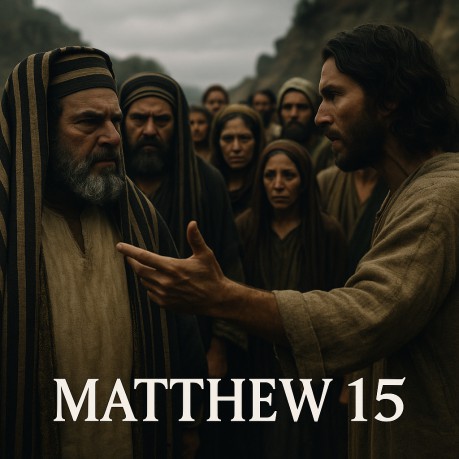
Matthew 15 Matthew 15:1-2 † The Pharisees attacked the disciples over
traditions, not Scripture. Their accusation exposed their obsession
with externals. Matthew 15:3-6 † Jesus rebuked them for nullifying God's
command with man-made vows. The command to honor parents was
undermined by false piety. Matthew 15:7-9 † Jesus declared that Isaiah's prophecy (Isaiah
29:13) was fulfilled in them. Outward worship was worthless without
obedience. Matthew 15:10-11 † Jesus shifted the focus from ritual purity to
moral purity. Matthew 15:12-14 † The Pharisees were offended because truth
exposed their system. Matthew 15:15-20 † Jesus explained plainly that defilement is
moral, not ritual. Food passes through the body, but sin flows from
the heart. Matthew 15:21-28 † The Canaanite woman's persistence showed
faith greater than Israel's leaders. She called Him "Son of
David," acknowledging His Messianic role. Matthew 15:29-31 † The miracles fulfilled messianic expectation.
Isaiah promised that the lame would leap and the blind would see. Matthew 15:32-39 † The feeding of the four thousand showed
Jesus' power to provide abundantly. Seven baskets symbolize fullness
and completion. How it applies to us today: † This is the fulfilled perspective we proclaim at
Fulfilled Prophecies † Source Index
By Dan Maines
Then some Pharisees and
scribes came to Jesus from Jerusalem and said, "Why do Your
disciples break the tradition of the elders? For they do not wash
their hands when they eat bread."
† Josephus records that
Pharisees elevated traditions above the law itself (Antiquities
13.297).
† The Mishnah confirms their laws of
ritual washing (Yadayim 1.1).
But He answered and said to
them, "Why do you yourselves break the commandment of God for
the sake of your tradition? For God said, 'Honor your father and
mother,' and, 'The one who speaks evil of father or mother is to be
put to death.' But you say, 'Whoever says to his father or mother,
"Whatever I have that would help you has been given to God,"
he is not to honor his father or mother.' And by this you have
invalidated the word of God for the sake of your tradition."
† The Mishnah
(Nedarim 9.1) confirms these vows, and Josephus criticized Pharisaic
corruption.
† Their traditions prepared the
nation for judgment because they made void the law of God.
"You hypocrites, rightly
did Isaiah prophesy about you, by saying, 'This people honors Me with
their lips, but their heart is far away from Me. And in vain do they
worship Me, teaching as doctrines the commandments of men.'"
† Early church fathers, like
Irenaeus, condemned the same error of replacing God's truth with
man's rules.
† This hypocrisy marked Israel's
leaders as ripe for covenantal judgment.
After Jesus called the
crowd to Him, He said to them, "Hear and understand! It is not
what enters the mouth that defiles the person, but what comes out of
the mouth, this defiles the person."
† He announced the true
standard of holiness, the heart, not externals.
†
This teaching foreshadowed the end of ritual law at the destruction
of Jerusalem in AD 70.
Then the disciples came and
said to Him, "Do You know that the Pharisees were offended when
they heard this statement?" But He answered and said, "Every
plant which My heavenly Father did not plant will be uprooted. Leave
them alone, they are blind guides of the blind. And if a person who
is blind guides another who is blind, both will fall into a pit."
† Jesus prophesied
their uprooting, fulfilled in the fall of Jerusalem. Josephus
describes their corrupt leadership leading the nation to ruin (Wars
4.316).
† Tacitus likewise observed that
Jewish leaders drove their people into destruction (Histories 5.13).
Peter said to Him, "Explain
the parable to us." Jesus said, "Are you also still lacking
in understanding? Do you not understand that everything that goes
into the mouth passes into the stomach, and is eliminated? But the
things that come out of the mouth come from the heart, and those
things defile the person. For out of the heart come evil thoughts,
murders, acts of adultery, other immoral sexual acts, thefts, false
testimonies, slanderous statements. These are the things that defile
the person, but to eat with unwashed hands does not defile the
person."
† Josephus described the
wickedness inside Jerusalem before AD 70, including murders, thefts,
and false testimony (Wars 5.10).
† Their
obsession with ritual blinded them to the real corruption that would
bring judgment.
Jesus went away from there,
and withdrew into the region of Tyre and Sidon. And a Canaanite woman
from that region came out and began to cry out, saying, "Have
mercy on me, Lord, Son of David, my daughter is severely
demon-possessed." But He did not answer her a word. And His
disciples came up and kept requesting Him, saying, "Send her
away, because she keeps shouting at us!" But He answered and
said, "I was sent only to the lost sheep of the house of
Israel." But she came and began to bow down before Him, saying,
"Lord, help me!" Yet He answered and said, "It is not
good to take the children's bread and throw it to the dogs." And
she said, "Yes, Lord, but please help, for even the dogs feed on
the crumbs that fall from their masters' table." Then Jesus said
to her, "O woman, your faith is great, it shall be done for you
as you desire." And her daughter was healed at once.
†
Jesus tested her humility, but she persisted, proving that faith, not
lineage, gains blessing.
† Early fathers like
Justin Martyr and Irenaeus pointed to this as proof that Gentiles
were brought into the New Covenant.
Departing from there, Jesus
went along the Sea of Galilee, and after going up on the mountain, He
was sitting there. And large crowds came to Him, bringing with them
those who were lame, crippled, blind, mute, and many others, and they
placed them down at His feet, and He healed them. So the crowd was
astonished as they saw those who were mute speaking, those who were
crippled restored, those who were lame walking, and those who were
blind seeing, and they glorified the God of Israel.
†
Philo recorded that Jews expected the Messiah to heal the afflicted
(On Dreams 2.242).
† These signs proved the
kingdom had arrived in their generation.
Now Jesus called His
disciples to Him and said, "I feel compassion for the people,
because they have remained with Me now for three days and have
nothing to eat, and I do not want to send them away hungry, for they
might faint on the way." The disciples said to Him, "Where
would we get so many loaves in this desolate place to satisfy such a
large crowd?" And Jesus said to them, "How many loaves do
you have?" And they said, "Seven, and a few small fish."
And He directed the people to sit down on the ground, and He took the
seven loaves and the fish, and after giving thanks, He broke them and
started giving them to the disciples, and the disciples gave them to
the people. And they all ate and were satisfied, and they picked up
what was left over of the broken pieces, seven large baskets full.
And those who ate were four thousand men, besides women and children.
And sending away the crowds, Jesus got into the boat and came to the
region of Magadan.
† Josephus records famine and
hunger in Jerusalem during the revolt (Wars 5.13.6), contrasting with
Christ's provision for His people.
† The
Messiah was the true provider, unlike Israel's failed leaders who
left the nation starving.
†
Matthew 15 shows that ritual traditions cannot save, only Christ can.
The Pharisees' hypocrisy and blindness led to the destruction of the
Old Covenant order in AD 70, exactly as Jesus warned. The Canaanite
woman proves that faith, not bloodline, brings covenant blessing,
which was fulfilled when the gospel went out to the nations. The
miracles reveal the compassion and sufficiency of Christ, in contrast
to the famine and ruin of unbelieving Israel. For us today in the
fulfilled kingdom, this means we rest in Christ's completed work,
reject empty traditions, and live as people purified from the heart.
† Josephus,
Antiquities 13.297-298; Wars 4.316; 5.10; 5.13.6
†
Mishnah, Nedarim 9.1; Yadayim 1.1
† Tacitus,
Histories 5.13
† Philo, On Dreams 2.242
†
Justin Martyr, Dialogue with Trypho 121
†
Irenaeus, Against Heresies 3.20.2; 4.12.1
Links