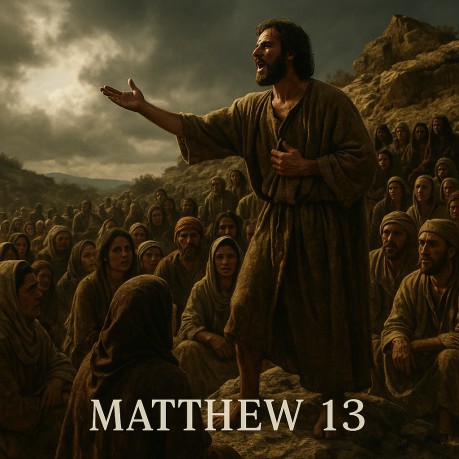
Matthew 13 Matthew 13:1-2 † Jesus teaches from the boat to reach the
multitude. The sea and the shore form a natural amphitheater, a
common practice in Galilee. † Josephus mentions how crowds often pressed
around Galilean teachers (Wars 2.268). Jesus uses creation itself as
His pulpit. Matthew 13:3-9 † The parable of the sower sets the stage for
covenant response. The soils represent hearts, and the seed is the
word of the kingdom. † The Dead Sea Scrolls used sowing imagery to
describe God's planting of truth among His people (1QH 6.15). Matthew 13:10-13 † Parables both reveal and conceal. The
mysteries of the kingdom are unveiled to disciples but hidden from
those who harden their hearts. † Isaiah 6:9-10 is fulfilled, as Israel's
dullness prevented them from seeing and hearing. Matthew 13:14-15 † Israel's rejection fulfills Isaiah's prophecy
of spiritual blindness. Matthew 13:16-17 † The disciples are blessed to witness
fulfillment the prophets longed for. † Irenaeus stressed this privilege of living in
the time of fulfillment (Against Heresies 4.20.6). Matthew 13:18-23 † The soils reveal responses to the kingdom.
Only the good soil bears lasting fruit. † Origen explained that the fruitfulness is not
about numbers but about transformation by the word (Commentary on
Matthew 10.1). Matthew 13:24-30 † The parable of the wheat and weeds shows the
coexistence of true and false until judgment. The harvest is
covenantal, fulfilled in AD 70. † Josephus describes how zealots and true
Israelites were separated in the war's destruction (Wars 6.409). Matthew 13:31-32 † The kingdom begins small but grows into
worldwide shelter. † The Mishnah called mustard the smallest seed
commonly planted (Niddah 5:2). Jesus uses this to illustrate the
kingdom's surprising growth. Matthew 13:33 † Leaven, often a symbol of corruption, is here
positive, showing the quiet but pervasive spread of the kingdom. Matthew 13:34-35 † Matthew cites Psalm 78:2. Jesus fulfills
prophecy by teaching in parables, revealing hidden mysteries. Matthew 13:36-43 † Jesus explains the parable. The end of the
age refers to the Old Covenant age, which closed in AD 70. The
righteous shine in the fulfilled kingdom. † Eusebius identified the judgment on Jerusalem
as the close of the age (Ecclesiastical History 3.7). Matthew 13:44 † The kingdom is worth total sacrifice. Matthew 13:45-46 † The kingdom is beyond all worldly value,
worth everything. Matthew 13:47-50 † The parable of the net confirms final
covenant separation in AD 70. Matthew 13:51-52 † Fulfillment brings both continuity and
newness, the old covenant giving way to the new. Matthew 13:53-58 † Even with wisdom and miracles, unbelief
blinded His own people. † How it applies to us today: Matthew 13
teaches us that the kingdom was established in their generation, not
delayed. The parables reveal that the kingdom begins in small and
hidden ways, spreads like leaven, separates true from false, and is
worth everything we have. The end of the age was the end of the Old
Covenant system, culminating in AD 70 when judgment fell on
unbelieving Israel and the righteous shone forth in the kingdom. For
us today, this means we live in the reality of that fulfilled
kingdom. We are the good soil called to bear fruit, the wheat
gathered safely, and the treasure that shows God’s eternal plan is
complete. Our task now is to boldly live as citizens of the fulfilled
kingdom, proving with our lives that Christ’s promises came true
exactly when He said. † This is the fulfilled perspective we proclaim at
Fulfilled Prophecies † Source Index
By Dan Maines
On that day Jesus had gone
out of the house and was sitting by the sea. And large crowds
gathered to Him, so He got into a boat and sat down, and the whole
crowd was standing on the beach.
And He told them many things
in parables, saying, "Behold, the sower went out to sow, and as
he sowed, some seeds fell beside the road, and the birds came and ate
them up. Others fell on the rocky places, where they did not have
much soil, and they sprang up immediately, because they had no depth
of soil. But after the sun rose, they were scorched, and because they
had no root, they withered away. Others fell among the thorns, and
the thorns came up and choked them out. But others fell on the good
soil and yielded a crop, some a hundred, some sixty, and some thirty
times as much. The one who has ears, let him hear."
And the disciples came up
and said to Him, "Why do You speak to them in parables?"
And Jesus answered them, "To you it has been granted to know the
mysteries of the kingdom of heaven, but to them it has not been
granted. For whoever has, to him more shall be given, and he will
have an abundance, but whoever does not have, even what he has shall
be taken away from him. Therefore I speak to them in parables,
because while seeing they do not see, and while hearing they do not
hear, nor do they understand."
"And in their case the
prophecy of Isaiah is being fulfilled, which says, 'You shall keep on
listening, and shall not understand, and you shall keep on looking,
and shall not perceive, for the heart of this people has become dull,
with their ears they scarcely hear, and they have closed their eyes,
otherwise they might see with their eyes, hear with their ears,
understand with their heart, and return, and I would heal them.'"
"But blessed are your
eyes, because they see, and your ears, because they hear. For truly I
say to you that many prophets and righteous people longed to see what
you see, and did not see it, and to hear what you hear, and did not
hear it."
"Listen then to the
parable of the sower. When anyone hears the word of the kingdom and
does not understand it, the evil one comes and snatches away what has
been sown in his heart. This is the one sown with seed beside the
road. The one sown with seed on the rocky places, this is the one who
hears the word and immediately receives it with joy, yet he has no
firm root in himself, but is only temporary, and when affliction or
persecution occurs because of the word, immediately he falls away.
And the one sown with seed among the thorns, this is the one who
hears the word, and the anxiety of the world and the deceitfulness of
wealth choke the word, and it becomes unfruitful. But the one sown
with seed on the good soil, this is the one who hears the word and
understands it, who indeed bears fruit and produces, some a hundred,
some sixty, and some thirty times as much."
Jesus presented another
parable to them, saying, "The kingdom of heaven is like a man
who sowed good seed in his field. But while his men were sleeping,
his enemy came and sowed weeds among the wheat, and left. And when
the wheat sprouted and produced grain, then the weeds also became
evident. And the slaves of the landowner came and said to him, 'Sir,
did you not sow good seed in your field? How then does it have
weeds?' And he said to them, 'An enemy has done this!' The slaves
said to him, 'Do you want us, then, to go and gather them up?' But he
said, 'No, while you are gathering up the weeds, you may uproot the
wheat with them. Allow both to grow together until the harvest, and
at the time of the harvest I will say to the reapers, "First
gather up the weeds and bind them in bundles to burn them, but gather
the wheat into my barn."'"
He presented another
parable to them, saying, "The kingdom of heaven is like a
mustard seed, which a person took and sowed in his field, and this is
smaller than all the other seeds, but when it is fully grown, it is
larger than the garden plants and becomes a tree, so that the birds
of the sky come and nest in its branches."
He spoke another parable to
them: "The kingdom of heaven is like leaven, which a woman took
and hid in three measures of flour until it was all leavened."
All these things Jesus
spoke to the crowds in parables, and He did not speak anything to
them without a parable. This was so that what was spoken through the
prophet would be fulfilled: "I will open My mouth in parables, I
will proclaim things hidden since the foundation of the world."
Then He left the crowds and
went into the house. And His disciples came to Him and said, "Explain
to us the parable of the weeds of the field." And He said, "The
one who sows the good seed is the Son of Man, and the field is the
world, and as for the good seed, these are the sons of the kingdom,
and the weeds are the sons of the evil one, and the enemy who sowed
them is the devil, and the harvest is the end of the age, and the
reapers are angels. So just as the weeds are gathered up and burned
with fire, so shall it be at the end of the age. The Son of Man will
send forth His angels, and they will gather out of His kingdom all
stumbling blocks, and those who commit lawlessness, and they will
throw them into the furnace of fire; in that place there will be
weeping and gnashing of teeth. Then the righteous will shine forth
like the sun in the kingdom of their Father. The one who has ears,
let him hear."
"The kingdom of heaven is
like a treasure hidden in the field, which a man found and hid again,
and from joy over it he goes and sells everything that he has, and
buys that field."
"Again, the kingdom of
heaven is like a merchant seeking fine pearls, and upon finding one
pearl of great value, he went and sold everything that he had and
bought it."
"Again, the kingdom of
heaven is like a dragnet that was cast into the sea, and gathered
fish of every kind, and when it was filled, they pulled it up on the
beach, and they sat down and gathered the good fish into containers,
but the bad they threw away. So it will be at the end of the age, the
angels will come out and remove the wicked from among the righteous,
and they will throw them into the furnace of fire; in that place
there will be weeping and gnashing of teeth."
"Have you understood
all these things?" They said to Him, "Yes." And Jesus
said to them, "Therefore every scribe who has become a disciple
of the kingdom of heaven is like a head of a household, who brings
out of his treasure things new and old."
When Jesus had finished
these parables, He departed from there. And He came to His hometown
and began teaching them in their synagogue, with the result that they
were astonished, and said, "Where did this man acquire this
wisdom and these miraculous powers? Is this not the carpenter's son?
Is His mother not called Mary, and His brothers, James, Joseph,
Simon, and Judas? And His sisters, are they not all with us? Where
then did this man acquire all these things?" And they took
offense at Him. But Jesus said to them, "A prophet is not
dishonored except in his hometown and in his own household." And
He did not do many miracles there because of their unbelief.
† Josephus,
Wars 2.268; 6.409
† Dead Sea Scrolls, 1QH
6.15
† Irenaeus, Against Heresies 4.20.6
†
Origen, Commentary on Matthew 10.1
† Mishnah,
Niddah 5:2
† Psalm 78:2
†
Eusebius, Ecclesiastical History 3.7
Links