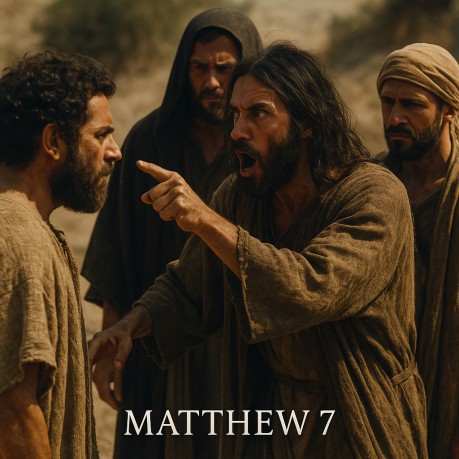
Matthew 7 Matthew 7:1-2 † Jesus warns against hypocritical judgment.
This does not forbid discernment but condemns a spirit of
self-righteousness. † The Mishnah often emphasized just measures
and fair standards (Avot 1:1). Jesus applies that principle to
personal relationships. † To us today, it shows that the measure we use
with others will be used on us. Grace must guide our dealings. Matthew 7:3-5 † Jesus uses exaggeration to expose hypocrisy.
Correcting others while ignoring our own sins is blindness. † Philo condemned those who judged others while
guilty themselves (On the Special Laws 4.174). Jesus brings that
principle into vivid picture. † To us today, it shows that self-examination
must come before correction of others. Matthew 7:6 † The holy and pearls symbolize covenant truth.
Dogs and pigs represent those who despise it. † The Dead Sea Scrolls describe keeping the
mysteries of God from the unfaithful (1QS 9.16). Jesus affirms wise
discernment. † To us today, it shows that truth must be
guarded and given with wisdom. Matthew 7:7-8 † Persistent prayer is encouraged. God responds
to those who seek Him. † Early church fathers like Origen saw this as
the invitation into covenant fellowship with God (On Prayer 24). † To us today, it assures us that God is
accessible to those who seek Him sincerely. Matthew 7:9-11 † Jesus uses common sense. If human fathers
give good gifts, how much more does God. † Josephus highlighted the Jewish emphasis on
the kindness of fathers (Against Apion 2.206). Jesus points to God's
perfect fatherhood. † To us today, it assures us God provides
exactly what His children need. Matthew 7:12 † This Golden Rule sums up covenant ethics. It
is the heart of God's law. † Similar principles appear in Jewish
tradition, but Jesus makes it the fulfillment of the Law and Prophets
(Tobit 4:15; Mishnah Shabbat 31a). † To us today, it shows that love for others is
the essence of the fulfilled law. Matthew 7:13-14 † The narrow way is covenant faithfulness,
leading to life. The wide path represents Israel's majority rejecting
Christ, leading to destruction in AD 70. † Josephus records how multitudes followed
zealotry into destruction, while the faithful remnant was small (Wars
6.420). † To us today, it shows that truth is not found
in majority opinion but in Christ alone. Matthew 7:15-16 † False prophets looked pious but bore corrupt
fruit. The destruction of Jerusalem proved them false. † The Mishnah warns of false teachers who lead
Israel astray (Sanhedrin 11:5). Jesus gives the ultimate test: fruit. † To us today, it shows that character and
works reveal the true nature of leaders. Matthew 7:17-20 † The image of trees mirrors Israel's
leadership. Judgment by fire points to AD 70. † Tacitus described how corruption destroyed
nations from within (Histories 5.13). Jesus applies this to covenant
leaders. † To us today, it shows God's kingdom is
identified by fruit, not appearance. Matthew 7:21-23 † Confession without obedience is worthless.
Jesus requires doing the Father's will. † Origen stressed that outward acts without
obedience are rejected (Homilies on Matthew 23). † To us today, it proves lip service is not
enough. True disciples obey Christ. Matthew 7:24-27 † Jesus ends with a parable of foundations. The
wise builder represents faithful disciples, the foolish builder
represents those who heard but rejected Him. The storm is covenant
judgment. † The Dead Sea Scrolls use storm imagery for
God's judgment (1QH 5.22). Jesus fulfills that warning. † To us today, it shows that hearing Christ
without obedience leads to ruin. Matthew 7:28-29 † Jesus' authority contrasted with the scribes,
who quoted traditions. He spoke as the living Word of God. † Eusebius noted that the early church marveled
at Christ's unique authority as the Son (Ecclesiastical History 1.3). † To us today, it shows that Christ's authority
still commands our obedience. † This is the fulfilled perspective we proclaim at
Fulfilled Prophecies † Source Index
By Dan Maines
Do not judge, so that you will
not be judged. For in the way you judge, you will be judged; and by
your standard of measure, it will be measured to you.
And why do you look at the
speck that is in your brother's eye, but do not notice the log that
is in your own eye? Or how can you say to your brother, "Let me
take the speck out of your eye," and look, the log is in your
own eye? You hypocrite, first take the log out of your own eye, and
then you will see clearly to take the speck out of your brother's
eye!
Do not give what is holy to
dogs, and do not throw your pearls before pigs, or they will trample
them under their feet, and turn and tear you to pieces.
Ask, and it will be given to
you; seek, and you will find; knock, and it will be opened to you.
For everyone who asks receives, and the one who seeks finds, and to
the one who knocks it will be opened.
Or what person is there among
you who, when his son asks for a loaf of bread, will give him a
stone? Or if he asks for a fish, he will not give him a snake, will
he? So if you, despite being evil, know how to give good gifts to
your children, how much more will your Father who is in heaven give
good things to those who ask Him!
In everything, therefore, treat
people the same way you want them to treat you, for this is the Law
and the Prophets.
Enter through the narrow
gate; for the gate is wide and the way is broad that leads to
destruction, and there are many who enter through it. For the gate is
narrow and the way is constricted that leads to life, and there are
few who find it.
Beware of the false
prophets, who come to you in sheep's clothing, but inwardly are
ravenous wolves. You will know them by their fruits. Grapes are not
gathered from thorn bushes, nor figs from thistles, are they?
So every good tree bears
good fruit, but the bad tree bears bad fruit. A good tree cannot bear
bad fruit, nor can a bad tree bear good fruit. Every tree that does
not bear good fruit is cut down and thrown into the fire. So you will
recognize them by their fruits.
Not everyone who says to Me,
"Lord, Lord," will enter the kingdom of heaven, but the one
who does the will of My Father who is in heaven will enter. Many will
say to Me on that day, "Lord, Lord, did we not prophesy in Your
name, and in Your name cast out demons, and in Your name perform many
miracles?" And then I will declare to them, "I never knew
you; leave Me, you who practice lawlessness."
Therefore, everyone who
hears these words of Mine, and acts on them, will be like a wise man
who built his house on the rock. And the rain fell and the floods
came, and the winds blew and slammed against that house; and yet it
did not fall, for it had been founded on the rock. And everyone who
hears these words of Mine, and does not act on them, will be like a
foolish man who built his house on the sand. And the rain fell and
the floods came, and the winds blew and slammed against that house;
and it fell—and its collapse was great.
When Jesus had finished
these words, the crowds were amazed at His teaching; for He was
teaching them as one who had authority, and not as their scribes.
† Mishnah,
Avot 1:1; 2:7; Sanhedrin 11:5; Shabbat 31a
†
Philo, On the Special Laws 4.174
† Dead Sea
Scrolls: 1QS 9.16; 1QH 5.22
† Josephus,
Against Apion 2.206; Wars 6.420
† Tacitus,
Histories 5.13
† Origen, On Prayer 24;
Homilies on Matthew 23
† Eusebius,
Ecclesiastical History 1.3
† Tobit 4:15
Links