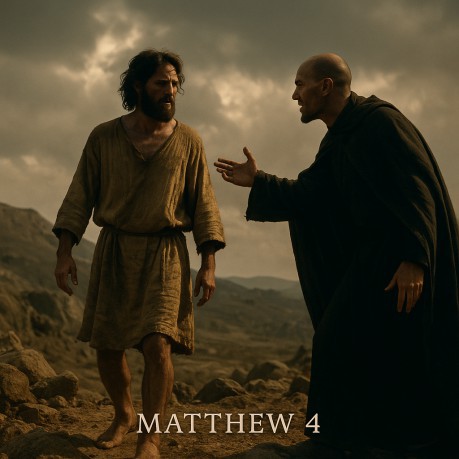
Matthew 4 Matthew 4:1 † Just as Israel was tested in the wilderness
for forty years, Jesus was tested for forty days. He succeeds where
Israel failed, proving Himself the true Son. † The Dead Sea Scrolls describe how the
faithful expected a final confrontation with evil powers in the
wilderness (1QM War Scroll). Matthew shows this fulfilled in Christ's
victory. † To us today, it shows that temptation is not
sin itself. Like Christ, we are called to resist by relying on God's
word. Matthew 4:2 † The forty days connect directly to Moses on
Sinai (Exodus 34:28) and Elijah's journey (1 Kings 19:8). Jesus
fulfills both the law and the prophets. † Irenaeus argued that Christ recapitulated
Israel's history in Himself (Against Heresies 3.18.1). His hunger
displays His humanity, yet He remained faithful. † To us today, it proves Jesus shares our
weakness but overcomes in perfect obedience. Matthew 4:3-4 † The first temptation targets physical need.
Jesus answers with Deuteronomy 8:3, reminding that true life is
sustained by God's word, not merely food. † Philo noted that true nourishment comes from
the divine Logos, not earthly bread (On the Migration of Abraham
130). Matthew presents Jesus as the embodiment of this truth. † To us today, it shows we must value God's
word above all earthly needs. Matthew 4:5-7 † Satan quotes Psalm 91, twisting Scripture to
promote presumption. Jesus answers with Deuteronomy 6:16, showing
Scripture interprets Scripture. Testing God is unbelief, not faith. † Origen wrote that twisting Scripture is the
devil's oldest weapon, but Christ gave the true interpretation
(Against Celsus 2.24). † To us today, it warns that Scripture out of
context is dangerous. Faith trusts God's word without putting Him to
the test. Matthew 4:8-10 † The third temptation is idolatry, offering
glory without suffering. Jesus rejects it with Deuteronomy 6:13.
Unlike Israel, He remains loyal to God alone. † Tacitus noted how Rome's emperors demanded
worship as gods (Annals 15.44). Jesus refuses all such compromises,
even if it meant avoiding suffering. † To us today, it proves God's kingdom cannot
be gained by compromise with worldly power. Matthew 4:11 † Victory comes through faithfulness. After
resisting temptation, Christ is ministered to by angels, showing
God's care for His Son. † Eusebius emphasized that Christ's victory
over the devil marked the start of His ministry and the breaking of
Satan's power (Ecclesiastical History 1.3). † To us today, it reminds us that when we
resist temptation, God provides strength and comfort. Matthew 4:12-16 † Jesus' ministry begins in Galilee, fulfilling
Isaiah 9:1-2. The despised region became the first to see the light
of Messiah. † Josephus describes Galilee as densely
populated and diverse (Wars 3.41-43). This made it the perfect place
for the gospel to shine first. † To us today, it shows God often works in the
least expected places. His light shines where darkness once ruled. Matthew 4:17 † Jesus begins His ministry with the same
message as John: repentance and the nearness of the kingdom. The
kingdom was not distant, but imminent in that generation. † To us today, it proves the kingdom has come.
We live in the blessings of what Christ announced. Matthew 4:18-20 † Jesus calls ordinary fishermen, showing the
kingdom is built on humble beginnings. The image of fishing for
people comes from Jeremiah 16:16, where God would gather His people. † The Mishnah records the value of obedience to
a rabbi, but Jesus calls disciples to Himself, a claim greater than
any rabbi (Avot 1:4). † To us today, it proves Christ calls us in our
ordinary lives to join His mission. Matthew 4:21-22 † James and John leave family and livelihood to
follow Christ. This demonstrates the radical call of discipleship. † To us today, it teaches us that following
Christ means placing Him above all other loyalties. Matthew 4:23-25 † Jesus demonstrates the reality of the kingdom
through healing and teaching. His miracles show that the kingdom was
present in power. † Early church fathers like Justin Martyr
pointed to Christ's healing as proof He fulfilled Isaiah's promises
of restoration (Dialogue with Trypho 69). † To us today, it reminds us that the kingdom
is not in words only but in power. Christ's authority brings life and
healing. † This is the fulfilled perspective we proclaim at
Fulfilled Prophecies † Source Index
By Dan Maines
Then Jesus was led up by the
Spirit into the wilderness to be tempted by the devil.
And after He had fasted for
forty days and forty nights, He then became hungry.
And the tempter came and said
to Him, "If You are the Son of God, command that these stones
become bread." But He answered and said, "It is written:
'Man shall not live on bread alone, but on every word that comes out
of the mouth of God.'"
Then the devil took Him along
into the holy city and had Him stand on the pinnacle of the temple,
and he said to Him, "If You are the Son of God, throw Yourself
down; for it is written: 'He will give His angels orders concerning
You'; and 'On their hands they will lift You up, so that You do not
strike Your foot against a stone.'" Jesus said to him, "On
the other hand, it is written: 'You shall not put the Lord your God
to the test.'"
Again, the devil took Him
along to a very high mountain, and showed Him all the kingdoms of the
world and their glory; and he said to Him, "All these things I
will give You, if You fall down and worship me." Then Jesus said
to him, "Go away, Satan! For it is written: 'You shall worship
the Lord your God, and serve Him only.'"
Then the devil left Him; and
behold, angels came and began to serve Him.
Now when Jesus heard that
John had been taken into custody, He withdrew into Galilee; and
leaving Nazareth, He came and settled in Capernaum, which is by the
sea, in the region of Zebulun and Naphtali. This happened so that
what was spoken through Isaiah the prophet would be fulfilled: "The
land of Zebulun and the land of Naphtali, by way of the sea, on the
other side of the Jordan, Galilee of the Gentiles—the people who
were sitting in darkness saw a great light, and those who were
sitting in the land and shadow of death, upon them a light dawned."
From that time Jesus began to
preach and say, "Repent, for the kingdom of heaven is at hand."
Now as Jesus was walking by
the Sea of Galilee, He saw two brothers, Simon, who was called Peter,
and Andrew his brother, casting a net into the sea; for they were
fishermen. And He said to them, "Follow Me, and I will make you
fishers of people." Immediately they left their nets and
followed Him.
Going on from there He saw
two other brothers, James the son of Zebedee, and John his brother,
in the boat with their father Zebedee, mending their nets; and He
called them. Immediately they left the boat and their father, and
followed Him.
Jesus was going about in all
of Galilee, teaching in their synagogues, and proclaiming the gospel
of the kingdom, and healing every disease and every sickness among
the people. And the news about Him spread throughout Syria; and they
brought to Him all who were ill, those suffering with various
diseases and severe pain, demon-possessed, people with epilepsy, and
people who were paralyzed; and He healed them. Large crowds followed
Him from Galilee and the Decapolis, and Jerusalem, and Judea, and
from beyond the Jordan.
† Dead Sea
Scrolls: 1QM War Scroll
† Irenaeus, Against
Heresies 3.18.1
† Philo, On the Migration of
Abraham 130
† Origen, Against Celsus 2.24
†
Tacitus, Annals 15.44
† Eusebius,
Ecclesiastical History 1.3
† Josephus, Wars
3.41-43
† Mishnah, Avot 1:4
†
Justin Martyr, Dialogue with Trypho 69
Links