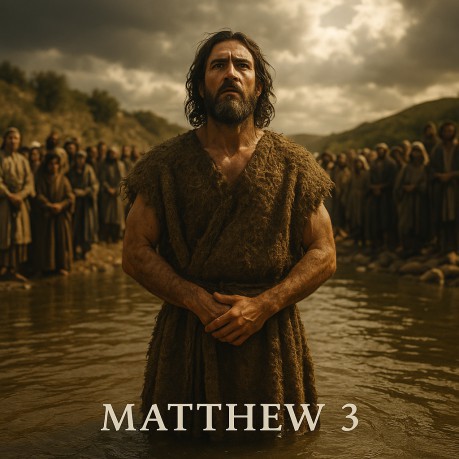
Matthew 3 Matthew 3:1-2 † John announces that the kingdom of heaven is
not far off but near, ready to break into history. His message of
repentance is covenantal, calling Israel to turn back to God before
judgment fell. † Josephus mentions John as a righteous man who
urged the Jews to practice virtue and baptism (Antiquities
18.116-117). His influence was widely known and respected. † To us today, it shows that repentance is the
entry point into the kingdom. The kingdom has come, and we live
within its blessings because it was truly at hand then, not
postponed. Matthew 3:3 † Isaiah 40:3 foretold a forerunner preparing
the way for the Lord. Matthew identifies John as that voice,
declaring that Yahweh Himself was coming in the person of Christ. † The Dead Sea Scrolls community also cited
Isaiah 40:3 to describe their own mission in the wilderness (1QS
8.13-14), but Matthew shows that John was the true fulfillment. † To us today, this proves God's promises were
fulfilled in that generation. John prepared the way, and the Lord
came in judgment and salvation. Matthew 3:4 † John's clothing and lifestyle reflect Elijah,
who also wore a garment of hair and a leather belt (2 Kings 1:8).
This fulfills Malachi 4:5 that Elijah would come before the day of
the Lord. † Early church fathers like Tertullian pointed
out John's austere life as evidence of his prophetic calling (On
Baptism 10). † To us today, it shows that God's messengers
often stand apart from worldly luxury. True service demands devotion,
not indulgence. Matthew 3:5-6 † John drew massive crowds, proving Israel was
in expectation of the Messiah. Baptism was a sign of cleansing, but
here it symbolized preparation for imminent covenant judgment. † Josephus confirms that John called people to
righteousness and baptism, which stirred great attention (Antiquities
18.116-117). † To us today, it shows that repentance must
precede renewal. The multitudes who responded foreshadow the new
covenant community being formed. Matthew 3:7-9 † John confronts the religious elite, exposing
their hypocrisy. Their claim to Abrahamic descent was worthless
without true repentance. The coming wrath refers to the covenant
judgment of AD 70. † The Mishnah shows Pharisees prided themselves
on lineage and outward observance (Mishnah Sotah 5:2). John destroys
that false security. † To us today, this proves heritage or religion
cannot save. Only true repentance and faith in Christ matter. Matthew 3:10 † Judgment was imminent. The axe was already at
the root, not delayed for thousands of years. The unfruitful trees
represented Israel's corrupt leaders and system. † Josephus records the coming destruction of
Jerusalem as a fiery judgment, cutting off the nation (Wars 6.271).
John's prophecy points directly to this. † To us today, it confirms that God keeps His
word. The judgment John announced did come, and the kingdom was
established. Matthew 3:11-12 † John distinguishes his baptism from Christ's.
Jesus would bring the Spirit for the faithful and fiery judgment for
the unrepentant. The imagery of wheat and chaff depicts covenant
separation. † Origen emphasized that the Spirit and fire
both purify and judge (Commentary on Matthew 10.23). † To us today, it means Christ's kingdom is
both blessing and judgment. Those in Him receive life, those
rejecting Him face fire. Matthew 3:13-15 † Jesus was sinless, but His baptism identified
Him with His people. He fulfilled righteousness by entering fully
into their covenant experience, preparing to bear their sins. † Irenaeus explained that Christ sanctified the
waters of baptism by His submission (Against Heresies 1.21.2). † To us today, it shows Christ's humility and
obedience. He fulfills the law on our behalf. Matthew 3:16-17 † This is the public confirmation of Jesus as
Messiah. The Spirit anoints Him, and the Father's voice declares Him
the Son. Psalm 2:7 and Isaiah 42:1 echo in these words. † Eusebius wrote that the baptism marked the
beginning of Christ's mission, sealed by the Spirit (Ecclesiastical
History 1.3). † To us today, it assures us that Jesus is the
true Son of God, anointed to fulfill all prophecy. † This is the fulfilled perspective we proclaim at
Fulfilled Prophecies † Source Index
By Dan Maines
Now in those days John the
Baptist came, preaching in the wilderness of Judea, saying, "Repent,
for the kingdom of heaven is at hand."
For this is the one referred to
by Isaiah the prophet when he said, "The voice of one calling
out in the wilderness, 'Prepare the way of the Lord, make His paths
straight!'"
Now John himself had a garment
of camel's hair and a leather belt around his waist; and his food was
locusts and wild honey.
At that time Jerusalem was
going out to him, and all Judea and all the region around the Jordan;
and they were being baptized by him in the Jordan River, as they
confessed their sins.
But when he saw many of the
Pharisees and Sadducees coming for baptism, he said to them, "You
offspring of vipers, who warned you to flee from the wrath to come?
Therefore produce fruit consistent with repentance; and do not assume
that you can say to yourselves, 'We have Abraham as our father'; for
I say to you that from these stones God is able to raise up children
for Abraham."
And the axe is already laid at
the root of the trees; therefore every tree that does not bear good
fruit is being cut down and thrown into the fire.
"As for me, I baptize
you with water for repentance, but He who is coming after me is
mightier than I, and I am not fit to remove His sandals; He will
baptize you with the Holy Spirit and fire. His winnowing fork is in
His hand, and He will thoroughly clear His threshing floor; and He
will gather His wheat into the barn, but He will burn up the chaff
with unquenchable fire."
Then Jesus arrived from
Galilee at the Jordan, coming to John to be baptized by him. But John
tried to prevent Him, saying, "I have the need to be baptized by
You, and yet You are coming to me?" But Jesus, answering, said
to him, "Allow it at this time; for in this way it is fitting
for us to fulfill all righteousness." Then he allowed Him.
After He was baptized, Jesus
came up immediately from the water; and behold, the heavens were
opened, and he saw the Spirit of God descending as a dove and
settling on Him, and behold, a voice from the heavens said, "This
is My beloved Son, with whom I am well pleased."
† Josephus,
Antiquities 18.116-117; Wars 6.271
† Dead Sea
Scrolls: 1QS 8.13-14
† Tertullian, On Baptism
10
† Mishnah, Sotah 5:2
†
Origen, Commentary on Matthew 10.23
†
Irenaeus, Against Heresies 1.21.2
† Eusebius,
Ecclesiastical History 1.3
Links