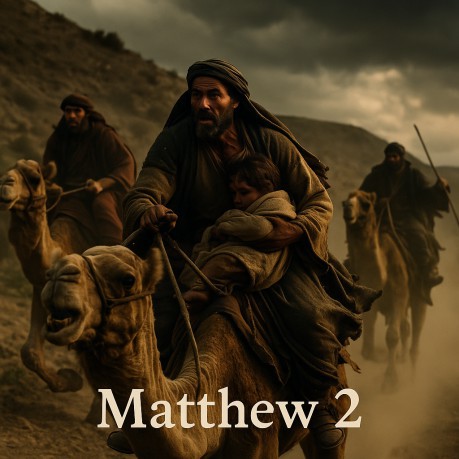
Matthew 2 Matthew 2:1-2 † The birth in Bethlehem fulfills Micah 5:2,
where the Messiah would come from the city of David. The magi, likely
scholars from Persia or Babylon, represent the nations coming to
Israel's Messiah. Their question, "Where is He who has been born
King of the Jews?" is politically dangerous, as it challenges
Herod's authority. † Josephus describes Herod as paranoid and
cruel, murdering even his own family to protect his throne
(Antiquities 16.394; Wars 1.431). The arrival of foreign dignitaries
announcing another king would have stirred deep fear in him. † To us today, this shows Christ's kingship
wasn't just over Israel but extended to all nations. The nations
recognized Him, while Israel's rulers resisted. Matthew 2:3-4 † Herod's fear spread to Jerusalem, since any
challenge to his throne could bring Roman retaliation. The priests
and scribes knew the Scriptures but didn't seek the Messiah
themselves. This exposes the hardness of Israel's leadership. † Philo criticizes rulers who live in fear of
losing power rather than leading with justice (On the Embassy to
Gaius 351). Herod fits this perfectly. † To us today, it warns us not to know
Scripture only with our minds while resisting it in our hearts. Matthew 2:5-6 † The priests quote Micah 5:2, identifying
Bethlehem as the birthplace of the Messiah. The irony is they knew
the prophecy but had no interest in seeking Him, while Gentiles
traveled far to worship Him. † The Dead Sea Scrolls show the expectation of
a ruler from David's line who would lead the faithful
(4QFlorilegium). Matthew is making it clear this prophecy was
fulfilled in Jesus. † To us today, it reminds us that prophecy
fulfillment is exact. God doesn't fail in detail. Matthew 2:7-8 † Herod pretends piety but plots murder. His
secrecy reveals his deceitful heart. This foreshadows the hostility
Jesus will face from the rulers of Israel and Rome. † Tacitus wrote of rulers who masked cruelty
with pious words (Annals 1.11). Herod's hypocrisy is a textbook case. † To us today, it warns against false religion
that hides evil under the appearance of devotion. Matthew 2:9-10 † The star is not explained scientifically but
understood as God's sign guiding the magi. They rejoiced because they
had reached the promised King. † Origen suggested the star was a supernatural
sign rather than a common celestial event (Against Celsus 1.58). † To us today, this reminds us that God guides
those who truly seek Him. Matthew 2:11 † The magi worshiped the Child, not Mary. The
gifts symbolize kingship (gold), deity (frankincense), and suffering
(myrrh). This reveals His identity and mission. † Early church fathers like Irenaeus saw the
gifts as prophetic symbols of Christ's role as King, God, and
sacrifice (Against Heresies 3.9.2). † To us today, it shows that true worship
offers our best to Christ, recognizing His authority and sacrifice. Matthew 2:12 † God protected the Child by redirecting the
magi. Human schemes cannot overthrow God's plan. † To us today, this proves God directs the
steps of those who obey Him, even when rulers oppose His will. Matthew 2:13-15 † Hosea 11:1 originally spoke of Israel, God's
son, being called out of Egypt. Matthew shows Jesus as the true
Israel, the faithful Son. † The Mishnah emphasizes Egypt as a place of
refuge in Jewish memory (Sotah 1:9). Matthew uses this history to
highlight Jesus as the fulfillment of Israel's story. † To us today, it reminds us that God brings
deliverance in His timing, calling us out of bondage into freedom in
Christ. Matthew 2:16-18 † This massacre fulfilled Jeremiah 31:15.
Herod's cruelty reflected his desperate grip on power. Josephus
confirms Herod's ruthless nature, even killing his own sons when he
feared plots against him (Antiquities 16.394). † To us today, it shows the world's rulers
often resist God's kingdom violently, yet their schemes fail.
Christ's kingdom cannot be stopped. Matthew 2:19-23 † Jesus' return to Israel after exile mirrors
Israel's own story. Settling in Nazareth fulfilled the prophetic
pattern, though not a direct quote of one prophet, but a summary of
themes that Messiah would be despised (Isaiah 53:3). † Eusebius noted that Nazareth was considered
insignificant, yet it was the place God chose to raise His Son
(Ecclesiastical History 1.7). † To us today, it shows that God exalts what
the world despises. Christ's kingdom doesn't come with worldly glory
but with humble power. † This is the fulfilled perspective we proclaim at
Fulfilled Prophecies † Source Index
By Dan Maines
Now after Jesus was born in
Bethlehem of Judea, in the days of Herod the king, magi from the east
arrived in Jerusalem, saying, "Where is He who has been born
King of the Jews? For we saw His star in the east, and have come to
worship Him."
When Herod the king heard
this, he was troubled, and all Jerusalem with him. And gathering
together all the chief priests and scribes of the people, he inquired
of them where the Messiah was to be born.
They said to him, "In
Bethlehem of Judea; for this is what has been written by the prophet:
'And you, Bethlehem, land of Judah, are by no means least among the
leaders of Judah; for from you will come forth a Ruler who will
shepherd My people Israel.'"
Then Herod secretly called for
the magi and determined from them the exact time the star appeared.
And he sent them to Bethlehem and said, "Go and search carefully
for the Child; and when you have found Him, report to me, so that I
too may come and worship Him."
After hearing the king, they
went on their way; and behold, the star, which they had seen in the
east, went on ahead of them until it came to a stop over the place
where the Child was to be found. When they saw the star, they
rejoiced exceedingly with great joy.
And after they came into the
house, they saw the Child with His mother Mary; and they fell down
and worshiped Him. Then they opened their treasures and presented to
Him gifts of gold, frankincense, and myrrh.
And after being warned by God
in a dream not to return to Herod, the magi left for their own
country by another way.
Now when they had gone,
behold, an angel of the Lord appeared to Joseph in a dream and said,
"Get up! Take the Child and His mother and flee to Egypt, and
stay there until I tell you; for Herod is going to search for the
Child to kill Him." So Joseph got up and took the Child and His
mother while it was still night, and left for Egypt. He stayed there
until the death of Herod; this happened so that what had been spoken
by the Lord through the prophet would be fulfilled: "Out of
Egypt I called My Son."
Then when Herod saw that he
had been tricked by the magi, he became very enraged, and sent men
and killed all the boys who were in Bethlehem and all its vicinity
who were two years old or under, according to the time which he had
determined from the magi. Then what had been spoken through Jeremiah
the prophet was fulfilled: "A voice was heard in Ramah, weeping
and great mourning, Rachel weeping for her children; and she refused
to be comforted, because they were no more."
But when Herod died, behold,
an angel of the Lord appeared in a dream to Joseph in Egypt, and
said, "Get up, take the Child and His mother, and go to the land
of Israel; for those who sought the Child's life are dead." So
Joseph got up, took the Child and His mother, and came into the land
of Israel. But when he heard that Archelaus was reigning over Judea
in place of his father Herod, he was afraid to go there. Then after
being warned by God in a dream, he left for the regions of Galilee,
and came and settled in a city called Nazareth. This happened so that
what was spoken through the prophets would be fulfilled: "He
will be called a Nazarene."
† Josephus,
Antiquities 16.394; Wars 1.431
† Philo, On
the Embassy to Gaius 351
† Dead Sea Scrolls:
4QFlorilegium
† Tacitus, Annals 1.11
†
Origen, Against Celsus 1.58
† Irenaeus,
Against Heresies 3.9.2
† Mishnah, Sotah 1:9
†
Eusebius, Ecclesiastical History 1.7
Links