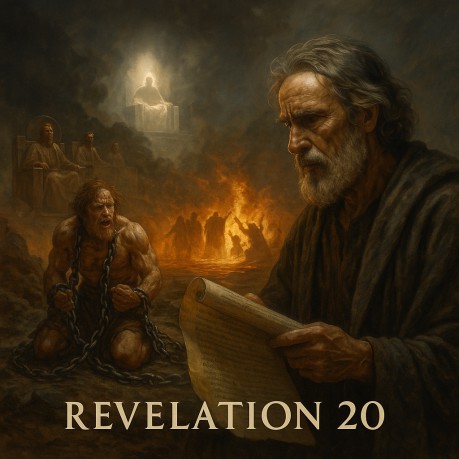
Revelation 20:1-2 † The binding of Satan symbolizes the restraint
of his power to deceive the nations. It is not literal chains but
covenantal authority through Christ's victory at the cross. Revelation 20:3 † Satan's restraint ensured the gospel's rapid
spread to the nations before AD 70. His "short release"
corresponds to the tribulation preceding Jerusalem's fall. Revelation 20:4 † The martyrs reign with Christ, vindicated for
their faithfulness. Their resurrection is spiritual, participation in
Christ's heavenly reign. Revelation 20:5-6 † The first resurrection is spiritual life in
Christ, seen in the martyrs' vindication. The second death is eternal
separation from God. Revelation 20:7-8 † Gog and Magog represent the nations stirred
up in rebellion. Symbolically, this depicts the final assault of Rome
and its allies upon Jerusalem. Revelation 20:9 † The "beloved city" is Jerusalem,
not the New Jerusalem, but the old covenant city under siege. Fire
symbolizes divine judgment carried out through Rome. Revelation 20:10 † Satan's defeat is final. The beast (imperial
Rome under Nero) and the false prophet (apostate Israel) share in
destruction. Revelation 20:11-12 † The great white throne signifies God's
ultimate judgment. The opening of the books reflects covenant
accountability. Revelation 20:13-14 † The universal resurrection and judgment
fulfill God's promises. Death itself is destroyed, swallowed up in
victory. Revelation 20:15 † The book of life holds the names of the
redeemed. Those outside face eternal judgment. How it applies to us today † Christ has bound Satan and reigns as King,
ensuring the gospel's triumph. † This is the fulfilled perspective we proclaim at
Fulfilled Prophecies † Source Index
By Dan MainesRevelation 20
Then I saw an angel coming
down from heaven, holding the key of the abyss and a great chain in
his hand. And he took hold of the dragon, the serpent of old, who is
the devil and Satan, and bound him for a thousand years.
†
Proof, Jesus said He bound the strong man in order to plunder his
house (Matthew 12:29). The "thousand years" is symbolic for
a complete period, representing the fullness of time between Christ's
resurrection and Jerusalem's destruction.
And he threw him into the
abyss, and shut it and sealed it over him, so that he would not
deceive the nations any longer, until the thousand years were
completed; after these things he must be released for a short time.
†
Proof, Paul wrote that "the mystery of lawlessness is already at
work" (2 Thessalonians 2:7), pointing to Satan's limited
resurgence before judgment.
Then I saw thrones, and they
sat on them, and judgment was given to them. And I saw the souls of
those who had been beheaded because of their testimony of Jesus and
because of the word of God, and those who had not worshiped the beast
or his image, and had not received the mark on their foreheads and on
their hands; and they came to life and reigned with Christ for a
thousand years.
† Proof, Daniel 7:22
says judgment was given to the saints of the Most High, fulfilled in
their vindication after Jerusalem's judgment. Early writers like
Tertullian (Against Marcion 3.24) saw martyrdom as a share in
Christ's reign.
The rest of the dead did
not come to life until the thousand years were completed. This is the
first resurrection. Blessed and holy is the one who has a part in the
first resurrection; over these the second death has no power, but
they will be priests of God and of Christ and will reign with Him for
a thousand years.
† Proof, Jesus said, "He
who believes in Me will live even if he dies" (John 11:25). The
church already shares in resurrection life.
When the thousand years
are completed, Satan will be released from his prison, and will come
out to deceive the nations which are at the four corners of the
earth, Gog and Magog, to gather them together for the war; the number
of them is like the sand of the seashore.
† Proof,
Ezekiel 38–39 describes Gog and Magog, applied here as covenantal
enemies opposing God's people. Josephus (Wars 5.1.5) records
multitudes gathered in Jerusalem's final days, deceived by false
prophets.
And they came up on the
broad plain of the earth and surrounded the camp of the saints and
the beloved city, and fire came down from heaven and devoured them.
†
Proof, Josephus (Wars 6.4.5) records the temple burned with fire,
fulfilling Christ's words in Matthew 24:2.
And the devil who deceived
them was thrown into the lake of fire and brimstone, where the beast
and the false prophet also are; and they will be tormented day and
night forever and ever.
† Proof, this fulfills Genesis
3:15 — the serpent crushed by Christ.
Then I saw a great white
throne and Him who sat upon it, from whose presence earth and heaven
fled, and no place was found for them. And I saw the dead, the great
and the small, standing before the throne, and books were opened; and
another book was opened, which is the book of life; and the dead were
judged from the things which were written in the books, according to
their deeds.
† Proof, Daniel 7:10
describes books opened before the Ancient of Days. Early Christians
like Clement of Rome (1 Clement 28) affirmed God's perfect record of
deeds.
And the sea gave up the
dead who were in it, and death and Hades gave up the dead who were in
them; and they were judged, each one of them according to their
deeds. Then death and Hades were thrown into the lake of fire. This
is the second death, the lake of fire.
† Proof, Paul wrote, "The last
enemy to be abolished is death" (1 Corinthians 15:26).
And if anyone's name was
not found written in the book of life, he was thrown into the lake of
fire.
†
Proof, Philippians 4:3 Paul speaks of fellow workers whose names are
in the book of life, affirming the same truth.
† The martyrs'
vindication proves that faithfulness is never wasted.
†
The first resurrection is ours now, spiritual life in Christ that no
power can take away.
† Judgment is real and
certain, but in Christ our names are written in the book of life.
† Genesis
3:15 – serpent crushed
† Exodus plagues
imagery – parallels in bowls
† Daniel 7:10,
22 – books opened, saints vindicated
†
Ezekiel 38–39 – Gog and Magog imagery
†
Matthew 12:29; 24:2 – binding of Satan, temple's fall
†
John 11:25 – living even in death
†
Philippians 4:3 – book of life
† 1
Corinthians 15:26 – last enemy destroyed
†
2 Thessalonians 2:7 – lawlessness at work
†
Clement of Rome, 1 Clement 28 – God's record of deeds
†
Tertullian, Against Marcion 3.24 – martyrs share in Christ's
reign
† Josephus, Wars 5.1.5; 6.4.5 –
multitudes deceived, temple burned
† Tacitus,
Histories – witness to the chaos of the time
Links