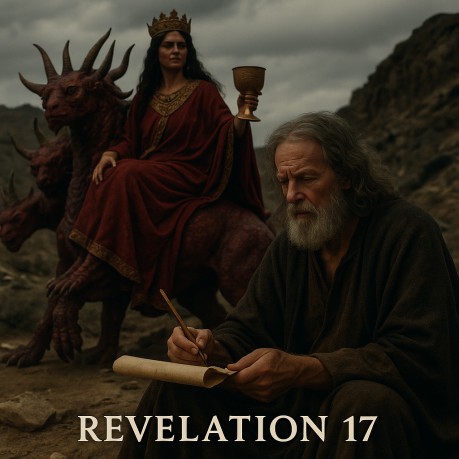
Revelation 17:1-2 † The great prostitute represents apostate
Jerusalem, which abandoned her covenant with God and allied with
Rome. "Many waters" symbolize peoples and nations she
influenced. Revelation 17:3 † The scarlet beast is Rome, arrayed in
imperial power. The woman sitting on the beast shows Jerusalem riding
on Rome's authority, complicit in her own destruction. Revelation 17:4-5 † The attire of purple and scarlet mirrors the
colors of the temple priests' garments, but here it is corrupted,
showing her outward beauty and inward filth. Revelation 17:6 † Jerusalem's guilt is clear: she killed the
prophets and the saints (Matthew 23:37). Revelation 17:7-8 † The beast "was, is not, and will come"
refers to the succession of Caesars. Nero "was," his death
created a gap "is not," and Vespasian's rise "will
come." Revelation 17:9-10 † Rome, the city of seven hills, is clearly
identified. The seven kings are the Caesars: Julius, Augustus,
Tiberius, Caligula, Claudius (five fallen), Nero (the one who is),
Galba (the one to remain briefly). Revelation 17:11 † The eighth is Vespasian, who rose after the
chaos of the year of the four emperors, yet is of the seven because
he continued the line of imperial rule. Revelation 17:12-13 † The horns represent client kings and regional
rulers who allied with Rome during the Jewish war. Revelation 17:14 † Rome and her allies opposed Christ by
persecuting His people, but the Lamb triumphed. The victory of the
saints is through faith, not military might. Revelation 17:15-16 † The irony is that Jerusalem, who allied with
Rome, is destroyed by the very beast she trusted. Revelation 17:17-18 † The great city is Jerusalem, guilty of
covenant adultery and now judged. Rome was God's instrument of wrath,
fulfilling His prophetic word. How it applies to us today † Trusting in worldly power brings destruction.
Jerusalem's alliance with Rome ended in betrayal and ruin. † This is the fulfilled perspective we proclaim at
Fulfilled Prophecies † Source Index
By Dan MainesRevelation 17
Then one of the seven
angels who had the seven bowls came and spoke with me, saying, "Come
here, I will show you the judgment of the great prostitute who sits
on many waters, with whom the kings of the earth committed acts of
sexual immorality, and those who live on the earth became drunk with
the wine of her sexual immorality."
† Proof, Jeremiah 2:20 and
Ezekiel 16 describe Jerusalem as a harlot committing adultery with
the nations. Josephus (Wars 4.3.9) records her alliances and
betrayals that led to her downfall.
And he carried me away in
the Spirit into a wilderness; and I saw a woman sitting on a scarlet
beast, full of blasphemous names, having seven heads and ten horns.
†
Proof, John 19:15 "We have no king but Caesar." By
rejecting Christ, Jerusalem chose to ride upon the beast.
The woman was clothed in
purple and scarlet, and adorned with gold, precious stones, and
pearls, holding in her hand a gold cup full of abominations and of
the unclean things of her sexual immorality, and on her forehead a
name was written: a mystery, "Babylon the great, the mother of
prostitutes and of the abominations of the earth."
†
The cup parallels Jeremiah 51:7 Babylon made the nations drunk with
her wine. Jerusalem became the new Babylon in her rebellion.
And I saw the woman drunk
with the blood of the saints, and with the blood of the witnesses of
Jesus. When I saw her, I wondered greatly.
†
Proof, Josephus (Wars 4.5.2) records that even during the siege,
Jerusalem's leaders shed innocent blood within the city, drunk with
violence.
And the angel said to me,
"Why do you wonder? I will tell you the mystery of the woman and
of the beast that carries her, which has the seven heads and the ten
horns. The beast that you saw was, and is not, and is about to come
up out of the abyss and go to destruction. And those who live on the
earth, whose names have not been written in the book of life from the
foundation of the world, will wonder when they see the beast, that he
was, and is not, and will come."
† Proof, Tacitus (Histories 1.2)
describes the chaos after Nero's death, when Rome seemed to collapse,
yet revived under Vespasian.
Here is the mind which
has wisdom. The seven heads are seven mountains upon which the woman
sits, and they are seven kings; five have fallen, one is, the other
has not yet come; and when he comes, he must remain a little while.
† Proof,
Suetonius records Galba's reign lasted only seven months, fulfilling
this prophecy.
The beast which was, and is
not, is himself also an eighth, and is one of the seven, and he goes
to destruction.
†
Proof, Josephus (Wars 4.10.3) hails Vespasian as the one to bring
Rome stability, though destined for destruction.
The ten horns which you
saw are ten kings who have not yet received a kingdom, but they
receive authority as kings with the beast for one hour. These have
one purpose, and they give their power and authority to the beast.
†
Proof, Josephus (Wars 3.4.2) lists rulers from the east who supplied
troops to Rome.
These will wage war against
the Lamb, and the Lamb will overcome them, because He is Lord of
lords and King of kings; and those who are with Him are the called
and chosen and faithful.
And he said to me, "The
waters which you saw where the prostitute sits are peoples and
multitudes and nations and languages. And the ten horns which you
saw, and the beast, these will hate the prostitute and will make her
desolate and naked, and will eat her flesh and will burn her up with
fire."
†
Proof, Rome burned the city and temple in AD 70 (Josephus, Wars
6.4.5).
For God has put it in
their hearts to execute His purpose by having a common purpose, and
by giving their kingdom to the beast, until the words of God will be
fulfilled. The woman whom you saw is the great city, which reigns
over the kings of the earth.
† Proof, Jesus
declared in Matthew 23:35-38 that all the blood of the righteous
would come upon that generation, and Jerusalem would be left
desolate.
†
God's sovereignty over history is absolute, as even Rome fulfilled
His prophetic purpose.
† The Lamb reigns, and
His people are called to faithfulness, not compromise.
†
The harlot's judgment assures us that God vindicates His saints and
avenges their blood.
† Jeremiah
2:20; Ezekiel 16 – Jerusalem as a harlot
†
Jeremiah 51:7 – Babylon's cup
† Matthew
23:35-38; 23:37; John 19:15 – Jerusalem's guilt and alliance with
Rome
† Daniel 7 – beast imagery
†
Psalm 2:6 – Zion's king
† Josephus, Wars
3.4.2; 4.3.9; 4.5.2; 4.10.3; 6.4.5 – alliances, corruption, Rome's
destruction of Jerusalem
† Tacitus, Histories
1.2 – chaos after Nero
† Suetonius, Galba 1
– short reign of Galba
† Sibylline Oracles,
Book 5 – Nero's return myth
Links