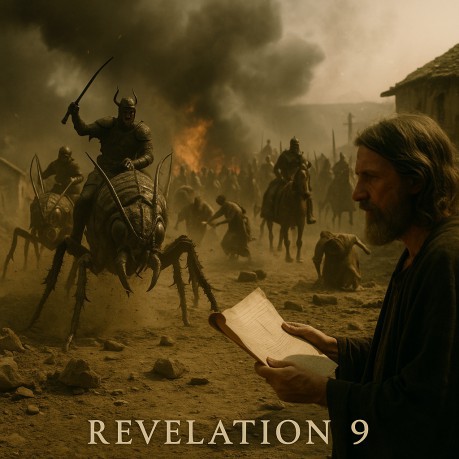
Revelation 9:1-2 † The fallen star represents a fallen ruler or
angelic power. Stars symbolize leaders in Scripture, Isaiah 14:12,
Revelation 1:20. This star is not Christ but one cast down. Revelation 9:3-4 † Unlike literal locusts, these harm people,
not vegetation. Their symbolic nature is clear. They represent
invading forces unleashed in judgment. Revelation 9:5-6 † Five months is the lifespan of a locust
swarm, a symbolic but limited period of judgment. It shows God's
wrath restrained, not total annihilation. Revelation 9:7-10 † The grotesque imagery emphasizes terror.
Locusts "like horses prepared for battle" points to cavalry
swarms. The human faces and lion's teeth symbolize intelligence and
ferocity. Revelation 9:11 † Abaddon and Apollyon mean "Destroyer."
This contrasts with literal locusts, which have no king (Proverbs
30:27). These are organized, destructive forces under satanic rule. Revelation 9:12-15 † The Euphrates was Israel's historic boundary
with invading empires (Assyria, Babylon). Releasing forces from the
Euphrates signaled invasion from the east. Revelation 9:16 † The number is symbolic of overwhelming force.
John hears the number, but no literal army of that size existed. The
point is terror and impossibility of resistance. Revelation 9:17-19 † This terrifying imagery portrays unstoppable
destruction. The colors of fire, hyacinth, and brimstone match battle
imagery of burning projectiles and sulfur. Revelation 9:20-21 † Even under devastation, the survivors refused
to repent. This reveals the hardness of heart in Jerusalem, clinging
to idolatry and rebellion against God. How it applies to us today † God's judgments are just, even when executed
through worldly powers. † This is the fulfilled perspective we proclaim at
Fulfilled Prophecies † Source Index
By Dan MainesRevelation 9
Then the fifth angel
sounded, and I saw a star from heaven which had fallen to the earth;
and the key to the shaft of the abyss was given to him. He opened the
shaft of the abyss, and smoke ascended out of the shaft like the
smoke of a great furnace; and the sun and the air were darkened from
the smoke of the shaft.
†
The abyss imagery recalls Isaiah 24:21-22, where rebellious powers
are imprisoned. The smoke darkening the sky shows spiritual deception
and chaos covering the land.
Then out of the smoke came
locusts onto the earth, and power was given to them, as the scorpions
of the earth have power. They were told not to harm the grass of the
earth, nor any green thing, nor any tree, but only the people who do
not have the seal of God on their foreheads.
†
Proof, Joel 2 describes locusts as an army advancing in ranks, a type
fulfilled here in the Roman and allied forces that invaded Judea.
†
The sealed, God's faithful, were spared this torment, proving God's
protection for His own during judgment.
And they were not permitted
to kill anyone, but to torment for five months; and their torment was
like the torment of a scorpion when it stings a person. And in those
days people will seek death and will not find it; they will long to
die, and death flees from them.
†
Proof, Josephus (Wars 5.12.3) describes people inside Jerusalem
suffering in torment, longing for death but unable to escape the
horrors of siege and famine.
The appearance of the
locusts was like horses prepared for battle; and on their heads
appeared to be crowns like gold, and their faces were like human
faces. They had hair like the hair of women, and their teeth were
like the teeth of lions. They had breastplates like breastplates of
iron; and the sound of their wings was like the sound of chariots of
many horses rushing to battle. They have tails like scorpions, and
stings; and in their tails is their power to hurt people for five
months.
† Proof, Parthian cavalry, famed
for their hair and horse tactics, were often feared by Rome. Many
scholars see the description fitting the eastern auxiliaries that
Rome employed. Their tormenting raids, rather than outright killing,
match John's description.
They have as king over them,
the angel of the abyss; his name in Hebrew is Abaddon, and in the
Greek he has the name Apollyon.
†
Proof, Rome itself is portrayed as under the Destroyer's authority,
executing divine judgment on Jerusalem, yet itself driven by dark
powers.
The first woe has passed;
behold, two woes are still coming after these things. Then the sixth
angel sounded, and I heard a voice from the four horns of the golden
altar which is before God, one saying to the sixth angel who had the
trumpet, "Release the four angels who are bound at the great
river Euphrates." And the four angels, who had been prepared for
the hour and day and month and year, were released, so that they
would kill a third of mankind.
†
Proof, Rome's eastern legions and auxiliaries, stationed near the
Euphrates, marched into Judea. Josephus (Wars 3.4.2) records
auxiliaries from Arabia, Syria, and beyond, all crossing into the
land.
The number of the armies of
the horsemen was two hundred million; I heard the number of them.
†
Proof, Josephus (Wars 6.9.3) records Jerusalem surrounded by "an
innumerable multitude," showing the overwhelming presence of
Roman forces and allies.
And this is how I saw in
the vision the horses and those who sat on them: the riders had
breastplates the color of fire, of hyacinth, and of brimstone; and
the heads of the horses are like the heads of lions; and out of their
mouths came fire, smoke, and brimstone. A third of mankind was killed
by these three plagues, by the fire, the smoke, and the brimstone
which came out of their mouths. For the power of the horses is in
their mouths and in their tails; for their tails are like serpents,
and have heads, and with them they do harm.
†
Proof, Josephus (Wars 5.6.3) describes the Roman siege engines
hurling fiery missiles into the city, setting houses and even entire
sections ablaze. The vision mirrors this destruction with fire and
smoke overwhelming the people.
The rest of mankind, who
were not killed by these plagues, did not repent of the works of
their hands, so as not to worship demons, and the idols of gold,
silver, brass, stone, and wood, which can neither see, nor hear, nor
walk; and they did not repent of their murders, nor of their
witchcraft, nor of their sexual immorality, nor of their thefts.
†
Proof, Josephus (Wars 5.13.6) laments the madness of the people, who,
though surrounded by armies and consumed by famine, continued
violence and abominations in the temple itself.
† Evil forces bring
torment and destruction, but the faithful are sealed and preserved.
†
Hard hearts persist in rebellion, proving that external calamity
alone cannot bring repentance, only the Lamb's blood can cleanse.
†
We are called to remain faithful, knowing the Lamb reigns even in the
midst of judgment.
† Isaiah
14:12 – fallen star imagery
† Isaiah
24:21-22 – abyss and imprisoned powers
†
Joel 2 – locusts as an army
† Proverbs
30:27 – locusts without a king
† Matthew
24:28 – eagles and destruction
† Josephus,
Wars 3.4.2 – eastern auxiliaries
†
Josephus, Wars 5.6.3 – fiery siege weapons
†
Josephus, Wars 5.12.3 – suffering and longing for death
†
Josephus, Wars 5.13.6 – abominations in the temple
†
Josephus, Wars 6.9.3 – innumerable multitude of armies
Links