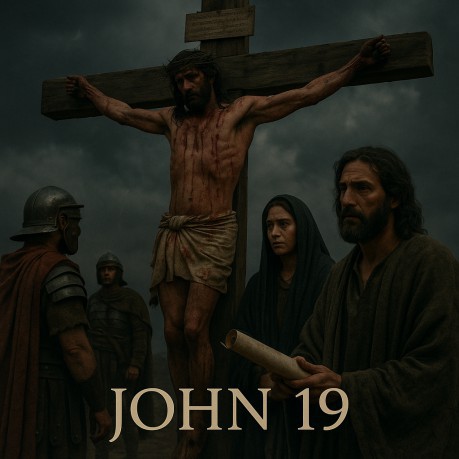
John 19:1-3 † Roman flogging was brutal, often fatal. The
crown of thorns and mockery highlighted Rome's cruelty, but also
fulfilled messianic prophecy. John 19:4-6 † Pilate's declaration of innocence contrasted
with the crowd's demand for death. "Behold, the Man"
unintentionally revealed Christ as the Second Adam. John 19:7-8 † The charge escalated from political treason
to blasphemy. Pilate, already uneasy, feared divine judgment. John 19:9-11 † Jesus declared divine sovereignty even over
Pilate's authority. Responsibility lay greater on those with fuller
revelation, namely the Jewish leaders. John 19:12-15 † In rejecting Christ, the leaders pledged
allegiance to Caesar, denying Israel's true King. John 19:16-18 † Crucifixion fulfilled prophecy (Isaiah
53:12). Bearing His own cross revealed His willing submission. John 19:19-22 † The trilingual inscription declared His
kingship universally, despite Jewish protest. God used Pilate's words
to proclaim truth. John 19:23-24 † The seamless tunic symbolized Christ's
perfect unity. Psalm 22:18 was fulfilled literally. John 19:25-27 † Even in death, Jesus cared for His mother. He
entrusted her to John, showing covenant family surpasses blood ties. John 19:28-30 † His final cry declared the work of redemption
complete. The hyssop recalled the Passover lamb's blood (Exodus
12:22). John 19:31-34 † The unbroken bones fulfilled Psalm 34:20. The
blood and water symbolized cleansing and new covenant life. John 19:35-37 † John's eyewitness confirmed prophecy from
Exodus 12:46 and Zechariah 12:10. John 19:38-42 † Joseph and Nicodemus, once secret followers,
boldly cared for Jesus' body. The garden tomb fulfilled Isaiah 53:9. How it applies to us today † The cross is the triumph of Christ, not His
defeat. † This is the fulfilled perspective we proclaim at
Fulfilled Prophecies † Source Index
By Dan MainesJohn 19
So Pilate then took Jesus and
had Him flogged. And the soldiers twisted together a crown of thorns
and placed it on His head, and put a purple cloak on Him; and they
repeatedly came up to Him and said, "Hail, King of the Jews!"
and slapped Him in the face again and again.
† Philo
(Flaccus 6.36) records similar Roman cruelty and mock coronations,
mocking kingship.
And then Pilate came out again
and said to them, "See, I am bringing Him out to you so that you
will know that I find no grounds at all for charges in His case."
Jesus then came out, wearing the crown of thorns and the purple robe.
And Pilate said to them, "Behold, the Man!" So when the
chief priests and the officers saw Him, they shouted, saying,
"Crucify, crucify!" Pilate said to them, "Take Him
yourselves and crucify Him; for I find no grounds in His case!"
The Jews answered him, "We
have a law, and by that law He ought to die, because He made Himself
out to be the Son of God!" Now when Pilate heard this statement,
he became even more afraid.
And he entered the Praetorium
again and said to Jesus, "Where are You from?" But Jesus
gave him no answer. So Pilate said to Him, "Are You not speaking
to me? Do You not know that I have authority to release You, and that
I have authority to crucify You?" Jesus answered him, "You
would have no authority over Me at all, if it had not been given to
you from above; for this reason the one who handed Me over to you has
the greater sin."
As a result of this, Pilate
made efforts to release Him; but the Jews shouted, saying, "If
you release this Man, you are no friend of Caesar; everyone who makes
himself out to be a king opposes Caesar!" Therefore when Pilate
heard these words, he brought Jesus out, and sat down on the judgment
seat at a place called The Stone Pavement, but in Hebrew, Gabbatha.
Now it was the day of preparation for the Passover; it was about the
sixth hour. And he said to the Jews, "Behold, your King!"
So they shouted, "Away with Him, away with Him, crucify Him!"
Pilate said to them, "Shall I crucify your King?" The chief
priests answered, "We have no king except Caesar."
†
Josephus (Wars 2.17.2) notes the Jewish people's hatred of Caesar's
rule, showing their hypocrisy here.
So he then handed Him over to
them to be crucified. They took Jesus, therefore, and He went out,
carrying His own cross, to the place called the Place of a Skull,
which in Hebrew is called, Golgotha. There they crucified Him, and
with Him two other men, one on either side, and Jesus in between.
Now Pilate also wrote an
inscription and put it on the cross. It was written: "JESUS THE
NAZARENE, THE KING OF THE JEWS." Therefore many of the Jews read
this inscription, because the place where Jesus was crucified was
near the city; and it was written in Hebrew, Latin, and in Greek. So
the chief priests of the Jews were saying to Pilate, "Do not
write, ‘The King of the Jews'; but rather, ‘He said, I am King of
the Jews.'" Pilate answered, "What I have written, I have
written."
Then the soldiers, when they
had crucified Jesus, took His outer garments and made four parts, a
part to each soldier, and also the tunic; now the tunic was seamless,
woven in one piece. So they said to one another, "Let's not tear
it, but cast lots for it, to decide whose it shall be." This
happened so that the Scripture would be fulfilled: "They divided
My garments among themselves, and they cast lots for My clothing."
Therefore the soldiers did these things.
Now beside the cross of Jesus
stood His mother, His mother's sister, Mary the wife of Clopas, and
Mary Magdalene. When Jesus saw His mother, and the disciple whom He
loved standing nearby, He said to His mother, "Woman, behold,
your son!" Then He said to the disciple, "Behold, your
mother!" And from that hour the disciple took her into his own
household.
After this, Jesus, knowing
that all things had already been accomplished, in order that the
Scripture would be fulfilled, said, "I am thirsty." A jar
full of sour wine was standing there; so they put a sponge full of
the sour wine on a branch of hyssop and brought it up to His mouth.
Therefore when Jesus had received the sour wine, He said, "It is
finished!" And He bowed His head and gave up His spirit.
Now then, since it was the day
of preparation, to prevent the bodies from remaining on the cross on
the Sabbath (for that Sabbath was a high day), the Jews requested of
Pilate that their legs be broken, and the bodies be taken away. So
the soldiers came and broke the legs of the first man, and of the
other who was crucified with Him; but after they came to Jesus, when
they saw that He was already dead, they did not break His legs. Yet
one of the soldiers pierced His side with a spear, and immediately
blood and water came out.
†
Early church fathers saw the blood and water as symbols of baptism
and communion.
And he who has seen has
testified, and his testimony is true; and he knows that he is telling
the truth, so that you also may believe. For these things took place
so that the Scripture would be fulfilled: "Not a bone of Him
shall be broken." And again, another Scripture says, "They
will look at Him whom they pierced."
Now after these things Joseph
of Arimathea, being a disciple of Jesus, but a secret one for fear of
the Jews, requested of Pilate that he might take away the body of
Jesus; and Pilate granted permission. So he came and took away His
body. Nicodemus, who had first come to Him by night, also came,
bringing a mixture of myrrh and aloes, about a hundred litra weight.
So they took the body of Jesus and bound it in linen wrappings with
the spices, as is the burial custom of the Jews. Now in the place
where He was crucified there was a garden, and in the garden a new
tomb in which no one had yet been laid. Therefore because of the
Jewish day of preparation, since the tomb was nearby, they laid Jesus
there.
† His finished work secures
salvation, leaving nothing to be added.
† We
are called to stand boldly with Him, as Joseph and Nicodemus did at
the end.
† The blood and water from His side
testify to cleansing and life in the new covenant.
† Philo,
Flaccus 6.36 – Roman cruelty and mock coronations
†
Josephus, Wars 2.17.2 – Jewish hatred of Caesar
†
Chrysostom, Homilies on John – Peter's rashness contrasted with
Christ's patience
† Psalm 22:18 – prophecy
of garments divided
† Zechariah 12:10 –
prophecy of the pierced one
Links