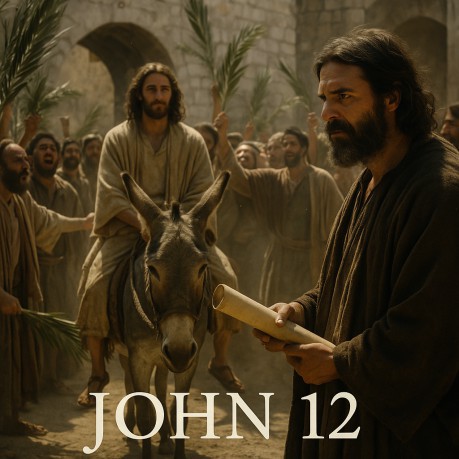
John 12:1-2 † The setting emphasized the miracle's reality:
Lazarus, once dead, was alive and dining with Jesus. Bethany became a
testimony to His authority over death. John 12:3 † Mary's devotion anticipated His burial. Her
costly act revealed extravagant love, filling the house with both
fragrance and testimony. John 12:4-6 † Judas cloaked greed in false piety. His
objection revealed hypocrisy. John 12:7-8 † Jesus defended Mary. The act pointed to His
coming burial, revealing spiritual discernment beyond ordinary
hospitality. John 12:9-11 † Lazarus became living proof of Jesus' power,
so leaders sought to silence him too. Their hostility grew more
irrational. John 12:12-15 † The Triumphal Entry fulfilled Zechariah 9:9.
The people hailed Him as King, though their understanding was
political rather than spiritual. John 12:16 † Fulfillment was only fully grasped after His
resurrection, when the Spirit opened their understanding. John 12:17-19 † The raising of Lazarus fueled the public
celebration. The leaders despaired, exaggerating that "the
world" was turning to Him. John 12:20-22 † The arrival of Greeks symbolized the gospel's
reach beyond Israel. The nations were beginning to come to Christ. John 12:23-26 † His glorification came through death, like a
grain that bears fruit only when buried. True discipleship requires
self-denial and following Him. John 12:27-28 † Jesus faced deep anguish but submitted to the
Father's will. The divine voice affirmed the certainty of His
glorification. John 12:29-30 † The heavenly voice confirmed His mission to
the crowd, though some dismissed it as natural sound. John 12:31-33 † The cross was both judgment on the world and
defeat of Satan. Being "lifted up" meant crucifixion and
exaltation. John 12:34-36 † They misunderstood Scripture, expecting an
eternal political Messiah, not a suffering one. Jesus urged them to
believe while the Light was present. John 12:37-41 † Isaiah foresaw unbelief, and John declared
that Isaiah saw Christ's glory. Refusal to believe fulfilled
prophecy. John 12:42-43 † Some rulers believed secretly but feared
man's approval more than God's. John 12:44-46 † Believing in Christ is believing in the
Father. His mission was to bring light into darkness. John 12:47-50 † Christ's mission was salvation, not
condemnation, yet rejection leaves one judged by His very word. How it applies to us today † Christ is the resurrection and the life, and
His triumph over death assures our hope. † This is the fulfilled perspective we proclaim at
Fulfilled Prophecies † Source Index
By Dan MainesJohn 12
Now, six days before the
Passover, Jesus came to Bethany, where Lazarus was, whom Jesus had
raised from the dead. So they made Him a dinner there, and Martha was
serving; but Lazarus was one of those reclining at the table with
Him.
Mary then took a pound of very
expensive perfume of pure nard, and anointed the feet of Jesus and
wiped His feet with her hair; and the house was filled with the
fragrance of the perfume.
† Pliny the Elder
(Natural History 12.26) notes the high value of Indian nard,
confirming its expense.
But Judas Iscariot, one of His
disciples, the one who intended to betray Him, said, "Why
was this perfume not sold for three hundred denarii and the proceeds
given to poor people?" Now he said this, not because he cared
about the poor, but because he was a thief, and as he kept the money
box, he used to steal from what was put into it.
† Augustine
noted that Judas loved money more than the Lord, showing divided
hearts betray Christ.
Therefore Jesus said, "Leave
her alone, so that she may keep it for the day of My burial. For you
always have the poor with you, but you do not always have Me."
The large crowd of the Jews
then learned that He was there; and they came, not on account of
Jesus only, but so that they might also see Lazarus, whom He raised
from the dead. But the chief priests planned to put Lazarus to death
also, because on account of him many of the Jews were going away and
were believing in Jesus.
On the next day, when the
large crowd that had come to the feast heard that Jesus was coming to
Jerusalem, they took the branches of the palm trees and went out to
meet Him, and began shouting: "Hosanna! Blessed is He who comes
in the name of the Lord, indeed, the King of Israel!" Jesus,
finding a young donkey, sat on it; as it is written: "Do not
fear, daughter of Zion; behold, your King is coming, seated on a
donkey's colt."
† Josephus
(Wars 6.9.3) notes the fervor of Jewish crowds at festivals,
underscoring the scene's intensity.
These things His disciples did
not understand at the first; but when Jesus was glorified, then they
remembered that these things were written about Him, and that they
had done these things for Him.
So the crowd, who had been
with Him when He called Lazarus out of the tomb and raised him from
the dead, continued to testify about Him. For this reason also the
crowd went to meet Him, because they heard that He had performed this
sign. So the Pharisees said to one another, "You see that you
are not accomplishing anything; look, the world has gone after Him!"
Now there were some Greeks
among those who were going up to worship at the feast; these then
came to Philip, who was from Bethsaida of Galilee, and were making a
request of him, saying, "Sir, we wish to see Jesus." Philip
came and told Andrew; then Andrew and Philip came and told Jesus.
But Jesus answered them by
saying, "The hour has come for the Son of Man to be glorified.
Truly, truly I say to you, unless a grain of wheat falls into the
earth and dies, it remains alone; but if it dies, it bears much
fruit. The one who loves his life loses it, and the one who hates his
life in this world will keep it to eternal life. If anyone serves Me,
he must follow Me; and where I am, there My servant will be also; if
anyone serves Me, the Father will honor him."
"Now My soul has become
troubled; and what am I to say? ‘Father, save Me from this hour'?
But for this purpose I came to this hour. Father, glorify Your name."
Then a voice came out of heaven: "I have both glorified it, and
will glorify it again."
So the crowd who stood by and
heard it were saying that it had thundered; others were saying, "An
angel has spoken to Him!" Jesus responded and said, "This
voice has not come for My sake, but for yours."
"Now judgment is upon
this world; now the ruler of this world will be cast out. And I, if I
am lifted up from the earth, will draw all people to Myself."
Now He was saying this to indicate by what kind of death He was going
to die.
The crowd then answered Him,
"We have heard from the Law that the Christ is to remain
forever; and how is it that You say, ‘The Son of Man must be lifted
up'? Who is this Son of Man?" So Jesus said to them, "For a
little while longer the Light is among you. Walk while you have the
Light, so that darkness will not overtake you; also, the one who
walks in the darkness does not know where he is going. While you have
the Light, believe in the Light, so that you may become sons of
Light." These things Jesus proclaimed, and He went away and hid
Himself from them.
† The
Dead Sea Scrolls (1QS 3.13-21) often contrast light and darkness,
matching His imagery.
But though He had performed so
many signs in their sight, they still were not believing in Him. This
happened so that the word of Isaiah the prophet would be fulfilled,
which he spoke: "Lord, who has believed our report? And to whom
has the arm of the Lord been revealed?" For this reason they
could not believe, for Isaiah said again, "He has blinded their
eyes and He hardened their heart, so that they will not see with
their eyes and understand with their heart, and be converted, and so
I will not heal them." These things Isaiah said because he saw
His glory, and he spoke about Him.
Nevertheless many, even of the
rulers, believed in Him, but because of the Pharisees they were not
confessing Him, so that they would not be excommunicated from the
synagogue; for they loved the approval of people rather than the
approval of God.
Now Jesus cried out and said,
"The one who believes in Me, does not believe only in Me, but
also in Him who sent Me. And the one who sees Me sees Him who sent
Me. I have come as Light into the world, so that no one who believes
in Me will remain in darkness."
"And if anyone hears My
teachings and does not keep them, I do not judge him; for I did not
come to judge the world, but to save the world. The one who rejects
Me and does not accept My teachings has one who judges him: the word
which I spoke. That will judge him on the last day. For I did not
speak on My own, but the Father Himself who sent Me has given Me a
commandment as to what to say and what to speak. And I know that His
commandment is eternal life; therefore the things I speak, I speak
just as the Father has told Me."
†
True discipleship requires costly devotion, like Mary's act of
worship.
† The cross was victory over Satan
and judgment on the world.
† Believing in
Christ is believing in the Father; rejecting Him is rejecting God.
† Pliny the
Elder, Natural History 12.26 – costliness of nard
†
Josephus, Wars 6.9.3 – fervor of Jewish festival crowds
†
Dead Sea Scrolls, 1QS 3.13-21 – imagery of light and darkness
†
Chrysostom, Homilies on John – Christ's tears and humanity
†
Augustine, Homilies on John – Judas and the love of money
Links