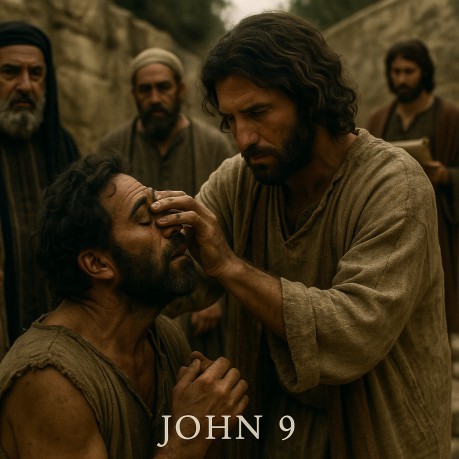
John 9:1-2 † The disciples reflected common Jewish
thought: suffering was tied to sin. Yet Scripture shows that trials
may serve higher purposes. John 9:3 † Jesus redirected their thinking: this man's
blindness was an opportunity for God's glory. John 9:4-5 † Jesus emphasized urgency. His mission was
temporary in the flesh, yet He shone as the Light of the world. John 9:6-7 † Jesus used humble means to heal, pointing to
faith and obedience. The pool of Siloam, meaning "Sent,"
symbolized Christ as the One sent from the Father. John 9:8-9 † The miracle was undeniable, yet some refused
to believe even the evidence before them. John 9:10-12 † His testimony was simple: obedience to Jesus
brought sight. John 9:13-16 † The controversy was over Sabbath law, not the
miracle. Their blindness was spiritual, elevating tradition above
truth. John 9:17-18 † The healed man confessed Jesus as a prophet,
growing in faith. Leaders hardened further, demanding more evidence. John 9:19-23 † Fear of excommunication silenced the parents.
Social pressure was strong, but truth remained. John 9:24-25 † The healed man gave the most powerful
testimony: personal transformation. John 9:26-27 † His boldness grew. From a beggar, he now
challenged the leaders. John 9:28-29 † They claimed Moses, yet rejected the One
Moses foretold. Their pride blinded them to fulfillment. John 9:30-33 † The healed man reasoned clearly: such a
miracle proved divine backing. His faith surpassed the leaders'
blindness. John 9:34 † Unable to refute him, they resorted to insult
and rejection. John 9:35-38 † The healed man moved from seeing Jesus as
man, to prophet, to Lord. His worship declared true faith. John 9:39-41 † Christ reversed expectations: the blind
received sight, the proud became blind. Recognition of need is the
path to grace; pride is the path to judgment. How it applies to us today † Suffering is not always punishment; it may
display God's glory. † This is the fulfilled perspective we proclaim at
Fulfilled Prophecies † Source Index
By Dan MainesJohn 9
As Jesus passed by, He saw a man
who had been blind from birth. And His disciples asked Him, "Rabbi,
who sinned, this man or his parents, that he would be born blind?"
† The Dead Sea
Scrolls (1QH 4.37-38) reveal a worldview that often linked sin with
affliction.
Jesus answered, "It was
neither that this man sinned, nor his parents; but it was so that the
works of God might be displayed in him."
"We must carry out the works
of Him who sent Me as long as it is day; night is coming, when no one
can work. While I am in the world, I am the Light of the world."
When He had said this, He spit on
the ground, and made mud from the saliva, and applied the mud to his
eyes, and said to him, "Go, wash in the pool of Siloam"
(which is translated, Sent). So he left and washed, and came back
seeing.
†
Archaeology has uncovered the Pool of Siloam, confirming John's
detail.
So the neighbors, and those who
previously saw him as a beggar, were saying, "Is this not the
one who used to sit and beg?" Some were saying, "This is
the one"; others were saying, "No, but he is like him."
He kept saying, "I am the one."
So they were saying to him,
"How then were your eyes opened?" He answered, "The
man who is called Jesus made mud, and spread it on my eyes, and said
to me, ‘Go to Siloam and wash'; so I went away and washed, and I
received sight." And they said to him, "Where is He?"
He said, "I do not know."
They brought the man who
was previously blind to the Pharisees. Now it was a Sabbath on the
day that Jesus made the mud and opened his eyes. Then the Pharisees
also were asking him again how he received his sight. And he said to
them, "He applied mud to my eyes, and I washed, and I see."
So some of the Pharisees were saying, "This man is not from God,
because He does not keep the Sabbath." But others were saying,
"How can a man who is a sinner perform such signs?" And
there was dissension among them.
† Josephus (Antiquities 16.2.3) notes
Jewish debates on Sabbath regulations, echoing this conflict.
So they said again to the blind
man, "What do you say about Him, since He opened your eyes?"
And he said, "He is a prophet." The Jews then did not
believe it about him, that he had been blind and had received sight,
until they called the parents of the very one who had received his
sight.
And they questioned them,
saying, "Is this your son, who you say was born blind? Then how
does he now see?" His parents then answered and said, "We
know that this is our son, and that he was born blind; but how he now
sees, we do not know. Or who opened his eyes, we do not know. Ask
him; he is of age, he will speak for himself." His parents said
these things because they were afraid of the Jews; for the Jews had
already reached the decision that if anyone confessed Him to be
Christ, he was to be excommunicated from the synagogue. It was for
this reason that his parents said, "He is of age; ask him."
†
The Mishnah (Sanhedrin 11:1) reflects the seriousness of being cut
off from synagogue fellowship.
So for a second time they
summoned the man who had been blind, and said to him, "Give
glory to God; we know that this man is a sinner." He then
answered, "Whether He is a sinner, I do not know; one thing I do
know, that though I was blind, now I see."
So they said to him, "What
did He do to you? How did He open your eyes?" He answered them,
"I told you already and you did not listen; why do you want to
hear it again? You do not want to become His disciples too, do you?"
They spoke abusively to him and
said, "You are His disciple, but we are disciples of Moses. We
know that God has spoken to Moses, but as for this man, we do not
know where He is from."
The man answered and said to
them, "Well, here is the amazing thing, that you do not know
where He is from, and yet He opened my eyes! We know that God does
not listen to sinners; but if someone is God-fearing and does His
will, He listens to him. Since the beginning of time it has never
been heard that anyone opened the eyes of a person born blind. If
this man were not from God, He could do nothing."
They answered him, "You were
born entirely in sins, and yet you are teaching us?" So they put
him out.
Jesus heard that they had put
him out, and upon finding him, He said, "Do you believe in the
Son of Man?" He answered by saying, "And who is He, Sir,
that I may believe in Him?" Jesus said to him, "You have
both seen Him, and He is the one who is talking with you." And
he said, "I believe, Lord." And he worshiped Him.
And Jesus said, "For
judgment I came into this world, so that those who do not see may
see, and those who see may become blind." Those who were with
Him from the Pharisees heard these things, and said to Him, "We
are not blind too, are we?" Jesus said to them, "If you
were blind, you would have no sin; however, now that you say, ‘We
see,' your sin remains."
† Testimony of
transformation is powerful against unbelief.
†
Fear of rejection must not silence truth.
†
Jesus gives spiritual sight, but pride blinds.
† Dead Sea
Scrolls, 1QH 4.37-38 – affliction and sin association
†
Archaeology – Pool of Siloam discovery
†
Josephus, Antiquities 16.2.3 – Sabbath disputes
†
Mishnah, Sanhedrin 11:1 – synagogue expulsion
†
Augustine, Homilies on John – stages of faith in the blind man
Links