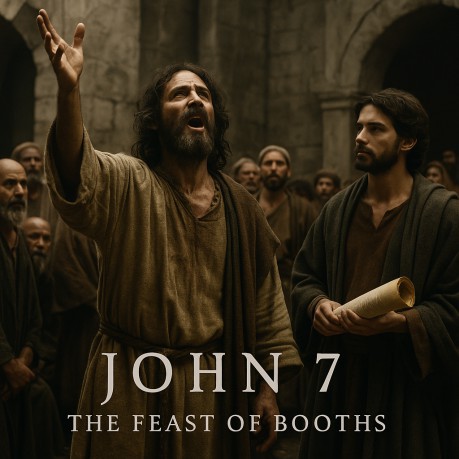
John 7:1 † Hostility was rising from the Judean leaders,
yet His time had not come. Galilee offered temporary safety and
further ministry. John 7:2-5 † His brothers urged Him to display power
publicly, yet their words carried unbelief. The Feast of Booths
recalled Israel's wilderness journey, and Jesus would soon reveal
Himself as the true source of living water. John 7:6-9 † Jesus moved according to the Father's timing,
not human urging. His testimony against sin provoked hatred. John 7:10-13 † Division about Jesus was already evident.
Fear of leaders silenced open discussion, but the crowds could not
ignore Him. John 7:14-16 † Jesus revealed His authority came from God,
not rabbinic training. His teaching carried divine power and clarity. John 7:17-18 † Understanding comes through obedience. Jesus
contrasted self-seeking teachers with His own God-centered mission. John 7:19-20 † Their denial showed blindness. Accusing Him
of demon possession revealed their hardness of heart. John 7:21-23 † Jesus exposed hypocrisy: they permitted
circumcision on Sabbath, yet condemned healing. True obedience
honored God's intent, not rigid rules. John 7:24 † True judgment discerns the heart and intent,
not mere surface observance. John 7:25-27 † Confusion marked the people. Some believed
rulers secretly recognized Him, others dismissed Him because of His
known hometown. Rabbinic tradition expected the Messiah to appear
suddenly, which blinded them to prophecy. John 7:28-29 † Jesus declared divine origin and mission,
rebuking their ignorance of God. John 7:30-32 † Hostility grew, but belief spread. Signs
convinced some, while leaders hardened further. John 7:33-34 † He foretold His return to the Father,
inaccessible to unbelief. John 7:35-36 † They misunderstood again, mocking the
possibility of His mission reaching Gentiles, though this was God's
plan. John 7:37-39 † During the Feast of Booths, priests poured
water at the altar, praying for rain and harvest. Jesus declared
Himself the source of living water, promising the Spirit. John 7:40-43 † Misunderstanding of His birthplace caused
division. They knew prophecy but not His true birth in Bethlehem. John 7:44-47 † Even the officers recognized Jesus'
authority, but leaders mocked them. John 7:48-49 † The leaders despised the common people,
revealing arrogance and blindness. John 7:50-52 † Nicodemus cautiously defended Jesus,
appealing to fairness. Their reply mocked Galilee, ignoring that
Jonah and perhaps others came from there. John 7:53 † Division ended unresolved. The confrontation
foreshadowed coming judgment and revelation. How it applies to us today † Christ reveals Himself at God's timing, not
man's urging. † This is the fulfilled perspective we proclaim at
Fulfilled Prophecies † Source Index
By Dan MainesJohn 7
After these things Jesus was
walking in Galilee, for He was unwilling to walk in Judea, because
the Jews were seeking to kill Him.
Now the feast of the Jews, the
Feast of Booths, was near. So His brothers said to Him, "Move on
from here and go into Judea, so that Your disciples also may see Your
works which You are doing. For no one does anything in secret when he
himself is striving to be known publicly. If You are doing these
things, show Yourself to the world." For not even His brothers
believed in Him.
†
Josephus (Antiquities 3.10.4) describes the Feast of Booths as a time
of great national celebration.
So Jesus said to them, "My
time is not yet here, but your time is always ready. The world cannot
hate you, but it hates Me, because I testify about it, that its deeds
are evil. Go up to the feast yourselves; I am not going up to this
feast yet, because My time has not yet fully arrived." Now
having said these things to them, He stayed in Galilee.
But when His brothers had gone
up to the feast, then He Himself also went up, not publicly, but as
though in secret. So the Jews were looking for Him at the feast and
saying, "Where is He?" And there was a great deal of talk
about Him in secret among the crowds: some were saying, "He is a
good man"; others were saying, "No, on the contrary, He is
misleading the people." However, no one was speaking openly
about Him, for fear of the Jews.
But when it was now the middle
of the feast, Jesus went up into the temple, and began to teach. The
Jews then were astonished, saying, "How has this man become
learned, not having been educated?" So Jesus answered them and
said, "My teaching is not My own, but His who sent Me."
"If anyone is willing to
do His will, he will know about the teaching, whether it is of God,
or I am speaking from Myself. The one who speaks from himself seeks
his own glory; but He who is seeking the glory of the One who sent
Him, He is true, and there is no unrighteousness in Him."
"Did Moses not give you
the Law, and yet none of you carries out the Law? Why are you seeking
to kill Me?" The crowd answered, "You have a demon! Who is
seeking to kill You?"
Jesus answered them, "I
did one deed, and you all are astonished. For this reason Moses has
given you circumcision (not that it is from Moses, but from the
fathers), and on the Sabbath you circumcise a man. If a man receives
circumcision on the Sabbath so that the Law of Moses will not be
broken, are you angry with Me because I made an entire man well on
the Sabbath?"
"Do not judge by the outward
appearance, but judge with righteous judgment."
So some of the people of
Jerusalem were saying, "Is this not the man whom they are
seeking to kill? And yet look, He is speaking publicly, and they are
saying nothing to Him. The rulers do not really know that this is the
Christ, do they? However, we know where this man is from; but when
the Christ comes, no one knows where He is from."
Then Jesus cried out in the
temple, teaching and saying, "You both know Me, and you know
where I am from; and I have not come of Myself, but He who sent Me is
true, whom you do not know. I do know Him, because I am from Him, and
He sent Me."
So they were seeking to arrest
Him; and yet no one laid a hand on Him, because His hour had not yet
come. But many of the crowd believed in Him; and they were saying,
"When the Christ comes, He will not perform more signs than
those which this man has done, will He?" The Pharisees heard the
crowd whispering these things about Him, and the chief priests and
the Pharisees sent officers to arrest Him.
Therefore Jesus said, "For
a little while longer I am going to be with you, and then I am going
to Him who sent Me. You will seek Me, and will not find Me; and where
I am, you cannot come."
The Jews then said to one
another, "Where does this man intend to go that we will not find
Him? He is not intending to go to the Dispersion among the Greeks,
and teach the Greeks, is He? What is this statement that He said,
‘You will seek Me, and will not find Me; and where I am, you cannot
come'?"
Now on the last day, the great
day of the feast, Jesus stood and cried out, saying, "If anyone
is thirsty, let him come to Me and drink. The one who believes in Me,
as the Scripture said, ‘From his innermost being will flow rivers
of living water.'" But this He said in reference to the Spirit,
whom those who believed in Him were to receive; for the Spirit was
not yet given, because Jesus was not yet glorified.
†
The Dead Sea Scrolls (1QH 8.21) use water imagery for the Spirit's
work, matching His words.
Some of the people therefore,
after hearing these words, were saying, "This truly is the
Prophet." Others were saying, "This is the Christ."
But others were saying, "Surely the Christ is not going to come
from Galilee, is He? Has the Scripture not said that the Christ comes
from the descendants of David, and from Bethlehem, the village where
David was?" So a dissension occurred in the crowd because of
Him.
And some of them wanted to
arrest Him, but no one laid hands on Him. The officers then came to
the chief priests and Pharisees, and they said to them, "Why did
you not bring Him?" The officers answered, "Never has a man
spoken in this way!" The Pharisees then replied to them, "You
have not been led astray too, have you?"
"Not one of the rulers or
Pharisees has believed in Him, has he? But this crowd that does not
know the Law is accursed!"
Nicodemus (the one who came to
Him before, being one of them) said to them, "Our Law does not
judge the person unless it first hears from him and knows what he is
doing, does it?" They answered and said to him, "You are
not from Galilee as well, are you? Examine, and you will see that no
prophet comes out of Galilee."
And everyone went to his home.
† True judgment is righteous,
not superficial.
† Jesus alone gives living
water, the Spirit, to those who believe.
†
Division over Christ remains, but His word stands as truth beyond
opinion.
† Josephus,
Antiquities 3.10.4 – Feast of Booths celebrations
†
Josephus, Antiquities 18.1.6 – false messianic movements
†
Dead Sea Scrolls, 1QH 8.21 – living water imagery
†
Chrysostom, Homilies on John – Christ's timing and teaching
authority
† Augustine, Tractates on John –
faith vs. superficial judgment
Links