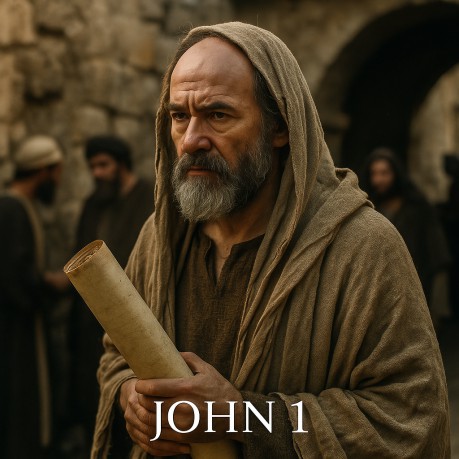
John 1:1 † John begins with eternity, not genealogy. The
Word (Logos) existed before creation, distinct from God yet fully
God. John 1:2 † The Word did not come into existence at
creation; He was already there. His eternal pre-existence affirms His
deity. John 1:3 † The Word is the divine agent of creation.
Nothing exists apart from Him. This echoes Genesis 1 and shows
Christ's active role in creation. John 1:4-5 † Christ is both life and light. Darkness could
not overcome Him. His life brought truth, holiness, and revelation
into a fallen world. John 1:6-8 † John the Baptist's role was preparatory. He
was not the Light but bore witness to it. His humility and boldness
point us to Christ. John 1:9-11 † The rejection of Christ by Israel fulfilled
prophecy. Though the Creator entered His creation, most remained
blind. John 1:12-13 † Spiritual birth is from God alone, not from
ancestry, flesh, or human effort. The New Covenant creates a new
family of God. John 1:14 † The eternal Word entered history in human
flesh. "Dwelt" literally means "tabernacled,"
showing Christ as the fulfillment of God's dwelling presence. John 1:15 † Though John was older in birth, Christ's
eternal pre-existence made Him supreme. John 1:16-17 † The Law was preparatory, pointing forward.
Grace and truth came in fullness through Christ. The New Covenant
surpassed the Old. John 1:18 † The Son reveals the Father perfectly. To see
Jesus is to see God. John 1:19-22 † John denied being the Christ, Elijah in the
flesh, or the Prophet. His humility magnified his role as forerunner. John 1:23 † John identified himself with Isaiah 40:3. His
mission was preparation, not exaltation. John 1:24-28 † John contrasted his water baptism with
Christ's Spirit baptism. His humility reflected the greatness of the
One coming. John 1:29 † Jesus is identified as the sacrificial Lamb,
fulfilling the Passover and Isaiah 53. John 1:30-31 † John admitted his ministry was preparatory.
Christ's eternal pre-existence is again emphasized. John 1:32-34 † The Spirit's descent confirmed Jesus as the
Messiah. Unlike temporary Old Testament anointings, the Spirit
remained permanently. John 1:35-37 † John pointed his own disciples away from
himself to Christ. True ministry leads people to follow Jesus, not
the messenger. John 1:38-39 † Jesus invited seekers with "Come and
see." Faith begins with encounter, not theory. John 1:40-42 † Andrew immediately brought his brother to
Christ. Jesus renamed Simon, showing His authority to redefine lives. John 1:43-46 † The invitation to "come and see"
again highlights the simplicity of faith. Nathanael's prejudice
revealed human skepticism, yet he would soon confess Christ. John 1:47-49 † Jesus' supernatural knowledge convinced
Nathanael. His confession identified Jesus as both Son of God and
Messianic King. John 1:50-51 † Jesus identified Himself as the ladder of
Jacob's vision (Genesis 28:12). He is the connection between heaven
and earth. How it applies to us today † Christ is the eternal Word, the Light and
Life of all mankind. † This is the fulfilled perspective we proclaim at
Fulfilled Prophecies † Source Index
By Dan MainesJohn 1
In the beginning was the Word, and
the Word was with God, and the Word was God.
† Philo of Alexandria used "Logos"
to describe God's wisdom active in the world, but John identifies the
Logos as a living Person who is God Himself.
He was in the beginning with God.
All things came into being through
Him, and apart from Him not even one thing came into being that has
come into being.
† Early
church father Irenaeus (Against Heresies 2.2.4) affirmed that Christ
is the Maker of heaven and earth, not a created being.
In Him was life, and the life was
the Light of mankind. And the Light shines in the darkness, and the
darkness did not grasp it.
† The Dead Sea Scrolls
(1QS 3.18-21) describe the struggle between light and darkness,
showing this theme was present in Jewish thought.
A man came, sent from God, and
his name was John. He came as a witness, to testify about the Light,
so that all might believe through him. He was not the Light, but he
came to testify about the Light.
This was the true Light that,
coming into the world, enlightens every person. He was in the world,
and the world came into being through Him, and yet the world did not
know Him. He came to His own, and His own people did not accept Him.
† Josephus (Antiquities 18.5.2) notes
Israel's rejection of prophets, paralleling their rejection of
Christ.
But as many as received Him, to
them He gave the right to become children of God, to those who
believe in His name, who were born, not of blood, nor of the will of
the flesh, nor of the will of a man, but of God.
And the Word became flesh, and
dwelt among us; and we saw His glory, glory as of the only Son from
the Father, full of grace and truth.
†
Early church father Athanasius (On the Incarnation 8) declared that
God became man so that man might be brought into fellowship with God.
John testified about Him and
called out, saying, "This was He of whom I said, ‘He who is
coming after me has proved to be my superior, because He existed
before me.'"
For of His fullness we have all
received, and grace upon grace. For the Law was given through Moses;
grace and truth were realized through Jesus Christ.
No one has seen God at any time;
God the only Son, who is in the arms of the Father, He has explained
Him.
† Early church father
Origen emphasized that Christ is the perfect exegesis of the
invisible God.
This is the testimony of John,
when the Jews sent priests and Levites to him from Jerusalem to ask
him, "Who are you?" And he confessed and did not deny; and
this is what he confessed: "I am not the Christ." And so
they asked him, "What then? Are you Elijah?" And he said,
"I am not." "Are you the Prophet?" And he
answered, "No." Then they said to him, "Who are you?
Tell us, so that we may give an answer to those who sent us. What do
you say about yourself?"
He said, "I am the voice of
one calling out in the wilderness, ‘Make the way of the Lord
straight,' as Isaiah the prophet said."
And the messengers had been
sent from the Pharisees. They asked him, and said to him, "Why
then are you baptizing, if you are not the Christ, nor Elijah, nor
the Prophet?" John answered them, saying, "I baptize in
water, but among you stands One whom you do not know. It is He who
comes after me, of whom I am not worthy even to untie the strap of
His sandal." These things took place in Bethany beyond the
Jordan, where John was baptizing people.
The next day he *saw Jesus coming
to him, and said, "Behold, the Lamb of God who takes away the
sin of the world!"
†
Philo and Jewish writings spoke of lamb imagery, but John applied it
uniquely to Christ as the final atonement.
"This is He in behalf of
whom I said, ‘After me is coming a Man who has proved to be my
superior, because He existed before me.' And I did not recognize Him,
but so that He would be revealed to Israel, I came baptizing in
water."
And John testified, saying, "I
have seen the Spirit descending as a dove out of heaven, and He
remained upon Him. And I did not recognize Him, but He who sent me to
baptize in water said to me, ‘He upon whom you see the Spirit
descending and remaining upon Him, this is the One who bapt baptizes
in the Holy Spirit.' And I myself have seen, and have testified that
this is the Son of God."
Again the next day John was
standing with two of his disciples, and he looked at Jesus as He
walked, and said, "Behold, the Lamb of God!" And the two
disciples heard him speak, and they followed Jesus.
And Jesus turned and saw them
following, and said to them, "What are you seeking?" They
said to Him, "Rabbi (which translated means Teacher), where are
You staying?" He said to them, "Come, and you will see."
So they came and saw where He was staying; and they stayed with Him
that day, for it was about the tenth hour.
One of the two who heard John
speak, and followed Him, was Andrew, Simon Peter's brother. He first
found his own brother Simon and said to him, "We have found the
Messiah" (which translated means Christ). He brought him to
Jesus. Jesus looked at him and said, "You are Simon the son of
John; you shall be called Cephas" (which is translated Peter).
The next day He decided to go
to Galilee, and He found Philip. And Jesus said to him, "Follow
Me." Now Philip was from Bethsaida, the city of Andrew and
Peter. Philip found Nathanael and said to him, "We have found
Him of whom Moses wrote in the Law, and the Prophets also wrote:
Jesus the son of Joseph, from Nazareth!" Nathanael said to him,
"Can anything good be from Nazareth?" Philip said to him,
"Come and see."
Jesus saw Nathanael coming to
Him, and said of him, "Here is truly an Israelite, in whom there
is no deceit!" Nathanael said to Him, "How do You know me?"
Jesus answered and said to him, "Before Philip called you, when
you were under the fig tree, I saw you." Nathanael answered Him,
"Rabbi, You are the Son of God; You are the King of Israel!"
Jesus answered and said to him,
"Because I said to you that I saw you under the fig tree, do you
believe? You will see greater things than these." And He said to
him, "Truly, truly I say to you, you will see heaven opened and
the angels of God ascending and descending on the Son of Man."
† The New Covenant
family of God is born by faith, not bloodline or human effort.
†
Testimony about Jesus, like John's, points others to Him, not to
ourselves.
† Faith begins with "come and
see" and grows into full confession of Christ as Son of God.
† Philo of
Alexandria, On the Creation – use of Logos
†
Irenaeus, Against Heresies 2.2.4 – Christ as Creator
†
Dead Sea Scrolls, 1QS 3.18-21 – imagery of light and darkness
†
Josephus, Antiquities 18.5.2 – Israel's rejection of prophets
†
Athanasius, On the Incarnation 8 – Word became flesh
†
Origen, Commentary on John – Christ reveals the Father
†
Isaiah 53 – prophecy of the suffering servant
†
Eusebius, Ecclesiastical History – growth of the church through
testimony
Links