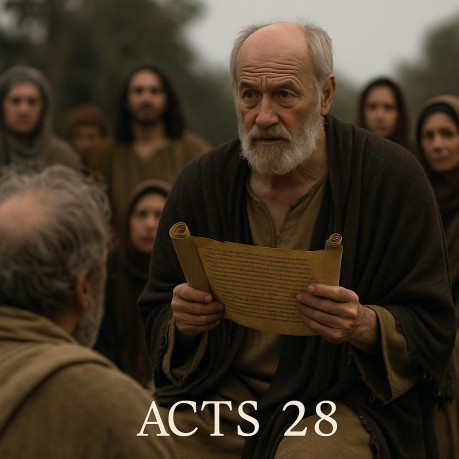
Acts 28:1-2 † God's promise was fulfilled: all survived the
shipwreck. The people of Malta, often called "barbarians"
by Romans because of their non-Greek tongue, showed unusual
hospitality. Acts 28:3-6 † The Maltese assumed divine judgment, but
Paul's preservation demonstrated God's protection. Their shift from
condemnation to deification mirrored earlier reactions at Lystra
(Acts 14). Acts 28:7-9 † Paul's miracles brought healing to Malta,
testifying of Christ's power. Publius later became honored in
Christian tradition as the first bishop of Malta. Acts 28:10 † God provided for Paul and the travelers
through the generosity of the Maltese, preparing them for the journey
to Rome. Acts 28:11-13 † The figurehead of the Twin Brothers, Castor
and Pollux, reflected pagan reliance on mythological protectors of
sailors. In contrast, Paul's safety came from the living God. Acts 28:14-15 † The presence of Christians in Italy showed
the gospel had already reached Rome before Paul. Their journey to
greet him testified of their love. Acts 28:16 † Paul's semi-freedom allowed continued
ministry under Roman watch. Acts 28:17-20 † Paul explained his innocence and the reason
for his imprisonment: the hope of Israel, fulfilled in Christ. Acts 28:21-22 † Christianity's reputation as controversial
was already established in Rome. This provided Paul an open door to
preach. Acts 28:23-24 † Paul's teaching remained rooted in Scripture,
showing Jesus as fulfillment of Moses and the Prophets. As always,
some believed, others rejected. Acts 28:25-27 † Paul applied Isaiah 6:9-10 to Israel's
hardness of heart. Their rejection fulfilled prophecy. Acts 28:28 † Israel's rejection led to the gospel going to
the nations, fulfilling God's plan of worldwide salvation. Acts 28:30-31 † Acts ends with Paul boldly proclaiming the
gospel in Rome. Though in chains, the word of God was not bound. How it applies to us today † God fulfills His promises despite storms,
trials, and opposition. † This is the fulfilled perspective we proclaim at
Fulfilled Prophecies † Source Index
By Dan MainesActs 28
When they had been brought
safely through, then we found out that the island was called Malta.
The natives showed us extraordinary kindness, for they kindled a fire
and took us all in because of the rain that had started and because
of the cold.
But when Paul had gathered a
bundle of sticks and laid them on the fire, a viper came out because
of the heat and fastened on his hand. When the natives saw the
creature hanging from his hand, they began saying to one another,
"Undoubtedly this man is a murderer, and though he has been
saved from the sea, Justice has not allowed him to live."
However, Paul shook the creature off into the fire and suffered no
harm. Now they were expecting that he was going to swell up or
suddenly fall down dead. But after they had waited a long time and
had seen nothing unusual happen to him, they changed their minds and
began to say that he was a god.
† Mark 16:18 predicted such signs
for the apostles, showing God's promise fulfilled.
Now in the neighboring parts of
that place were lands belonging to the leading man of the island,
named Publius, who welcomed us and entertained us warmly for three
days. And it happened that the father of Publius was lying in bed,
afflicted with a recurrent fever and dysentery; and Paul went in to
see him, and after he had prayed, he laid his hands on him and healed
him. After this happened, the rest of the people on the island who
had diseases were coming to him and being cured.
†
Early church tradition, recorded by the writings of Chrysostom,
affirms the impact of Paul's ministry in Malta.
They also showed us many honors,
and when we were setting sail, they supplied us with everything we
needed.
After three months we set sail
on an Alexandrian ship which had wintered at the island, and which
had the Twin Brothers for its figurehead. After we put in at
Syracuse, we stayed there for three days, and from there we sailed
around and arrived at Rhegium, and a day later a south wind came up,
and on the second day we came to Puteoli.
There we found some brothers
and sisters, and were invited to stay with them for seven days; and
that is how we came to Rome. And from there, the brothers and
sisters, when they heard about us, came as far as the Market of
Appius and Three Inns to meet us; when Paul saw them, he thanked God
and took courage.
†
Suetonius and Tacitus both attest to the spread of Christianity in
Rome by the mid-first century.
When we entered Rome, Paul was
allowed to stay by himself with the soldier who was guarding him.
After three days Paul called
together those who were the leading men of the Jews, and when they
came together, he began saying to them, "Brothers, though I had
done nothing against our people or the customs of our fathers, yet I
was handed over to the Romans as a prisoner from Jerusalem. And when
they had examined me, they were willing to release me because there
were no grounds for putting me to death. But when the Jews objected,
I was forced to appeal to Caesar, not that I had any accusation
against my nation. For this reason, therefore, I requested to see you
and to speak with you, since I am wearing this chain for the sake of
the hope of Israel."
They said to him, "We
have neither received letters about you from Judea, nor have any of
the brothers come here and reported or spoken anything bad about you.
But we desire to hear from you what your views are; for regarding
this sect, it is known to us that it is spoken against everywhere."
When they had set a day for
Paul, people came to him at his lodging in large numbers; and he was
explaining to them by solemnly testifying about the kingdom of God
and trying to persuade them concerning Jesus from both the Law of
Moses and from the Prophets, from morning until evening. Some were
being persuaded by the things said by Paul, but others would not
believe.
And when they disagreed with
one another, they began leaving after Paul had said one statement:
"The Holy Spirit rightly spoke through Isaiah the prophet to
your fathers, saying, ‘Go to this people and say, You will keep on
hearing, and will not understand; And you will keep on seeing, and
will not perceive; For the hearts of this people have become
insensitive, And with their ears they hardly hear, And they have
closed their eyes; Otherwise they might see with their eyes, And hear
with their ears, And understand with their hearts and return, And I
would heal them.'"
"Therefore, let it be known
to you that this salvation of God has been sent to the Gentiles; they
will listen as well."
Now Paul stayed two full years
in his own rented lodging and welcomed all who came to him, preaching
the kingdom of God and teaching things about the Lord Jesus Christ
with all openness, unhindered.
†
Eusebius (Ecclesiastical History 2.22) notes Paul's ministry in Rome
and his eventual martyrdom under Nero.
† The gospel is
unstoppable, spreading to the ends of the earth.
†
Some will believe, others will harden their hearts, but God's word
never fails.
† Like Paul, we must proclaim
Christ with boldness, unhindered by circumstances.
† Josephus,
Antiquities 20.8.9 – Jewish opposition and plots
†
Chrysostom, Homilies on Acts – Paul's preservation and ministry in
Malta
† Suetonius, Life of Claudius 25.4;
Tacitus, Annals 15.44 – Spread of Christianity in Rome
†
Isaiah 6:9-10 – Prophecy of Israel's hardness
†
Eusebius, Ecclesiastical History 2.22 – Paul's ministry and
martyrdom in Rome
Links