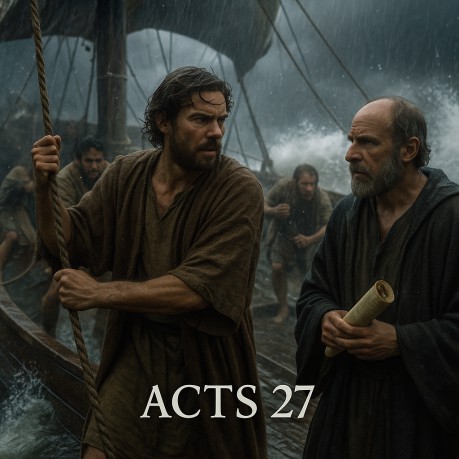
Acts 27:1-2 † Luke again uses "we," showing his
presence. Aristarchus also accompanied Paul, demonstrating loyalty
even in chains. The Augustan cohort was an elite Roman unit,
confirming the importance of this mission. Acts 27:3 † God granted Paul favor with Julius, the
centurion. Roman law allowed such leniency for citizens under escort. Acts 27:4-6 † The Alexandrian ship was likely a grain
vessel transporting wheat from Egypt to Rome, a vital supply route. Acts 27:7-8 † Luke's precise nautical details match known
geography, further proving his eyewitness testimony. Acts 27:9-10 † The "fast" refers to the Day of
Atonement (Yom Kippur), placing the voyage in late autumn, when
Mediterranean sailing was risky. Paul, though a prisoner, warned them
prophetically. Acts 27:11-12 † Human reasoning prevailed over divine
warning. Paul's word was dismissed in favor of sailors' expertise. Acts 27:13-15 † The dreaded northeaster, Euraquilo, was a
known terror to ancient sailors. Their overconfidence led to
disaster. Acts 27:16-17 † Ancient sailors sometimes "undergirded"
ships by passing ropes around the hull to prevent breaking apart.
Luke's description matches maritime practices of the time. Acts 27:18-20 † The storm stripped them of all human hope.
Without stars, ancient navigation was impossible. Acts 27:21-22 † Paul's authority rose as God's word proved
true. Despite despair, Paul offered hope. Acts 27:23-24 † God's providence was declared: Paul would
stand before Caesar, and all lives on the ship were preserved through
him. Acts 27:25-26 † Faith in God's promise brought courage amid
disaster. Acts 27:27-29 † Ancient soundings with weighted lines
confirmed approaching land. Fear gripped them, but Paul held to God's
promise. Acts 27:30-32 † Paul's leadership became decisive. Survival
depended on obedience to God's word. Acts 27:33-36 † Paul gave thanks and broke bread,
foreshadowing the Lord's Supper imagery. His faith uplifted the
entire crew. Acts 27:37-38 † The specific number of passengers shows
Luke's attention to detail. Throwing the wheat, their cargo, showed
total surrender of wealth to survive. Acts 27:39-41 † The shipwreck fulfilled Paul's prophecy. They
lost the vessel but their lives were spared. Acts 27:42-44 † Roman policy demanded execution of prisoners
to prevent escape, but God moved Julius to spare Paul and all with
him. Every word of God was fulfilled. How it applies to us today † God's promises are certain, even when storms
rage and hope seems lost. † This is the fulfilled perspective we proclaim at
Fulfilled Prophecies † Source Index
By Dan MainesActs 27
Now when it was decided that we
would set sail for Italy, they proceeded to turn Paul and some other
prisoners over to a centurion of the Augustan cohort, named Julius.
And we boarded an Adramyttian ship that was about to sail to the
regions along the coast of Asia, and put out to sea accompanied by
Aristarchus, a Macedonian of Thessalonica.
The next day we put in at Sidon;
and Julius treated Paul with consideration and allowed him to go to
his friends and receive care.
From there we put out to sea and
sailed under the shelter of Cyprus, because the winds were contrary.
When we had sailed through the sea along the coast of Cilicia and
Pamphylia, we landed at Myra in Lycia. There the centurion found an
Alexandrian ship sailing for Italy, and he put us aboard it.
†
Historical records, including inscriptions, confirm Rome's dependence
on Egyptian grain fleets.
When we had sailed slowly for a
good many days, and with difficulty had arrived off Cnidus, since the
wind did not permit us to go farther, we sailed under the shelter of
Crete, off Salmone; and with difficulty sailing past it we came to a
place called Fair Havens, near which was the city of Lasea.
When considerable time had
passed and the voyage was now dangerous, since even the fast was
already over, Paul started admonishing them, saying, "Men, I
perceive that the voyage will certainly be with damage and great
loss, not only of the cargo and the ship, but also of our lives."
But the centurion was more
persuaded by the pilot and the captain of the ship than by what was
being said by Paul. Since the harbor was not suitable for wintering,
the majority reached a decision to put out to sea from there, if
somehow they could reach Phoenix, a harbor of Crete, facing southwest
and northwest, and spend the winter there.
When a moderate south wind
came up, thinking that they had attained their purpose, they weighed
anchor and began sailing along Crete, closer to shore. But before
very long a violent wind, called Euraquilo, rushed down from the
land; and when the ship was caught in it and could not head into the
wind, we gave way to it and let ourselves be driven along.
Running under the shelter of a
small island called Clauda, we were able to get the ship's boat under
control only with difficulty. After they had hoisted it up, they used
supporting cables in undergirding the ship; and fearing that they
might run aground on the shallows of Syrtis, they let down the sea
anchor and let themselves be driven along in this way.
The next day as we were being
violently tossed by the storm, they began to jettison the cargo; and
on the third day they threw the ship's tackle overboard with their
own hands. Since neither sun nor stars appeared for many days, and no
small storm was assailing us, from then on all hope of our being
saved was gradually abandoned.
When many had lost their
appetites, Paul then stood among them and said, "Men, you should
have followed my advice and not set sail from Crete, and thereby
spared yourselves this damage and loss. And yet now I urge you to
keep up your courage, for there will be no loss of life among you,
only of the ship."
"For this very night an
angel of the God to whom I belong, whom I also serve, came to me,
saying, ‘Do not be afraid, Paul; you must stand before Caesar; and
behold, God has graciously granted you all those who are sailing with
you.'"
"Therefore, men, keep up
your courage, for I believe God that it will turn out exactly as I
have been told. But we must run aground on a certain island."
But when the fourteenth night
came, as we were being driven around in the Adriatic Sea, about
midnight the sailors began to suspect that some land was approaching
them; and they took soundings and found it to be twenty fathoms; and
a little farther on, they found it to be fifteen fathoms. And fearing
that we might run aground somewhere on rocks, they cast four anchors
from the stern and prayed for daybreak.
But as the sailors were trying
to escape from the ship and had let down the ship's boat into the
sea, on the pretense of intending to lay out anchors from the bow,
Paul said to the centurion and the soldiers, "Unless these men
remain on the ship, you yourselves cannot be saved." Then the
soldiers cut away the ropes of the ship's boat and let it fall away.
Until the day was about to
dawn, Paul kept encouraging them all to take some food, saying,
"Today is the fourteenth day that you have been constantly
watching and going without eating, having taken nothing. Therefore, I
encourage you to take some food, for this is for your survival; for
not a hair from the head of any of you will perish." Having said
this, he took bread and gave thanks to God in the presence of them
all, and he broke it and began to eat. All of them were encouraged
and they themselves also took food.
We were 276 people on the ship
in all. When they had eaten enough, they began lightening the ship by
throwing the wheat out into the sea.
When day came, they could not
recognize the land; but they did notice a bay with a beach, and they
resolved to run the ship onto it if they could. And casting off the
anchors, they left them in the sea while at the same time they were
loosening the ropes of the rudders; and hoisting the foresail to the
wind, they were heading for the beach. But striking a reef where two
seas met, they ran the vessel aground; and the bow stuck firmly and
remained immovable, but the stern began to be broken up by the force
of the waves.
Now the soldiers' plan was to
kill the prisoners, so that none of them would swim away and escape;
but the centurion, wanting to bring Paul safely through, kept them
from accomplishing their intention, and gave orders that those who
could swim were to jump overboard first and get to land, and the rest
were to follow, some on planks, and others on various things from the
ship. And in this way it happened that they all were brought safely
to land.
† Human wisdom and
power cannot save, but obedience to God's word preserves life.
†
Faith strengthens not only believers but also those around them.
†
Christ, through His servants, still brings hope in the darkest storms
of life.
† Josephus,
Antiquities 20.8.9 – Jewish plots against opponents
†
Roman grain fleets – Historical records of Egyptian wheat trade to
Rome
† Chrysostom, Homilies on Acts –
Paul's example of courage in storms
† Ancient
maritime practices – Undergirding ships and navigation soundings
Links