Acts 21:1-3 † Luke's detailed travel notes confirm his
presence as an eyewitness. These geographical details also match
ancient maritime routes. Acts 21:4-6 † The Spirit warned of coming danger, yet Paul
was resolved. The farewell on the beach mirrors earlier farewells,
filled with prayer and love. Acts 21:7-9 † Philip, first seen in Acts 6 and 8, reappears
here. His daughters carried on the prophetic ministry, showing the
Spirit's ongoing work. Acts 21:10-11 † Agabus' symbolic prophecy paralleled Old
Testament prophets like Jeremiah, who acted out messages. Paul's fate
was sealed in God's plan. Acts 21:12-14 † Paul's courage echoed Christ's determination
to go to Jerusalem, knowing suffering awaited. The submission to
God's will was ultimate trust. Acts 21:15-16 † Mnason, an early disciple, hosted Paul.
Hospitality played a key role in the church's strength. Acts 21:17-20 † The Jerusalem church glorified God for
Gentile conversions, yet Jewish believers still struggled with
attachment to the Law. Acts 21:21-22 † Rumors distorted Paul's teaching. He never
rejected Jewish customs for Jews, only opposed imposing them on
Gentiles. Acts 21:23-26 † Paul willingly joined in the vow to show he
was not hostile to the Law. His action was one of wisdom for peace,
not compromise of the gospel. Acts 21:27-29 † False accusations fueled the riot. Paul was
charged with defiling the temple, though he had not done so. Acts 21:30-32 † Roman soldiers swiftly intervened to prevent
a riot. The Romans kept close watch over the temple area from the
Antonia Fortress. Acts 21:33-36 † Paul was bound, fulfilling Agabus' prophecy.
The mob's cry echoed the cry against Jesus: "Away with him!" Acts 21:37-40 † The commander mistook Paul for an Egyptian
rebel. Josephus (Wars 2.13.5) describes this Egyptian who led a
revolt, confirming the background of the commander's question. How it applies to us today † God's will sometimes leads into suffering,
but His purpose stands unshaken. † This is the fulfilled perspective we proclaim at
Fulfilled Prophecies † Source Index
By Dan MainesActs 21
Now when we had parted from them
and had set sail, we ran a straight course to Cos, and on the next
day to Rhodes, and from there to Patara; and having found a ship
crossing over to Phoenicia, we went on board and set sail. When we
came in sight of Cyprus, leaving it on the left, we kept sailing to
Syria and landed at Tyre, for there the ship was to unload its cargo.
After looking up the disciples,
we stayed there for seven days; and they kept telling Paul through
the Spirit not to set foot in Jerusalem. When our days there were
ended, we left and started on our journey, while they all, with wives
and children, escorted us until we were out of the city. After
kneeling down on the beach and praying, we said farewell to one
another. Then we boarded the ship, and they returned home.
When we had finished the voyage
from Tyre, we arrived at Ptolemais, and after greeting the brothers
and sisters, we stayed with them for a day. On the next day we left
and came to Caesarea, and we entered the house of Philip the
evangelist, who was one of the seven, and stayed with him. Now this
man had four virgin daughters who were prophetesses.
As we were staying there for
several days, a prophet named Agabus came down from Judea. And he
came to us and took Paul's belt, and bound his own feet and hands,
and said, "This is what the Holy Spirit says: ‘In this way the
Jews in Jerusalem will bind the man who owns this belt and hand him
over to the Gentiles.'"
When we had heard this, we as
well as the local residents began begging him not to go up to
Jerusalem. Then Paul replied, "What are you doing, weeping and
breaking my heart? For I am ready not only to be bound, but even to
die in Jerusalem for the name of the Lord Jesus." And since he
would not be persuaded, we became quiet, remarking, "The will of
the Lord be done!"
After these days we got ready
and started on our way up to Jerusalem. Some of the disciples from
Caesarea also came with us, taking us to Mnason of Cyprus, a disciple
of long standing with whom we were to stay.
After we arrived in Jerusalem,
the brothers and sisters received us gladly. And the following day
Paul went in with us to James, and all the elders were present. After
he had greeted them, he began to relate one by one the things which
God had done among the Gentiles through his ministry. And when they
heard about them, they began glorifying God; and they said to him,
"You see, brother, how many thousands there are among the Jews
of those who have believed, and they are all zealous for the Law."
"and they have been told
about you, that you are teaching all the Jews who are among the
Gentiles to abandon Moses, telling them not to circumcise their
children nor to walk according to the customs. So what is to be done?
They will certainly hear that you have come."
"Therefore, do as we tell
you: we have four men who have a vow upon themselves; take them along
and purify yourself together with them, and pay their expenses so
that they may shave their heads; then everyone will know that there
is nothing to the rumors which they have been told about you, but
that you yourself also conform to keeping the Law. But regarding the
Gentiles who have believed, we sent a letter, having decided that
they should abstain from meat sacrificed to idols, from blood, from
what has been strangled, and from sexual immorality." Then Paul
took along the men the next day, and after purifying himself together
with them, he went into the temple giving notice of the completion of
the days of purification until the sacrifice was offered for each one
of them.
When the seven days were
almost over, the Jews from Asia, upon seeing him in the temple, began
to stir up all the crowd and laid hands on him, crying out, "Men
of Israel, help! This is the man who instructs everyone everywhere
against our people, the Law, and this place; and besides, he has even
brought Greeks into the temple and has defiled this holy place!"
For they had previously seen Trophimus the Ephesian in the city with
him, and they thought that Paul had brought him into the temple.
†
Josephus (Wars 6.2.4) notes the strict Jewish laws regarding Gentiles
in the temple, showing why this accusation enraged the crowd.
Then the whole city was
provoked, and the people rushed together, and taking hold of Paul
they dragged him out of the temple, and immediately the doors were
shut. While they were intent on killing him, a report came up to the
commander of the Roman cohort that all Jerusalem was in confusion. He
immediately took along soldiers and centurions and ran down to them;
and when they saw the commander and the soldiers, they stopped
beating Paul.
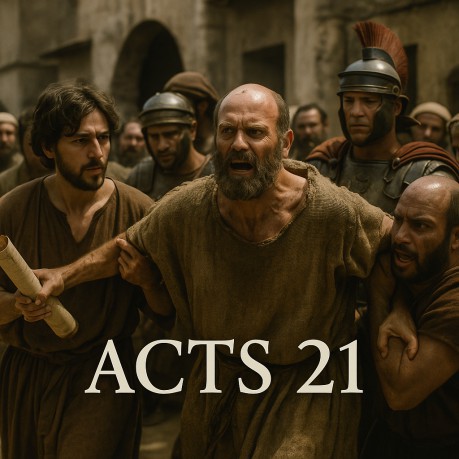
Then the commander came up and
took hold of him, and ordered him to be bound with two chains; and he
began asking who he was and what he had done. But among the crowd
some were shouting one thing and some another, and when he could not
find out the facts because of the uproar, he ordered that Paul be
brought into the barracks. When Paul got to the stairs, it came about
that he was carried by the soldiers because of the violence of the
mob; for the multitude of people kept following them, shouting, "Away
with him!"
As Paul was about to be
brought into the barracks, he said to the commander, "May I say
something to you?" And he said, "Do you know Greek? Then
you are not the Egyptian who some time ago stirred up a revolt and
led the four thousand men of the Assassins out into the wilderness?"
But Paul said, "I am a Jew of Tarsus in Cilicia, a citizen of no
insignificant city; and I beg you, allow me to speak to the people."
When he had given permission, Paul, standing on the stairs, motioned
to the people with his hand; and when there was a great hush, he
spoke to them in the Hebrew dialect, saying,
†
Paul's use of Hebrew gained the crowd's attention, showing his
identity with his people even in the face of hostility.
† False
accusations and hostility cannot stop God's mission.
†
Believers must be willing to endure misunderstanding and persecution
for the name of Christ.
† Like Paul, we must
show wisdom, humility, and courage in defending the truth.
† Josephus,
Antiquities 20.2.3 – Jewish plots against opponents
†
Josephus, Wars 6.2.4 – Jewish temple laws about Gentile entry
†
Josephus, Wars 2.13.5 – The Egyptian rebel and the Roman
confusion
† Suetonius, Life of Claudius 25.4
– Expulsion of Jews from Rome
Links