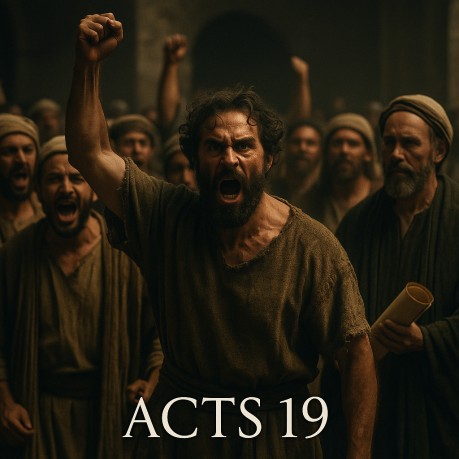
Acts 19:1-2 † Paul discovered believers who only knew part
of the truth. Their understanding was limited to John's baptism, not
the fullness of the Spirit in Christ. Acts 19:3-5 † Paul clarified that John's baptism prepared
for Christ, but baptism into Christ brought union with Him and
covenant entrance. Acts 19:6-7 † The Spirit's outpouring confirmed their
inclusion in the body of Christ, paralleling Pentecost and Cornelius'
household. Acts 19:8-10 † Paul's long ministry in Ephesus spread the
gospel throughout Asia Minor. The school of Tyrannus became a
training center for discipleship. Acts 19:11-12 † Miracles authenticated Paul's message,
showing Christ's authority over sickness and demons. Acts 19:13-16 † The name of Jesus is not a magic formula.
True authority comes through relationship with Christ. The failure of
the sons of Sceva revealed the reality of demonic power and Christ's
supremacy. Acts 19:17-20 † The power of Christ led many to renounce
sorcery. The book-burning was public repentance, costing them greatly
in wealth. Acts 19:21-22 † Paul sensed his mission turning toward
Jerusalem and Rome, the heart of the empire. His course was
Spirit-directed. Acts 19:23-27 † The gospel threatened idolatry and commerce.
Demetrius' speech revealed how economic interests were tied to pagan
worship. Acts 19:28-29 † The riot in the theater demonstrated the
hostility of pagan society toward the gospel. The theater at Ephesus,
still visible today, held 24,000 people. Acts 19:30-32 † Paul was willing to face the mob, but the
disciples and local officials restrained him. The chaos reflected
blind rage, not reason. Acts 19:33-34 † The crowd's irrational chanting revealed the
spiritual blindness of idolatry. Acts 19:35-37 † The town clerk appealed to civic pride and
legal order. He acknowledged Paul and his companions had not
desecrated the temple. Acts 19:38-41 † Roman authorities prized order. The clerk
defused the riot by reminding them of Rome's legal system. Disorder
could bring harsh Roman response. How it applies to us today † Salvation is not partial; it is fullness in
Christ, sealed by the Spirit. † This is the fulfilled perspective we proclaim at
Fulfilled Prophecies † Source Index
By Dan MainesActs 19
Now it happened that while
Apollos was in Corinth, Paul went through the upper districts and
came to Ephesus, and found some disciples. He said to them, "Did
you receive the Holy Spirit when you believed?" And they said to
him, "On the contrary, we have not even heard if there is a Holy
Spirit."
And he said, "Into what
then were you baptized?" They said, "Into John's baptism."
Paul said, "John baptized with a baptism of repentance, telling
the people to believe in Him who was coming after him, that is, in
Jesus." When they heard this, they were baptized in the name of
the Lord Jesus.
And when Paul had laid hands
upon them, the Holy Spirit came on them and they began speaking with
tongues and prophesying. There were about twelve men in all.
And he entered the synagogue
and continued speaking out boldly for three months, having
discussions and persuading them about the kingdom of God. But when
some were becoming hardened and disobedient, speaking evil of the Way
before the people, he withdrew from them and took the disciples away,
and held daily discussions in the school of Tyrannus. This took place
for two years, so that all who lived in Asia heard the word of the
Lord, both Jews and Greeks.
† Eusebius
(Ecclesiastical History 5.18) mentions how teaching centers
multiplied the spread of Christianity.
God was performing
extraordinary miracles by the hands of Paul, so that handkerchiefs or
aprons were even carried from his body to the sick, and the diseases
left them and the evil spirits went out.
But also some of the Jewish
exorcists, who went from place to place, attempted to use the name of
the Lord Jesus over those who had evil spirits, saying, "I order
you in the name of Jesus whom Paul preaches!" Now there were
seven sons of Sceva, a Jewish chief priest, doing this. But the evil
spirit responded and said to them, "I recognize Jesus, and I
know of Paul, but who are you?" And the man in whom was the evil
spirit, pouncing on them and subduing all of them, overpowered them,
so that they fled out of that house naked and wounded.
† Josephus (Wars 7.6.3) describes
Jewish exorcists using incantations, showing this was a known
practice.
This became known to all who
lived in Ephesus, both Jews and Greeks; and fear fell upon them all,
and the name of the Lord Jesus was being magnified. Also many of
those who had practiced magic arts brought their books together and
began burning them in the sight of everyone; and they added up the
prices of the books and found it to be fifty thousand pieces of
silver. So the word of the Lord was growing and prevailing mightily.
† The magical papyri from Ephesus
confirm the city's deep involvement in occult practices.
Now after these things were
finished, Paul resolved in the Spirit to go to Jerusalem, after he
had passed through Macedonia and Achaia, saying, "After I have
been there, I must also see Rome." And after he sent two of
those who assisted him, Timothy and Erastus, to Macedonia, he himself
stayed in Asia for a while.
About that time a major
disturbance occurred in regard to the Way. For a man named Demetrius,
a silversmith who made silver shrines of Artemis, was bringing
significant business to the craftsmen; he gathered these men together
with the workmen of similar trades, and said, "Men, you know
that our prosperity depends upon this business. You see and hear that
not only in Ephesus, but in almost all of Asia, this Paul has
persuaded and perverted a considerable number of people, by saying
that gods made by hands are not gods at all. Not only is there danger
that this trade of ours will fall into disrepute, but also that the
temple of the great goddess Artemis will be regarded as worthless,
and that she whom all of Asia and the world worship will even be
dethroned from her magnificence."
† Strabo (Geography 14.1.22)
describes the Temple of Artemis in Ephesus as one of the wonders of
the world, confirming its centrality.
When they heard this and were
filled with rage, they began shouting, saying, "Great is Artemis
of the Ephesians!" The city was filled with the confusion, and
they rushed together into the theater, dragging along Gaius and
Aristarchus, Paul's traveling companions from Macedonia.
And when Paul wanted to go
into the assembly, the disciples would not let him. Also some of the
Asiarchs who were friends of his sent word to him and repeatedly
urged him not to venture into the theater. So then, some were
shouting one thing and some another, for the assembly was in
confusion, and the majority did not know for what reason they had
come together.
Some of the crowd concluded it
was Alexander, since the Jews had pushed him forward; and having
motioned with his hand, Alexander was intending to make a defense to
the assembly. But when they recognized that he was a Jew, a single
outcry arose from them all as they shouted for about two hours,
"Great is Artemis of the Ephesians!"
After quieting the crowd, the
town clerk said, "Men of Ephesus, what person is there after all
who does not know that the city of the Ephesians is guardian of the
temple of the great Artemis and of the image which fell down from the
sky? So, since these are undeniable facts, you ought to keep calm and
to do nothing rash. For you have brought these men here who are
neither temple robbers nor blasphemers of our goddess."
"So then, if Demetrius
and the craftsmen who are with him have a complaint against anyone,
the courts are in session and proconsuls are available; have them
bring charges against one another. But if you want anything beyond
this, it shall be settled in the lawful assembly. For indeed, we are
in danger of being accused of a riot in connection with today's
events, since there is no real reason for it, and in this case we
will be unable to account for this disorderly gathering." After
saying this he dismissed the assembly.
† The gospel
exposes false religion and undermines idolatry, even when tied to
economics.
† Believers must expect hostility
when Christ's kingdom collides with worldly systems.
†
God uses even civic leaders and legal systems to preserve His mission
when necessary.
† Eusebius,
Ecclesiastical History 5.18 – Christian teaching centers spreading
faith
† Josephus, Wars 7.6.3 – Jewish
exorcists and incantations
† Magical papyri –
Evidence of occult practices in Ephesus
†
Strabo, Geography 14.1.22 – Temple of Artemis described as a
wonder
† Archaeological remains of the
Ephesian theater – Capacity of 24,000 people
Links