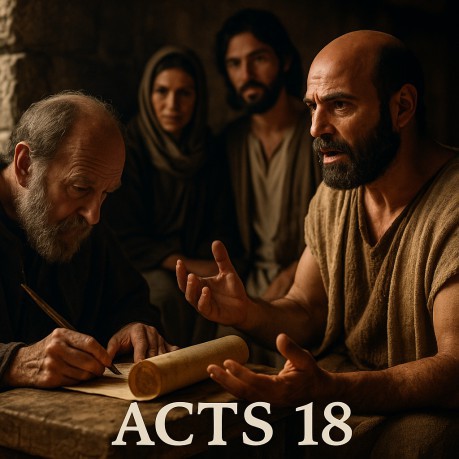
Acts 18:1-3 † Corinth was a major commercial hub, known for
trade and immorality. Paul found fellowship and work with Aquila and
Priscilla, Jewish exiles from Rome. Acts 18:4 † Paul's pattern continued: first to the
synagogue, then to the Gentiles. His reasoning was grounded in
Scripture. Acts 18:5-6 † Paul's declaration echoed Ezekiel's watchman
imagery (Ezekiel 33:4-6). Rejection of the gospel placed
responsibility on the hearers. Acts 18:7-8 † Even the synagogue leader believed, showing
God's power to reach influential figures. The gospel spread quickly
in Corinth. Acts 18:9-11 † God reassured Paul of His protection. Despite
Corinth's reputation for sin, God had chosen many in the city. Acts 18:12-13 † Gallio's tribunal took place at the bema seat
in Corinth, an archaeological site still visible today. Acts 18:14-16 † Gallio dismissed the case, viewing it as an
internal Jewish dispute. This provided protection for the church
under Roman law at that time. Acts 18:17 † Sosthenes, possibly a later convert (1
Corinthians 1:1), suffered for the conflict. Gallio's indifference
showed Rome's general disregard for Jewish quarrels. Acts 18:18 † Paul's vow may have been a Nazirite-style vow
of thanksgiving. Cenchrea, Corinth's eastern port, was a key location
for travel. Acts 18:19-21 † Paul planted seeds in Ephesus but left
quickly. God later opened the door for extended ministry there (Acts
19). Acts 18:22-23 † Paul completed his second missionary journey
and began his third. Antioch remained the sending base. Acts 18:24-26 † Apollos was eloquent and zealous, yet
incomplete in knowledge. Priscilla and Aquila gently corrected him. Acts 18:27-28 † Apollos became a powerful apologist, publicly
refuting opposition and strengthening believers. His ministry
complemented Paul's, though some later misused his name in Corinth (1
Corinthians 1:12). How it applies to us today † God raises up partners like Aquila,
Priscilla, and Apollos to strengthen the church. † This is the fulfilled perspective we proclaim at
Fulfilled Prophecies † Source Index
By Dan MainesActs 18
After these events Paul left
Athens and went to Corinth. And he found a Jew named Aquila, a native
of Pontus, having recently come from Italy with his wife Priscilla,
because Claudius had commanded all the Jews to leave Rome. He came to
them, and because he was of the same trade he stayed with them, and
they worked together, for they were tent-makers by trade.
†
Suetonius (Life of Claudius 25.4) records Claudius expelling Jews
from Rome due to disturbances over "Chrestus," a likely
reference to disputes about Christ.
And Paul was reasoning in the
synagogue every Sabbath and trying to persuade Jews and Greeks.
But when Silas and Timothy came
down from Macedonia, Paul began devoting himself completely to the
word, testifying to the Jews that Jesus was the Christ. But when they
resisted and blasphemed, he shook out his garments and said to them,
"Your blood is on your own heads! I am clean. From now on I will
go to the Gentiles."
Then he left the synagogue and
went to the house of a man named Titius Justus, a worshiper of God,
whose house was next to the synagogue. Crispus, the leader of the
synagogue, believed in the Lord together with all his household, and
many of the Corinthians, when they heard, were believing and being
baptized.
† 1 Corinthians 1:14 mentions
Crispus, confirming continuity between Acts and Paul's letters.
And the Lord said to Paul by a
vision at night, "Do not be afraid any longer, but go on
speaking and do not be silent; for I am with you, and no one will
attack you to harm you, for I have many people in this city."
And he settled there for a year and six months, teaching the word of
God among them.
But while Gallio was proconsul
of Achaia, the Jews rose up together against Paul and brought him
before the judgment seat, saying, "This man is inciting the
people to worship God contrary to the law."
†
An inscription from Delphi (c. AD 52) mentions Gallio, confirming his
historicity and dating Paul's time in Corinth.
But when Paul was about to
open his mouth, Gallio said to the Jews, "If it were a matter of
some crime or vicious, unspeakable conduct, it would be reasonable
for me to put up with you. But if there are disputes about teaching
and names and your own law, see to it yourselves; I am unwilling to
be a judge of these matters." And he drove them away from the
judgment seat.
But they all took hold of
Sosthenes, the leader of the synagogue, and began beating him in
front of the judgment seat. And yet Gallio was not concerned about
any of these things.
Now Paul, after staying many days
longer, took leave of the brothers and sisters and sailed away to
Syria, and Priscilla and Aquila were with him. Paul first had his
hair cut at Cenchrea, for he was keeping a vow.
They came to Ephesus, and he
left them there. Now he himself entered the synagogue and reasoned
with the Jews. When they asked him to stay for a longer time, he did
not consent, but took leave of them and said, "I will return to
you again if God wills," and he set sail from Ephesus.
When he had landed in
Caesarea, he went up to Jerusalem and greeted the church, and went
down to Antioch. And after he spent some time there, he left and
passed successively through the Galatian region and Phrygia,
strengthening all the disciples.
Now a Jew named Apollos, an
Alexandrian by birth, an eloquent man, came to Ephesus; and he was
proficient in the Scriptures. This man had been instructed in the way
of the Lord; and being fervent in spirit, he was accurately speaking
and teaching things about Jesus, being acquainted only with the
baptism of John; and he began speaking boldly in the synagogue. But
when Priscilla and Aquila heard him, they took him aside and
explained the way of God more accurately to him.
†
Early church fathers like Jerome praised Apollos' eloquence, linking
him to the sophistication of Alexandrian learning.
And when he wanted to go
across to Achaia, the brothers encouraged him and wrote to the
disciples to welcome him; and when he had arrived, he greatly helped
those who had believed through grace, for he powerfully refuted the
Jews in public, demonstrating by the Scriptures that Jesus was the
Christ.
†
The gospel thrives even in corrupt cities when God's people are
faithful.
† Believers must defend the truth
with Scripture while relying on God's Spirit for boldness.
†
The church grows through both teaching and correction, as seen with
Apollos.
† Suetonius,
Life of Claudius 25.4 – Expulsion of Jews from Rome over
"Chrestus"
† 1 Corinthians 1:14 –
Crispus mentioned in Paul's letters
† Delphi
inscription (c. AD 52) – Gallio as proconsul of Achaia
†
Jerome, Commentary on Titus – Praise of Apollos' eloquence
Links