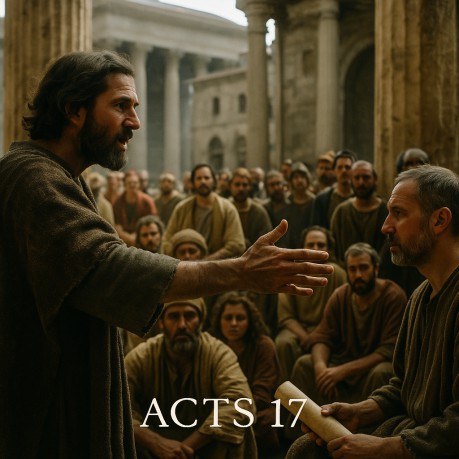
Acts 17:1-3 † Paul's strategy was always to begin with the
synagogue, grounding his message in the Scriptures. He demonstrated
that the Messiah's suffering and resurrection were foretold. Acts 17:4-5 † The gospel divided responses. God-fearing
Greeks and prominent women believed, but jealous Jews incited mob
violence. Acts 17:6-7 † The accusation revealed the heart of the
opposition: proclaiming Jesus as king challenged Caesar's authority.
The gospel was both spiritual and political in its implications. Acts 17:8-9 † Jason had to post bond for his release,
reflecting Roman legal practices. Acts 17:10-11 † The Bereans were commended for testing Paul's
teaching against Scripture. True nobility lies in openness to God's
word, not blind resistance. Acts 17:12-13 † Once again, belief spread to both Jews and
Gentiles. Opposition followed, proving that persecution often trails
gospel success. Acts 17:14-15 † Paul was removed for safety, yet the work
continued with his companions. God's mission was not dependent on one
man. Acts 17:16-17 † Athens was a center of philosophy but also
idolatry. Paul's provoked spirit drove him to reason in both
synagogue and marketplace. Acts 17:18 † The philosophers misunderstood Paul's message
as introducing foreign gods, likely thinking "Jesus" and
"resurrection" were two deities. Acts 17:19-21 † Paul was taken to the Areopagus, Athens'
council for philosophy and religion. They were curious but skeptical. Acts 17:22-23 † Paul began by building a bridge from their
altar to the unknown god. He used their own religious context to
proclaim the true God. Acts 17:24-25 † Paul proclaimed the Creator God, distinct
from idols and temples. His theology resonated with Scripture and
directly opposed idolatry. Acts 17:26-27 † Humanity's unity in Adam revealed God's
providential rule. Nations rise and fall under His plan. The purpose
of history is that people seek God. Acts 17:28 † Paul quoted Greek poets (Aratus and
Cleanthes) to connect truth in their culture with revelation. Acts 17:29-30 † Paul called them from idolatry to repentance.
God's patience had ended, and the call to repentance was universal. Acts 17:31 † The resurrection was the decisive proof.
Judgment was appointed through the risen Christ. Acts 17:32-34 † The resurrection divided Athens. Some mocked,
some delayed, and some believed. Among the converts was Dionysius the
Areopagite, later remembered in early church writings as bishop of
Athens. How it applies to us today † The gospel confronts both religious tradition
and secular philosophy with the truth of Christ. † This is the fulfilled perspective we proclaim at
Fulfilled Prophecies † Source Index
By Dan MainesActs 17
Now when they had traveled
through Amphipolis and Apollonia, they came to Thessalonica, where
there was a synagogue of the Jews. And according to Paul's custom, he
visited them, and for three Sabbaths reasoned with them from the
Scriptures, explaining and giving evidence that the Christ had to
suffer and rise from the dead, and saying, "This Jesus whom I am
proclaiming to you is the Christ."
†
Philo (On Rewards 95) also acknowledged Jewish hope in a coming
deliverer, though expectations varied.
And some of them were persuaded
and joined Paul and Silas, along with a large number of the
God-fearing Greeks and a significant number of the leading women. But
the Jews, becoming jealous and taking along some wicked men from the
marketplace, formed a mob and set the city in an uproar; and
attacking the house of Jason, they were seeking to bring them out to
the people.
† Josephus (Antiquities 17.2.4)
describes Jewish uprisings in cities, showing how quickly mobs could
be stirred.
When they did not find them,
they began dragging Jason and some brothers before the city
authorities, shouting, "These men who have upset the world have
come here also; and Jason has welcomed them, and they all act
contrary to the decrees of Caesar, saying that there is another king,
Jesus."
†
Tacitus (Annals 15.44) noted Rome's intolerance for rival kings,
making this accusation dangerous.
They stirred up the crowd and
the city authorities who heard these things. And when they had
received a pledge from Jason and the others, they released them.
The brothers immediately sent
Paul and Silas away by night to Berea, and when they arrived, they
went into the synagogue of the Jews. Now these people were more
noble-minded than those in Thessalonica, for they received the word
with great eagerness, examining the Scriptures daily to see whether
these things were so.
Therefore, many of them
believed, along with a significant number of prominent Greek women
and men. But when the Jews of Thessalonica found out that the word of
God had been proclaimed by Paul in Berea also, they came there as
well, agitating and stirring up the crowds.
Then immediately the brothers
sent Paul out to go as far as the sea; and Silas and Timothy remained
there. Now those who escorted Paul brought him as far as Athens, and
after receiving a command for Silas and Timothy to come to him as
soon as possible, they left.
Now while Paul was waiting for
them in Athens, his spirit was being provoked within him as he
observed that the city was full of idols. So he was reasoning in the
synagogue with the Jews and the God-fearing Gentiles, and in the
marketplace every day with those who happened to be present.
† Pausanias
(Description of Greece 1.24.3) records Athens as filled with statues
and altars, confirming Luke's description.
And some of the Epicurean and
Stoic philosophers as well were conversing with him. Some were
saying, "What could this scavenger of tidbits want to say?"
Others, "He seems to be a proclaimer of strange
deities,"—because he was preaching Jesus and the resurrection.
†
Diogenes Laertius (Lives of Eminent Philosophers 10.139) outlines
Epicurean and Stoic beliefs, showing why they found Paul strange.
And they took him and brought
him to the Areopagus, saying, "May we know what this new
teaching is which you are proclaiming? For you are bringing some
strange things to our ears; so we want to know what these things
mean." (Now all the Athenians and the strangers visiting there
used to spend their time on nothing other than telling or hearing
something new.)
So Paul stood in the midst of
the Areopagus and said, "Men of Athens, I see that you are very
religious in all respects. For while I was passing through and
examining the objects of your worship, I also found an altar with
this inscription: ‘To an Unknown God.' Therefore, what you worship
in ignorance, this I proclaim to you."
† Pausanias
(Description of Greece 1.1.4) confirms the existence of altars to
unknown gods in Athens.
"The God who made the
world and everything that is in it, since He is Lord of heaven and
earth, does not dwell in temples made by human hands, nor is He
served by human hands, as though He needed anything, since He Himself
gives to all people life and breath and all things."
"And He made from one man
every nation of mankind to live on all the face of the earth, having
determined their appointed times and the boundaries of their
habitation, that they would seek God, if perhaps they might grope for
Him and find Him, though He is not far from each one of us."
"For in Him we live and move
and exist, as even some of your own poets have said, ‘For we also
are His descendants.'"
†
Aratus, Phaenomena 5: "For we are also His offspring."
"Therefore, since we are
God's descendants, we ought not to think that the Divine Nature is
like gold or silver or stone, an image formed by human skill and
thought. So having overlooked the times of ignorance, God is now
proclaiming to mankind that all people everywhere are to repent."
"Because He has set a day on
which He will judge the world in righteousness through a Man whom He
has appointed, having furnished proof to all people by raising Him
from the dead."
Now when they heard of the
resurrection of the dead, some began to scoff, but others said, "We
shall hear from you again concerning this." So Paul went out
from among them. But some men joined him and believed, among whom
also were Dionysius the Areopagite and a woman named Damaris, and
others with them.
†
God has revealed Himself through creation, history, and ultimately
the resurrection.
† Believers must engage
culture with wisdom, using even its own language to proclaim truth.
†
Repentance and faith are required of all, because Christ has been
appointed as Judge of the living and the dead.
† Philo, On
Rewards 95 – Jewish hope in a deliverer
†
Josephus, Antiquities 17.2.4 – Jewish uprisings in cities
†
Tacitus, Annals 15.44 – Rome's intolerance of rival kings
†
Pausanias, Description of Greece 1.24.3 – Athens full of idols
†
Diogenes Laertius, Lives of Eminent Philosophers 10.139 – Stoic and
Epicurean views
† Pausanias, Description of
Greece 1.1.4 – Altars to unknown gods
†
Aratus, Phaenomena 5 – "We are His offspring"
Links