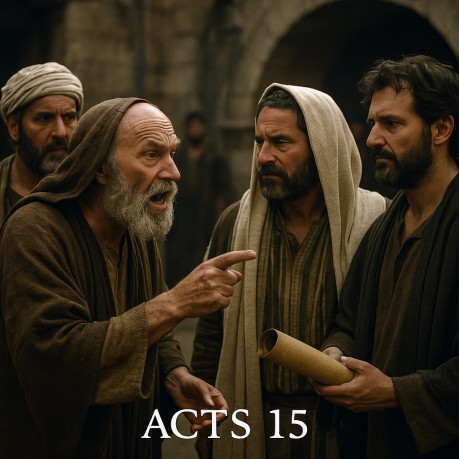
Acts 15:1-2 † The question of circumcision threatened the
unity of the church. Judaizers insisted Gentiles must keep Mosaic
customs to be saved. Paul and Barnabas strongly resisted, defending
salvation by grace through faith. Acts 15:3-4 † The Gentile conversions were a source of joy
among believers, showing God's Spirit was at work beyond Israel. Acts 15:5 † Even believing Pharisees struggled to let go
of the Law. The battle for the truth of the gospel had to be settled
decisively. Acts 15:6-7 † Peter reminded them of Cornelius' conversion
in Acts 10. God Himself had chosen to include Gentiles. Acts 15:8-9 † Peter emphasized that salvation was through
faith, not ritual law. The Spirit's gift to Gentiles proved their
acceptance. Acts 15:10-11 † The Law was a yoke Israel could not bear.
Peter declared salvation comes by grace for Jew and Gentile alike. Acts 15:12 † Testimony of God's work silenced opposition.
The evidence of the Spirit confirmed the Gentile mission. Acts 15:13-15 † James, the leader in Jerusalem, appealed to
Scripture to validate Peter's testimony. Acts 15:16-18 † James quoted Amos 9:11-12, showing God's plan
always included Gentiles. The restoration of David's tabernacle was
fulfilled in Christ's kingdom. Acts 15:19-21 † James proposed restrictions not for salvation
but for unity, so Gentile believers would not offend Jewish brethren. Acts 15:22-23 † The decision was unified and confirmed by
letter, demonstrating the church's commitment to truth and
fellowship. Acts 15:24-29 † The letter carried apostolic authority. The
essentials were about unity and holiness, not legalism. Acts 15:30-31 † The church received the decision with joy,
relieved from legalistic burdens. Acts 15:32-35 † Prophets built up the church through
encouragement. Paul and Barnabas remained faithful in teaching. Acts 15:36-39 † Even faithful servants disagreed. The
division showed their humanity but also led to the multiplication of
mission efforts. Acts 15:40-41 † God used the separation to expand the mission
field. The work continued through different teams, showing the
unstoppable advance of the gospel. How it applies to us today † Salvation is by grace through faith, not
law-keeping or human tradition. † This is the fulfilled perspective we proclaim at
Fulfilled Prophecies † Source Index
By Dan MainesActs 15
Some men came down from Judea
and began teaching the brothers, "Unless you are circumcised
according to the custom of Moses, you cannot be saved." And
after Paul and Barnabas had a heated argument and debate with them,
the brothers determined that Paul and Barnabas and some others of
them should go up to Jerusalem to the apostles and elders concerning
this issue.
† Josephus
(Antiquities 20.2.4) records Jewish insistence on circumcision as
essential for covenant membership, showing the cultural background of
this controversy.
Therefore, after being sent on
their way by the church, they were passing through both Phoenicia and
Samaria, describing in detail the conversion of the Gentiles, and
they were bringing great joy to all the brothers and sisters. When
they arrived in Jerusalem, they were received by the church, the
apostles, and the elders, and they reported all that God had done
with them.
But some of the sect of the
Pharisees who had believed stood up, saying, "It is necessary to
circumcise them and to direct them to keep the Law of Moses."
The apostles and the elders came
together to look into this matter. After there had been much debate,
Peter stood up and said to them, "Brothers, you know that in the
early days God made a choice among you, that by my mouth the Gentiles
would hear the word of the gospel and believe."
"And God, who knows the
heart, testified to them, giving them the Holy Spirit, just as He
also did to us; and He made no distinction between us and them,
cleansing their hearts by faith."
"Since this is the case,
why are you putting God to the test by placing upon the neck of the
disciples a yoke which neither our fathers nor we have been able to
bear? But we believe that we are saved through the grace of the Lord
Jesus, in the same way as they also are."
†
The Dead Sea Scrolls (1QH 4.30-32) describe the burden of sin and
law-keeping, showing the longing for grace fulfilled in Christ.
All the people kept silent, and
they were listening to Barnabas and Paul as they were relating all
the signs and wonders that God had done through them among the
Gentiles.
After they stopped speaking,
James responded, saying, "Brothers, listen to me. Simeon has
described how God first concerned Himself about taking a people for
His name from among the Gentiles. The words of the Prophets agree
with this, just as it is written."
"‘After these things I
will return, and I will rebuild the fallen tabernacle of David, and I
will rebuild its ruins, and I will restore it, so that the rest of
mankind may seek the Lord, and all the Gentiles who are called by My
name,' says the Lord, who makes these things known from long ago."
"Therefore, it is my
judgment that we do not cause trouble for those from the Gentiles who
are turning to God, but that we write to them that they abstain from
things contaminated by idols, from acts of sexual immorality, from
what has been strangled, and from blood. For from ancient generations
Moses has those who preach him in every city, since he is read in the
synagogues every Sabbath."
Then it seemed good to the
apostles and the elders, with the whole church, to choose men from
among them to send to Antioch with Paul and Barnabas: Judas who was
called Barsabbas, and Silas, leading men among the brothers, and they
sent this letter with them.
"Since we have heard that
some of our number to whom we gave no instruction have confused you
by their teaching, upsetting your souls, it seemed good to us, having
become of one mind, to select men to send to you with our beloved
Barnabas and Paul, men who have risked their lives for the name of
our Lord Jesus Christ. Therefore, we have sent Judas and Silas, who
themselves will also report the same things by word of mouth. For it
seemed good to the Holy Spirit and to us to lay upon you no greater
burden than these essentials: that you abstain from things sacrificed
to idols, from blood, from things strangled, and from acts of sexual
immorality; if you keep yourselves free from such things, you will do
well. Farewell."
So when they were sent away,
they went down to Antioch, and after gathering the congregation
together, they delivered the letter. When they had read it, they
rejoiced because of its encouragement.
Judas and Silas, also being
prophets themselves, encouraged and strengthened the brothers and
sisters with a lengthy message. After they had spent time there, they
were sent away from the brothers in peace to those who had sent them.
But Paul and Barnabas stayed in Antioch, teaching and preaching the
word of the Lord, with many others also.
Now after some days Paul said
to Barnabas, "Let's return and visit the brothers and sisters in
every city in which we proclaimed the word of the Lord, and see how
they are." Barnabas wanted to take John, called Mark, along with
them also. But Paul was of the opinion that they should not take him
along who had deserted them in Pamphylia and had not gone with them
to the work. Now it turned into such a sharp disagreement that they
separated from one another, and Barnabas took Mark with him and
sailed away to Cyprus.
But Paul chose Silas, and left
after being entrusted by the brothers to the grace of the Lord. And
he was traveling through Syria and Cilicia, strengthening the
churches.
† The church
must stand united on truth and guard against false teaching.
†
Cultural sensitivity promotes unity, but never at the expense of
gospel truth.
† Even disagreements among
leaders can serve God's purpose when the mission remains central.
† Josephus,
Antiquities 20.2.4 – Jewish insistence on circumcision
†
Dead Sea Scrolls, 1QH 4.30-32 – Burden of law-keeping and longing
for grace
† Amos 9:11-12 – Prophecy of
Gentile inclusion
† Tacitus, Annals 15.44 –
Early mention of Christians under Rome
Links