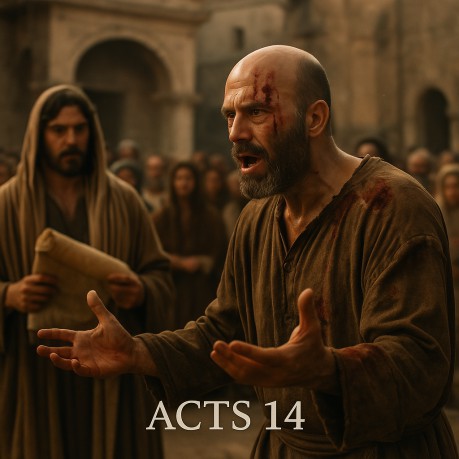
Acts 14:1 † The gospel was first proclaimed in
synagogues, fulfilling the pattern of "to the Jew first and also
to the Greek" (Romans 1:16). Many believed, showing the Spirit's
power in diverse groups. Acts 14:2-3 † Opposition did not drive Paul and Barnabas
away but strengthened their witness. God confirmed their word with
signs and wonders. Acts 14:4-7 † The gospel always divides, those who believe
and those who resist. Despite threats, Paul and Barnabas continued
preaching elsewhere. Acts 14:8-10 † This miracle paralleled Peter healing the
lame man in Acts 3, showing continuity of Christ's power through both
apostles. Acts 14:11-13 † The pagan reaction shows how Gentiles
interpreted miracles through their religious worldview. Paul and
Barnabas were mistaken for gods. Acts 14:14-15 † Paul redirected worship to the Creator, not
to men. Their humility contrasted sharply with Herod in Acts 12, who
accepted divine honors and was struck down. Acts 14:16-18 † Paul appealed to general revelation, God's
witness in creation and providence. The Gentiles were accountable for
recognizing the Creator. Acts 14:19-20 † Paul endured stoning but rose again, a living
testimony of God's preservation. This suffering fulfilled what Christ
told him he must endure (Acts 9:16). Acts 14:21-22 † Paul encouraged perseverance through
tribulation. The path to the kingdom was not ease, but endurance. Acts 14:23-25 † Elders were appointed in every church,
showing the early pattern of local leadership under the Lord's
authority. Acts 14:26-28 † Paul and Barnabas gave account of God's work,
showing missions as a work of God's grace. The door of faith to the
Gentiles had been opened widely. How it applies to us today † The gospel divides people, but God sustains
His servants through opposition. † This is the fulfilled perspective we proclaim at
Fulfilled Prophecies † Source Index
By Dan MainesActs 14
In Iconium they entered the
synagogue of the Jews together, and spoke in such a way that a large
number of people believed, both of Jews and of Greeks.
But the unbelieving Jews stirred
up the minds of the Gentiles and embittered them against the
brothers. Therefore they spent a long time there, speaking boldly
with reliance upon the Lord, who was testifying to the word of His
grace, granting that signs and wonders be performed by their hands.
† Josephus (Antiquities
13.10.6) records Jewish-Gentile tensions in various cities, which
explains the hostile response.
But the people of the city were
divided; and some sided with the Jews, while others with the
apostles. And when an attempt was made by both the Gentiles and the
Jews, together with their rulers, to treat them abusively and to
stone them, they became aware of it and fled to the cities of
Lycaonia, Lystra, and Derbe, and the surrounding region; and there
they continued to preach the gospel.
In Lystra a man was sitting
whose feet were disabled. He had been unable to walk since birth, and
had never walked. This man was listening to Paul as he spoke. Paul
looked at him intently and saw that he had faith to be made well, and
he said with a loud voice, "Stand upright on your feet!"
And he leaped up and began to walk.
When the crowds saw what Paul
had done, they raised their voices, saying in the Lycaonian language,
"The gods have become like men and have come down to us!"
And they began calling Barnabas, Zeus, and Paul, Hermes, since he was
the chief speaker. Moreover, the priest of Zeus, whose temple was
just outside the city, brought oxen and garlands to the gates, and
wanted to offer sacrifice with the crowds.
† Philo (On
the Embassy to Gaius 116) notes how Greeks often deified men of
power, which explains the crowd's reaction.
But when the apostles Barnabas
and Paul heard about it, they tore their robes and rushed out into
the crowd, crying out and saying, "Men, why are you doing these
things? We are also men, of the same nature as you, preaching the
gospel to you, to turn from these useless things to a living God, who
made the heaven and the earth and the sea, and everything that is in
them."
"In past generations He
permitted all the nations to go their own ways; yet He did not leave
Himself without witness, in that He did good and gave you rains from
heaven and fruitful seasons, satisfying your hearts with food and
gladness." And even by saying these things, only with difficulty
did they restrain the crowds from offering sacrifices to them.
† The Dead Sea
Scrolls (1QS 10.10-11) affirm God's providence in sustaining
creation, resonating with Paul's words.
But Jews came from Antioch and
Iconium, and having won over the crowds, they stoned Paul and dragged
him out of the city, thinking that he was dead. But while the
disciples stood around him, he got up and entered the city. The next
day he left with Barnabas for Derbe.
† 2
Corinthians 11:25 recalls Paul being stoned, likely referring to this
very incident.
And after they had preached
the gospel to that city and had made a good number of disciples, they
returned to Lystra, to Iconium, and to Antioch, strengthening the
souls of the disciples, encouraging them to continue in the faith,
and saying, "It is through many tribulations that we must enter
the kingdom of God."
When they had appointed elders
for them in every church, having prayed with fasting, they entrusted
them to the Lord in whom they had believed. They passed through
Pisidia and came into Pamphylia. When they had spoken the word in
Perga, they went down to Attalia.
From there they sailed to
Antioch, where they had been entrusted to the grace of God for the
work that they had accomplished. When they had arrived and gathered
the church together, they began to report all the things that God had
done with them and how He had opened a door of faith to the Gentiles.
And they spent a long time with the disciples.
† Miracles
confirm the message, but the focus must always remain on Christ, not
men.
† God's providence in creation testifies
to His reality even today.
† Tribulation is
part of the path to the kingdom, and perseverance brings maturity.
† Josephus,
Antiquities 13.10.6 – Jewish-Gentile tensions
†
Philo, On the Embassy to Gaius 116 – Greeks deifying men
†
Dead Sea Scrolls, 1QS 10.10-11 – God's providence in creation
†
2 Corinthians 11:25 – Paul stoned and preserved
Links