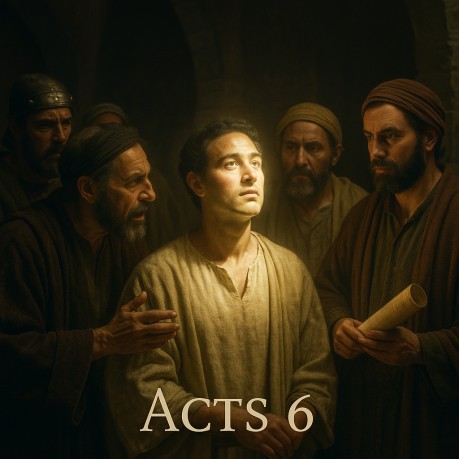
Acts 6:1 † Growth in the church led to tension between
Hellenistic (Greek-speaking) Jews and native Hebrews. The issue was
practical but revealed the need for organized leadership. † Josephus (Antiquities 12.1.1) describes
divisions between Greek-speaking Jews and those of Palestine. The
church faced the same cultural challenges. Acts 6:2 † The apostles recognized their primary duty
was prayer and teaching the word. Administrative work needed faithful
servants. Acts 6:3-4 † The solution was Spirit-filled servants.
Wisdom and reputation mattered as much as practical ability. † The Mishnah (Peah 8.7) emphasizes careful
distribution to widows and the poor. The church met this need with
Spirit-led order. Acts 6:5 † The seven included Stephen, who would soon
become the first martyr, and Philip, later an evangelist. Nicolas was
a Gentile convert, showing the gospel's wide reach. † Early tradition (Constitutions of the
Apostles 7.46) names these men as the first deacons of the church. Acts 6:6 † The laying on of hands signified appointment
and blessing. This practice had Old Testament roots (Numbers
27:18-23) and continued in the church. Acts 6:7 † The growth of the church included priests,
showing even those tied to temple service recognized Christ as the
true High Priest. † Eusebius (Ecclesiastical History 2.17)
affirms that many priests and Levites converted to Christ in the
early days. Acts 6:8 † Stephen's ministry was marked by miraculous
power, confirming God's favor and the advance of the gospel. Acts 6:9-10 † Opposition arose from diaspora Jews in
Jerusalem, but Stephen's Spirit-filled wisdom silenced them. † The Dead Sea Scrolls (1QS 9.11-12) emphasize
the Spirit of wisdom as God's gift to His chosen. Stephen embodied
this promise. Acts 6:11-14 † False witnesses accused Stephen, echoing the
false accusations against Jesus (Matthew 26:59-61). The charge was
that Stephen undermined the temple and the Law. † Josephus (Wars 6.2.1) confirms the Jews' deep
attachment to the temple, making accusations against it highly
inflammatory. Acts 6:15 † Stephen's radiant face recalled Moses' glory
after speaking with God (Exodus 34:29). God's presence was visibly
upon him, showing the council that their accusations were false. How it applies to us today † Church growth requires Spirit-led
organization. Practical needs must be met without neglecting prayer
and the word. † God calls leaders with wisdom, faith, and
Spirit-filled character, not just skill. † Opposition and false accusations will come,
but God equips His people with wisdom and boldness. † Stephen's shining face reminds us that God's
presence is with His servants even in trial. † This is the fulfilled perspective we proclaim at
Fulfilled Prophecies † Source Index
By Dan MainesActs 6
Now at this time, as the disciples
were increasing in number, a complaint developed on the part of the
Hellenistic Jews against the native Hebrews, because their widows
were being overlooked in the daily serving of food.
So the twelve summoned the
congregation of the disciples and said, "It is not desirable for
us to neglect the word of God in order to serve tables."
Instead, brothers and sisters,
select from among you seven men of good reputation, full of the
Spirit and of wisdom, whom we may put in charge of this task. But we
will devote ourselves to prayer and to the ministry of the word.
The announcement found approval
with the whole congregation; and they chose Stephen, a man full of
faith and of the Holy Spirit, and Philip, Prochorus, Nicanor, Timon,
Parmenas, and Nicolas, a proselyte from Antioch.
And they brought these men before
the apostles; and after praying, they laid their hands on them.
The word of God kept spreading; and
the number of the disciples continued to increase greatly in
Jerusalem, and a great many of the priests were becoming obedient to
the faith.
And Stephen, full of grace and
power, was performing great wonders and signs among the people.
But some men from what was
called the Synagogue of the Freedmen, including both Cyrenians and
Alexandrians, and some from Cilicia and Asia, rose up and argued with
Stephen. But they were unable to cope with his wisdom and the Spirit
by whom he was speaking.
Then they secretly induced men
to say, "We have heard him speak blasphemous words against Moses
and against God." And they stirred up the people, the elders,
and the scribes; and they came up to him, dragged him away, and
brought him before the Council. They put forward false witnesses who
said, "This man does not stop speaking against this holy place
and the Law; for we have heard him say that this Nazarene, Jesus,
will destroy this place and change the customs which Moses handed
down to us."
And all who were sitting in the
Council stared at him, and they saw his face, which was like the face
of an angel.
† Josephus,
Antiquities 12.1.1 – Division of Hellenistic and Hebrew Jews
†
Mishnah, Peah 8.7 – Proper distribution to widows and the poor
†
Constitutions of the Apostles 7.46 – The seven as the first
deacons
† Numbers 27:18-23 – Laying on of
hands
† Eusebius, Ecclesiastical History 2.17
– Priests and Levites converted
† Dead Sea
Scrolls, 1QS 9.11-12 – Spirit of wisdom given to the faithful
†
Josephus, Wars 6.2.1 – Jewish attachment to the temple
†
Exodus 34:29 – Moses' radiant face
Links